

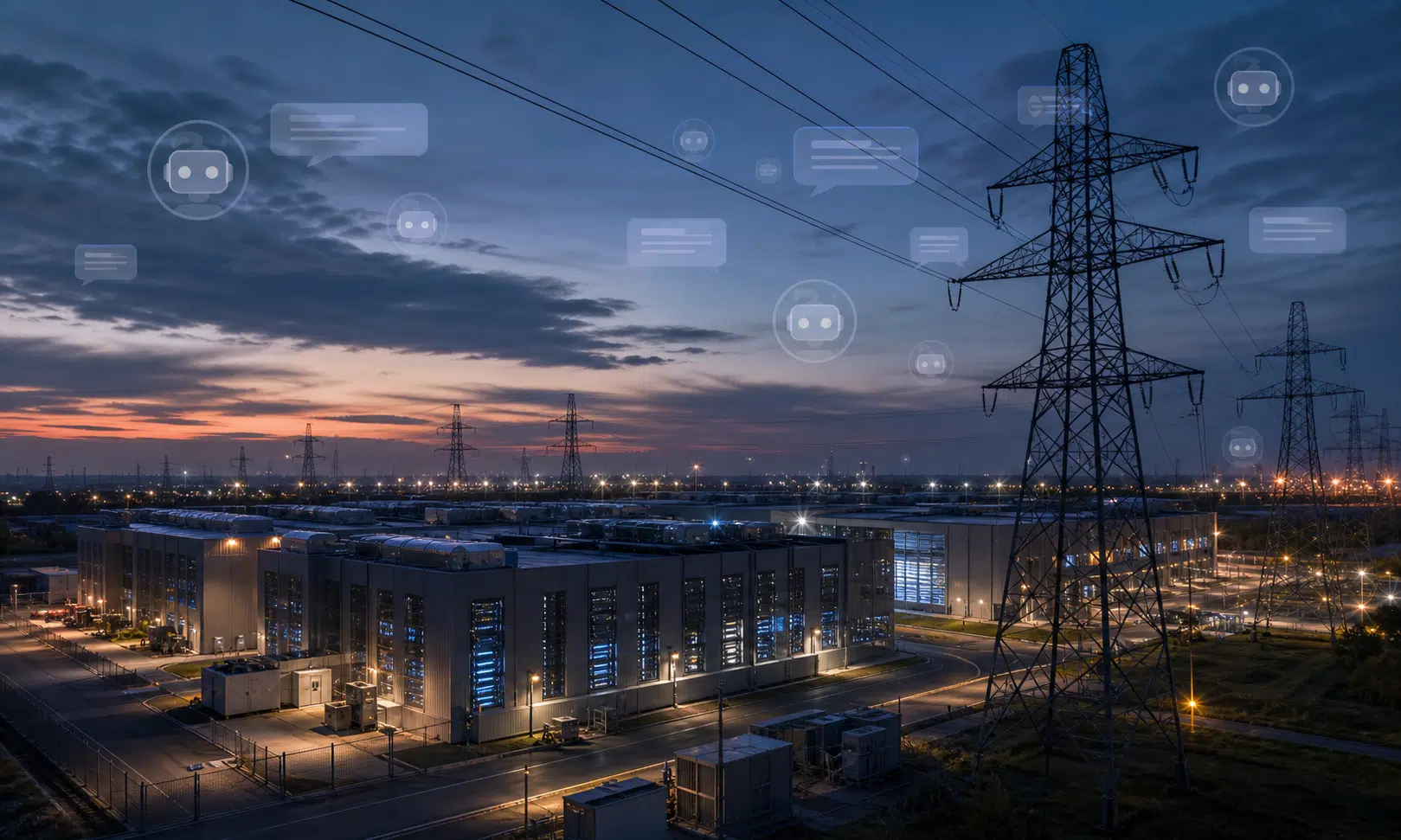

OpenAI says it banned two clusters of ChatGPT accounts that it believes were tied to operators in China and used its tools for covert influence work around U.S. technology and policy debates. One of the clusters, which OpenAI called “Data Center Bandwagon,” focused on criticism of AI data centers and their possible effect on household electricity bills.
The distinction matters for readers following the data center energy debate. OpenAI is not saying that concern over power prices was invented by the campaign. The company’s account is narrower: it says the operators tried to exploit an existing argument by generating social media comments and comic-strip style material about data center energy costs.
What OpenAI Says It Found
According to OpenAI, the “Data Center Bandwagon” accounts used ChatGPT to produce posts and cartoons that blamed AI data centers for rising residential electricity costs. OpenAI said the operators appeared to present themselves on X as Americans from different backgrounds, although those identity claims have not been independently verified here.
OpenAI also said the accounts requested material in connection with capacity auction prices, including comic strips built around reporting from a regional news outlet. The material was then allegedly used with hashtags related to capacity auctions and linked to legitimate news coverage.
That approach is worth separating from ordinary public opposition to data centers. Rising power demand from AI infrastructure is a real policy and utility planning issue, especially in regions where large computing campuses are being added quickly. The alleged campaign, as described by OpenAI, appears to have tried to attach itself to that debate rather than create it from scratch.
The Energy-Cost Debate Is Real, Even If The Campaign Was Ineffective
The source article connects the campaign to a broader dispute involving PJM Interconnection, the large regional grid operator serving parts of the eastern United States. It says PJM’s independent market monitor has blamed data centers for a major rise in power costs across the grid region, including sharply higher wholesale prices near some data center clusters.
Those figures are part of a larger argument over who should pay for the power infrastructure required by AI growth. If data centers increase peak demand, utilities and grid operators may need more generation, transmission, or capacity-market payments. The cost question then becomes practical: how much should be assigned to data center developers, cloud companies, ordinary ratepayers, or some mix of all three?
For buyers of cloud services, AI tools, or colocated infrastructure, that policy fight is not abstract. Higher energy costs can eventually show up in cloud pricing, regional availability decisions, sustainability claims, and the long-term cost of running AI workloads.
| Issue | What The Source Supports | Why It Matters |
|---|---|---|
| Influence activity | OpenAI says it banned accounts tied to covert campaigns using ChatGPT-generated content. | Shows how AI tools can be used to package political or policy messaging at scale. |
| Data center power costs | The campaign focused on an existing U.S. debate over electricity prices and AI infrastructure. | Energy costs can affect households, utilities, cloud providers, and enterprise AI budgets. |
| Audience impact | OpenAI characterized the activity as having little evidence of reaching genuine audiences. | The attempt may matter more as a warning sign than as a proven public-opinion success. |
A Second Cluster Focused On Tariffs And Tech Competition
OpenAI also described a separate cluster it called “Tech and Tariffs.” The company said this group generated political cartoons and batches of comments about U.S.-China competition, including tariffs, rare earths, AI, 5G, and industrial resilience. Those details come from OpenAI’s own assessment and should be read as the company’s characterization rather than independently confirmed findings.
The source article says the campaign included instructions about how political figures should be depicted and produced comments in several languages. OpenAI also said accounts in the same X network spread false claims that ChatGPT user data had been stolen. OpenAI interpreted that activity as an effort to harm its reputation, but that motive is also OpenAI’s assessment rather than a separately verified conclusion.
The practical point is that the reported activity was not limited to one policy issue. It touched several pressure points in U.S.-China technology competition: AI leadership, industrial policy, tariffs, rare earth supply chains, and public trust in major AI platforms.
How Much Weight Should Readers Give This?
OpenAI reportedly rated the activity at the lowest level on the Breakout Scale, meaning the campaign was limited in reach and showed no evidence of meaningful engagement from real audiences. That rating is important because it keeps the story in proportion. The accounts may illustrate misuse of AI tools, but the available description does not support treating them as a successful mass persuasion campaign.
For readers evaluating the data center power debate, the cleaner takeaway is this:
- Do not dismiss electricity-price concerns simply because a foreign-linked campaign allegedly tried to amplify them.
- Do not treat AI-generated influence material as evidence of broad public sentiment.
- Look for primary signals: utility filings, capacity market data, local rate cases, grid operator reports, and company power-purchase commitments.
- For AI infrastructure buyers, include energy exposure and regional grid constraints in vendor and location decisions.
That last point is where this story becomes commercially relevant. Enterprises choosing AI infrastructure should not only compare model access, GPU availability, latency, and contract terms. They should also ask how providers handle power procurement, whether workloads are concentrated in constrained grid regions, and how future energy costs might affect pricing.
Bottom Line
OpenAI’s report, as described by the source article, points to a small and apparently ineffective influence effort that used ChatGPT to generate material around live U.S. policy disputes. The “Data Center Bandwagon” campaign is notable because it tried to ride a genuine argument over AI infrastructure and electricity costs.
The stronger conclusion is not that criticism of data centers is foreign-made. It is that real energy-cost concerns are attractive targets for influence campaigns because they are already politically and economically sensitive. Anyone making infrastructure, cloud, or AI purchasing decisions should treat power availability and cost exposure as part of the comparison, while keeping unsupported social media narratives at arm’s length.