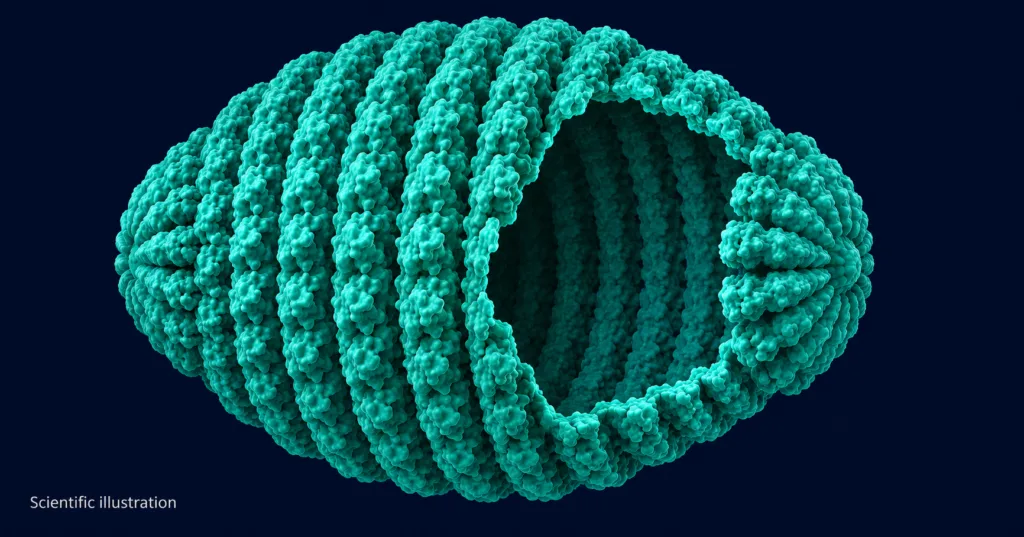
Anthropic said on November 4, 2026, that its biology research team used Claude to map a vault particle assembled from 96 copies of a protein called L05. The team describes the result as the first three-dimensional vault structure linked to bacterial life.
The researchers identify L05 as a bacteriophage protein, encoded by a virus that infects bacteria. The team produced the particles in E. coli and says it has not yet tested whether they form in the bacteria and phages where the proteins naturally occur.
Anthropic says the findings could provide a simpler system for studying vaults, large, hollow protein assemblies whose biological function remains unresolved. Claude assisted with protein searches, experimental design and microscopy analysis, while researchers directed the work and corrected errors.
A vault assembled from a phage protein
The researchers report that the L05 particle contains two halves, each comprising 48 copies of the same protein, with a combined molecular mass of approximately 9.5 megadaltons. They put its dimensions at roughly 54 nanometers long and 45 nanometers wide.
For comparison, the team describes mammalian vault shells as containing 78 copies of their major protein, arranged in two symmetrical halves. Although the L05 particle is shorter, the researchers estimate that it encloses about 25% more volume than a mammalian vault.
The team also reports engineering a larger version by adding two repeating segments to the protein. That modification increased the enclosed volume by approximately 20% relative to the original L05 particle.
Other modifications prevented the particles from closing properly, the researchers say. Together, the experiments suggest that repeating protein segments may influence vault size and that changes in specific regions can affect whether a closed shell forms. The team presents duplication as a possible route through which vault sizes could have changed during evolution.
From a sequence search to laboratory particles
Anthropic’s researchers say they searched approximately 15 billion predicted protein sequences for distant relatives of vault proteins. Their search identified candidates across 29 major bacterial groups and four groups of archaea. Those sequence matches identified proteins for investigation; laboratory experiments were needed to establish whether they assembled into particles.
The team selected 44 candidates for initial testing. Of 24 subsequently tested in living E. coli, 15 yielded soluble protein, the researchers say. Seven of those 15 formed vault-like particles. Cryogenic electron microscopy, or cryo-EM, confirmed vault-shaped structures for four candidates: two from bacteria and two from bacteriophages.
The researchers chose the phage-derived L05 protein for detailed structural analysis. Anthropic says it was among the candidates that most effectively formed complete, closed particles.
Claude’s role, speed estimates and errors
Anthropic says Claude contributed to protein searches, DNA design, protein purification and microscopy processing. The researchers report developing a chromatography-based isolation method that took about 90 minutes, compared with approximately three days for the conventional purification procedure. Claude helped identify equipment and refine the experimental process.
The team says its first full structural model was ready 34 hours after microscopy-data processing began. Final maps followed about a week after processing started. The comparison with weeks of conventional analysis is the team’s estimate. Anthropic also says the cryo-EM analysis used hundreds of graphics processors in parallel.
The work also exposed errors requiring human intervention. Anthropic says a protocol written by Claude specified an additive that interfered with getting DNA into cells, delaying the project by two weeks. During early microscopy processing, Claude skipped a standard step and produced an inaccurate structural map.
Researchers supervised the analysis and corrected problems as the work progressed. The team says it shared laboratory notes with the researchers developing Claude so they could examine where the system had gone wrong. The reported time savings therefore came alongside experimental setbacks and continued oversight.
The biological function remains unresolved
Anthropic’s researchers describe their work as an extension of a field that began with Leonard Rome and Nancy Kedersha’s identification of vault particles in 1986. The team notes that related structures occur in organisms ranging from slime molds to humans, but their presence across different organisms has not resolved what they do.
The researchers identify cellular transport, resistance to toxic compounds and immune defense as proposed functions. They say none has been conclusively established as the explanation for vaults’ biological role.
Anthropic says the absence of vaults from commonly used laboratory organisms has complicated investigations. Studying related particles in bacteria could give researchers another way to examine their assembly and evolutionary history. Whether the laboratory-produced particles also form in their native hosts, and what role they serve there, remain questions for further experiments.