
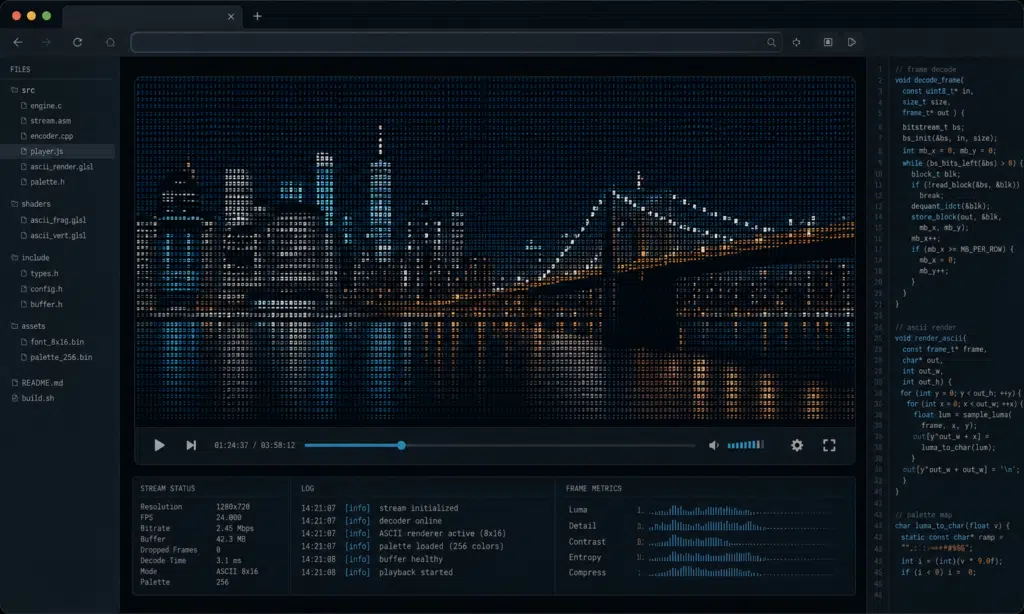
A developer using the name YusufB5 has presented ASCILINE Engine as an ASCII video streaming engine that can render video-like output using text-based representations rather than conventional embedded video tags. The project is described in its own materials as a real-time ASCII rendering system, with the developer claiming it can deliver 360p-style playback at 30 frames per second.
Those claims have not been independently verified, and the most provocative part of the pitch is not the frame rate. It is the description of the system as an “unblockable” video stream, a phrase that immediately raised concerns that similar techniques could be used to force ads or other unwanted media into web pages.
What ASCILINE Claims To Do
ASCILINE is presented as a browser-based engine that converts source video into text-driven output. In the developer’s description, the system maps pixels into ASCII or character-like visual forms, creating a stream that behaves more like a typographic canvas than a standard video embed.
The project materials describe multiple rendering modes. One mode is said to use colored text with a palette of roughly 32,000 colors and output at 30 FPS. A more advanced “Mode 5” is described as replacing characters with colored blocks to approach 360p video quality. The source article also notes that classic monochrome ASCII rendering is listed as an option.
Because these are claims from the project and related posts, they should be treated as developer-stated capabilities rather than confirmed performance benchmarks. The examples described in the source suggest higher visual fidelity than many older ASCII video experiments, but the result would still depend on display size, rendering method, browser performance, and the source material being converted.
Why The ‘Unblockable’ Label Is Controversial
The term “unblockable” is doing much of the work here. The developer’s framing suggests that because the stream is rendered as text or canvas-like output, it may avoid some of the ordinary ways browsers, extensions, or filters identify and block video elements.
That does not mean the output is literally impossible to remove. The source notes that critics have pointed out a straightforward counterexample: an ad blocker or browser extension with an element-zapping feature could remove the canvas or page element used to display the stream. In practical terms, a determined user or tool could still target the container, script, or surrounding page structure.
The larger concern is less about whether the first version is truly unblockable and more about the direction of the idea. If text-rendered media can be made convincing enough, some publishers, ad tech vendors, or malicious operators might try to use similar approaches to make unwanted video harder to detect, skip, or filter.
YusufB5 is said to have pointed to an anti-ad clause attached to the project despite its MIT-style licensing language. That kind of restriction may signal intent, but it is not a complete technical safeguard. Bad actors are unlikely to respect a license term, and legitimate companies would still need to weigh user trust, accessibility, browser behavior, and platform policies before experimenting with media that is designed to resist blocking.
Possible Uses Beyond Ads
The less sensational side of ASCILINE is its attempt to treat video as structured text-like output. The project description argues that text-based representations could become a bridge between visual media and AI systems, allowing lightweight language models to process semantic summaries of video-like streams. That claim remains conceptual based on the supplied material, but it explains why the developer is positioning the tool as more than a visual trick.
The source also describes features such as real-time CSS filters, low-bandwidth operation, delta frames that send only changed characters, and GZIP compression. Those details are presented as project capabilities, not independently measured results. If they work as described, they could make the engine interesting for constrained environments, experiments with web typography, or unusual interfaces where approximate video is acceptable and bandwidth is limited.
Still, the practical tradeoffs are important. Text-based or block-based video may look convincing in a small demo window while becoming visibly chunky at larger sizes. It may also introduce accessibility questions if screen readers, text selection, browser zoom, or user styles interact poorly with the rendered output. Any site using this kind of technique would need to be clear about what is being displayed and avoid using novelty rendering to bypass user choice.
For now, ASCILINE is best understood as an experimental web media project with a deliberately attention-grabbing pitch. Its claimed 360p, 30 FPS text-rendered output is technically interesting, but the “unblockable” branding is what has made it controversial. The discussion around it is a reminder that browser media experiments are judged not only by what they can render, but by how easily users can control, mute, block, or ignore them.
