

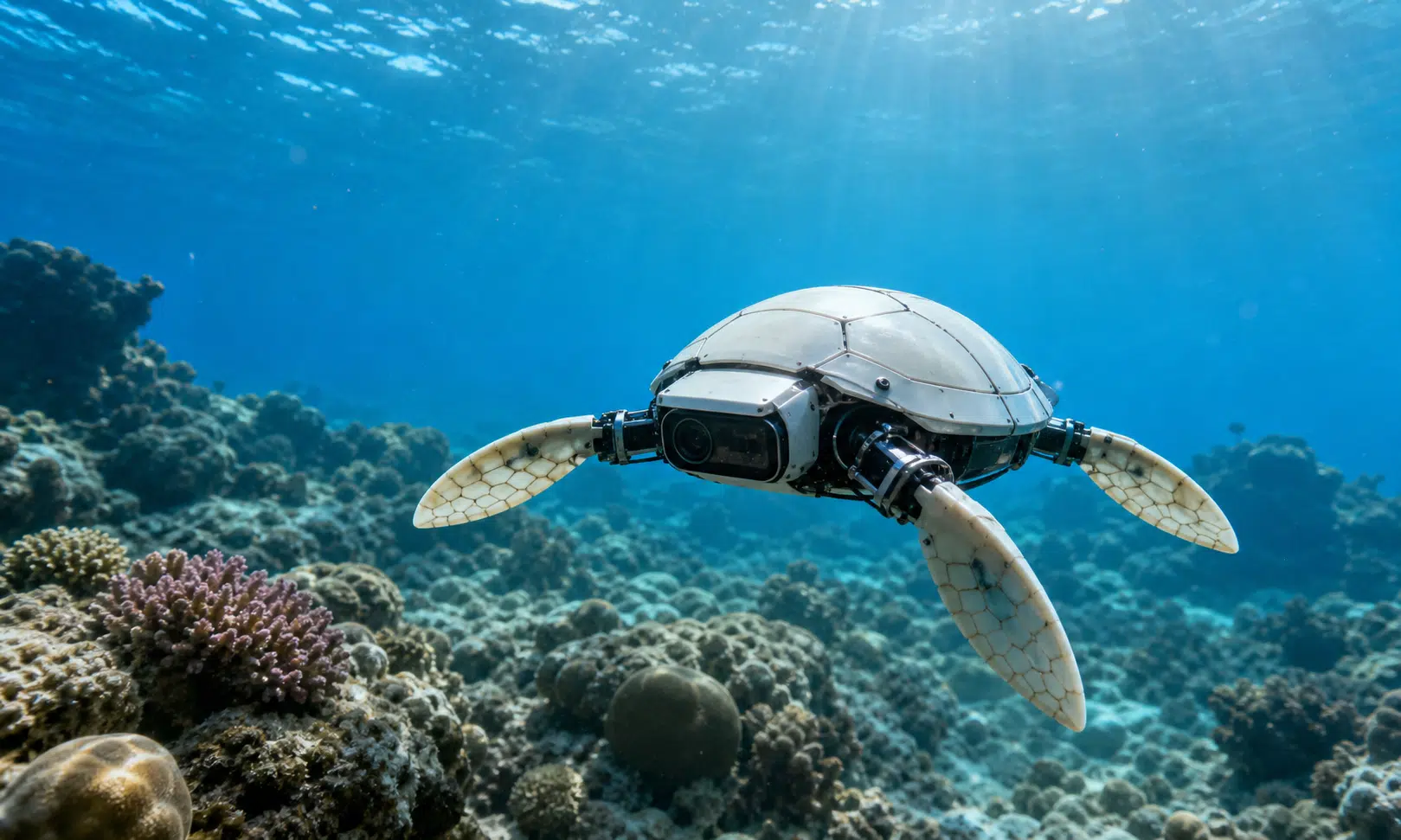

A Canadian high school student’s BURT robot turtle is an interesting prototype for a quieter kind of underwater monitoring. It is not, at least from the available information, a finished conservation product or a proven replacement for professional underwater drones.
That distinction matters. The project has been described as a bionic underwater robotic turtle that copies turtle-like swimming rather than relying on propellers. Its reported AI detection results, including a 96 percent figure for replicated coral bleaching tests, should be treated as prototype-stage claims rather than independently verified field performance.
For researchers, educators, and environmental groups watching low-cost monitoring tools, BURT is still worth attention. Its appeal is not that it solves ocean monitoring. It is that it shows how biomimicry, small onboard computing, and visual AI could be combined in a gentler inspection platform.
Verdict: promising prototype, not a proven field tool
BURT is best understood as a student-built research prototype with a clear design idea: move through water more like a turtle and collect environmental imagery with less mechanical disturbance than a conventional propeller-driven drone might create.
The practical buyer-aware takeaway is simple. Anyone looking for a deployable environmental monitoring system should not treat BURT as a product-ready platform based on the source material alone. Anyone evaluating early-stage underwater robotics, STEM projects, or biomimetic inspection concepts may find it useful as a case study.
| Question | What the source supports | What remains uncertain |
|---|---|---|
| Is BURT commercially available? | The source describes a student project and prototype. | No public product availability is established in the supplied material. |
| Does it avoid propellers? | The design is described as turtle-inspired, using flipper-like motion. | Independent technical validation is not provided in the source. |
| Is the 96 percent detection figure proven in the field? | The figure is presented as coming from Budz’s own testing on replicated coral bleaching. | Real-world accuracy in open aquatic environments is not independently verified. |
| Could it support conservation monitoring? | The concept fits low-impact observation use cases. | Durability, repeatability, navigation, and field performance need more testing. |

Raspberry Pi 5 single-board computer
A Raspberry Pi board is a practical starting point for small robotics projects that need camera input, lightweight processing, and GPIO control. It fits the kind of educational experimentation discussed here, though a real underwater system still needs waterproofing, power management, and careful testing.
As an Amazon Associate I earn from qualifying purchases.
What BURT is designed to do
BURT stands for Bionic Underwater Robotic Turtle. The project is attributed to Evan Budz, a high school student from Ontario, and is described as an underwater robot that imitates turtle movement instead of depending on loud propellers.
Because several technical claims in the source are not independently verified, they should be framed carefully. The available description says the robot uses four flippers, with the front pair providing propulsion and the smaller rear pair helping with steering and stability. That setup is intended to make the robot glide more naturally through water.
The inspiration reportedly came from watching a snapping turtle move through the water. The useful engineering idea is straightforward: instead of forcing a machine shape into an aquatic habitat, copy an animal that already moves efficiently in that setting.
For a conservation tool, that design goal is important. Underwater monitoring often needs patience more than speed. A slower, less disruptive platform could be useful where the task is repeated observation rather than rapid travel.
Why quieter underwater monitoring is the point
The strongest argument for a turtle-like robot is not novelty. It is disturbance reduction.
Many underwater drones use propellers, which can add noise, turbulence, and physical risk around delicate environments. The degree of impact depends on the drone, the site, and the mission, so it would be too strong to claim that propeller drones are always harmful. Still, in shallow or sensitive habitats, a lower-disturbance design is a reasonable target.
BURT’s source-backed promise is therefore conditional: if a flipper-driven robot can collect useful imagery while creating less disruption, it could help researchers observe reefs, lakes, or other aquatic environments with a lighter touch.
That is also where the project’s limits show. Moving quietly is only one part of the problem. A field tool also has to handle cloudy water, changing light, currents, debris, obstacles, battery constraints, and wildlife. The source does not establish that BURT has cleared those hurdles at professional scale.
How the AI detection claim should be read
The source says BURT used a front-mounted camera, a Raspberry Pi microcomputer, and AI models to identify environmental warning signs. It also reports a 96 percent accuracy result for replicated coral bleaching in Budz’s own testing.
That number may be meaningful inside the project, but it should not be treated as proof that the robot can detect coral bleaching with the same accuracy in natural conditions. Simulated tests and real underwater habitats are different environments. Open water can introduce poor visibility, glare, movement, biological variation, and backgrounds that are much harder for a vision model to interpret.
A careful reading is that the reported 96 percent result is an early test outcome, not an independently verified performance guarantee.
The same caution applies to references to detecting invasive species and plastic waste. The concept is plausible for a camera-and-AI monitoring platform, but the supplied source does not provide enough independent validation to present those detections as established field capability.
Reported specs and practical tradeoffs
The source describes BURT as weighing about 11 pounds and swimming for up to eight hours on a lithium battery. It also says the robot includes a solar panel that could extend operation and has been set to move at about 0.5 miles per hour, a pace described as close to turtle swimming speed.
Those specifications are useful, but they should be read as reported prototype details. They are not the same as tested product specifications from a commercial manufacturer.
- Reported weight: about 11 pounds.
- Reported runtime: up to eight hours on a lithium battery.
- Reported movement: flipper-driven swimming rather than propeller-first propulsion.
- Reported speed: about 0.5 miles per hour.
- Reported computing setup: camera, Raspberry Pi, and AI image recognition.
For a buyer or evaluator, the tradeoff is obvious. Slow movement would not suit every inspection job. It could, however, make sense for steady visual monitoring, educational research, or site surveys where minimizing disturbance is more valuable than covering distance quickly.
Testing so far, and why field validation matters
The source says Budz tested the robot using simulated coral reef models and trained it to recognize signs such as coral bleaching. It also says much of the testing took place in a backyard pool before the robot was tested in Lake Ontario.
That progression is normal for a prototype. A pool gives a builder control over depth, light, obstacles, and repeatability. A lake adds more realism, but it still does not answer every question about performance in complex marine or freshwater ecosystems.
Before a platform like BURT could be judged as a serious monitoring tool, the key questions would include:
- How well does the vision model perform in murky or low-light water?
- Can the robot navigate reliably around plants, rocks, debris, and wildlife?
- How repeatable are the detection results across different water bodies?
- How durable is the flipper mechanism after long deployments?
- Can the platform collect data in a format researchers can easily review and compare over time?
The source also mentions additions such as front lights for murky water and an ultrasonic transducer for obstacle detection. Those upgrades point in the right direction, but they do not remove the need for extended field testing.
From coral bleaching to microplastics
The project’s later direction appears to move toward real-time microplastics detection using AI and a 3D holographic camera system. That is a logical extension of the original idea: use a quiet underwater platform to collect visual data on environmental problems that are hard to track continuously.
Microplastics are difficult to monitor because they are small, widespread, and unevenly distributed. A mobile platform that could help observe them in real time would be valuable, but the source does not provide enough detail to judge the maturity of that newer system.
The safest conclusion is that BURT has become a broader experimental platform, not just a turtle-shaped robot. Its design can be adapted toward different sensing problems, but each new use case needs its own validation.
Awards, recognition, and the real takeaway
The source reports that Budz received major youth science recognition, including the $50,000 Gordon E. Moore Award for Positive Outcomes for Future Generations at the Regeneron International Science and Engineering Fair. It also mentions recognition at the European Union Contest for Young Scientists and through Canada’s national STEM fair network.
Those awards support the seriousness of the student project, but awards are not the same as field certification. BURT’s next meaningful test is not whether the idea is clever. It is whether the system can perform reliably in real aquatic environments over repeated use.
For now, the BURT robot turtle is most useful as a signal of where underwater monitoring may be heading: smaller platforms, quieter movement, onboard AI, and designs inspired by animals that already know how to move through water. The concept is compelling. The claims still need careful boundaries.