

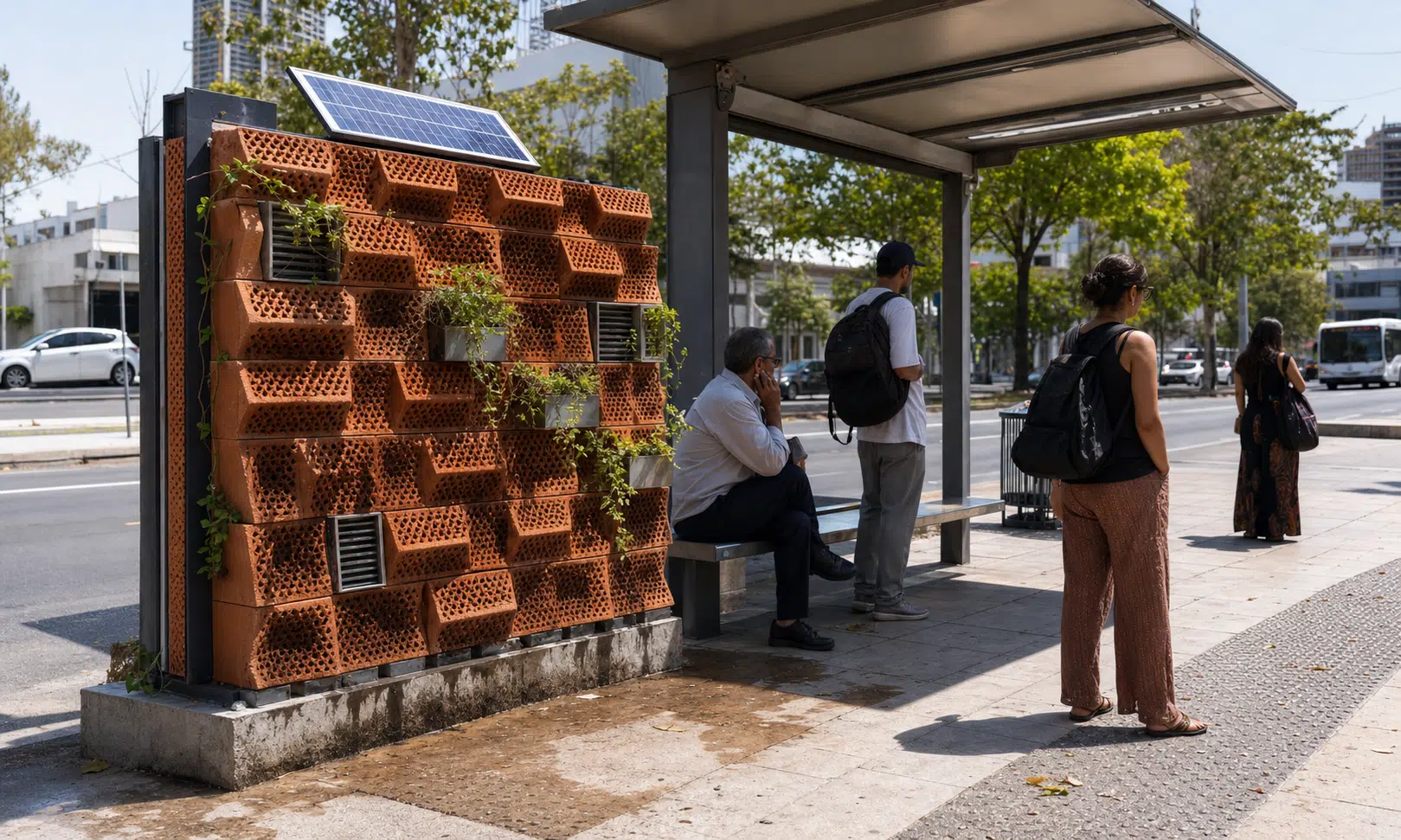

On very hot afternoons, exposed city spaces can feel punishing. Pavement, traffic, limited shade, and still air can combine into the kind of heat that makes a bus stop, plaza, or schoolyard difficult to use for long. Those conditions vary by site, and not every claim about street-level heat is easy to verify from a single project description, but the problem Bloc is trying to address is clear enough: people often need cooling exactly where they are waiting or working.
Bloc is a modular terracotta cooling concept designed by Andrin Stocker and Luc Schweizer. The project describes a 3D-printed ceramic unit intended for public spaces such as transit stops and open paved areas. Its headline claim is that it may cool nearby air by as much as 16 degrees F using water, clay, and solar-powered airflow rather than grid electricity. That performance figure should be treated as a project claim until full-scale public testing confirms it under real street conditions.
This is not a consumer product review in the usual sense. Bloc is closer to an early urban-design prototype, so the useful buyer question is not whether a homeowner should order one today. It is whether city planners, campus managers, developers, and facilities teams should watch this category of passive cooling equipment as a practical alternative to more power-hungry outdoor cooling ideas.
Verdict: promising, but still a prototype decision
Bloc is interesting because it takes a modest approach. It is not presented as a replacement for trees, shade structures, reflective roofs, water access, or broader heat planning. Its more realistic role would be cooling small hot spots: a bus shelter, a school entrance, a plaza edge, or a waiting area where people are exposed during the hottest part of the day.
For buyers or public agencies, that makes the concept worth tracking but not yet ready to treat as proven infrastructure. The idea rests on familiar physics, and terracotta-based evaporative cooling has support from related engineering work. The specific Bloc design, however, still needs field testing for cooling performance, water use, durability, maintenance, humidity limits, and misuse in public settings.
| Decision factor | What looks promising | What still needs proof |
|---|---|---|
| Cooling approach | Uses evaporation through damp terracotta rather than refrigerant-based air conditioning. | The claimed 16 degrees F cooling effect has not been independently verified in public use. |
| Energy demand | The concept uses solar-powered airflow instead of drawing from the grid. | Real output will depend on fan design, solar exposure, weather, and installation location. |
| Best setting | Small outdoor hot spots where people wait, gather, or pass through. | It is not designed to cool entire blocks or replace urban heat planning. |
| Operating needs | Water and ceramic materials are central to the design. | Water supply, cleaning, mineral buildup, vandalism, and seasonal upkeep still matter. |
How the Bloc cooling brick is supposed to work
The project uses an old cooling principle in a newer street-furniture form. Terracotta is a porous ceramic material, so it can hold moisture. When warm air moves across or through a wet porous surface, evaporation can remove some heat from the air. That is the same basic principle behind evaporative cooling systems, although the effect is much stronger in dry air than in humid conditions.
Bloc applies that idea through a shaped ceramic module. The design description says each unit is made from 3D-printed terracotta and uses a solar-powered fan to pull warm air through the damp body of the brick. The system is described as a low wall or street element, so people could stand near it or lean against the structure while cooler air moves through the immediate area.
According to the project description, a unit can operate with about 15 gallons of water on days above 86 degrees F, while the shaped top is intended to collect about 6 gallons of rainwater per day. Those numbers are useful for understanding the design goal, but they should not be read as guaranteed operating data for every city or climate.
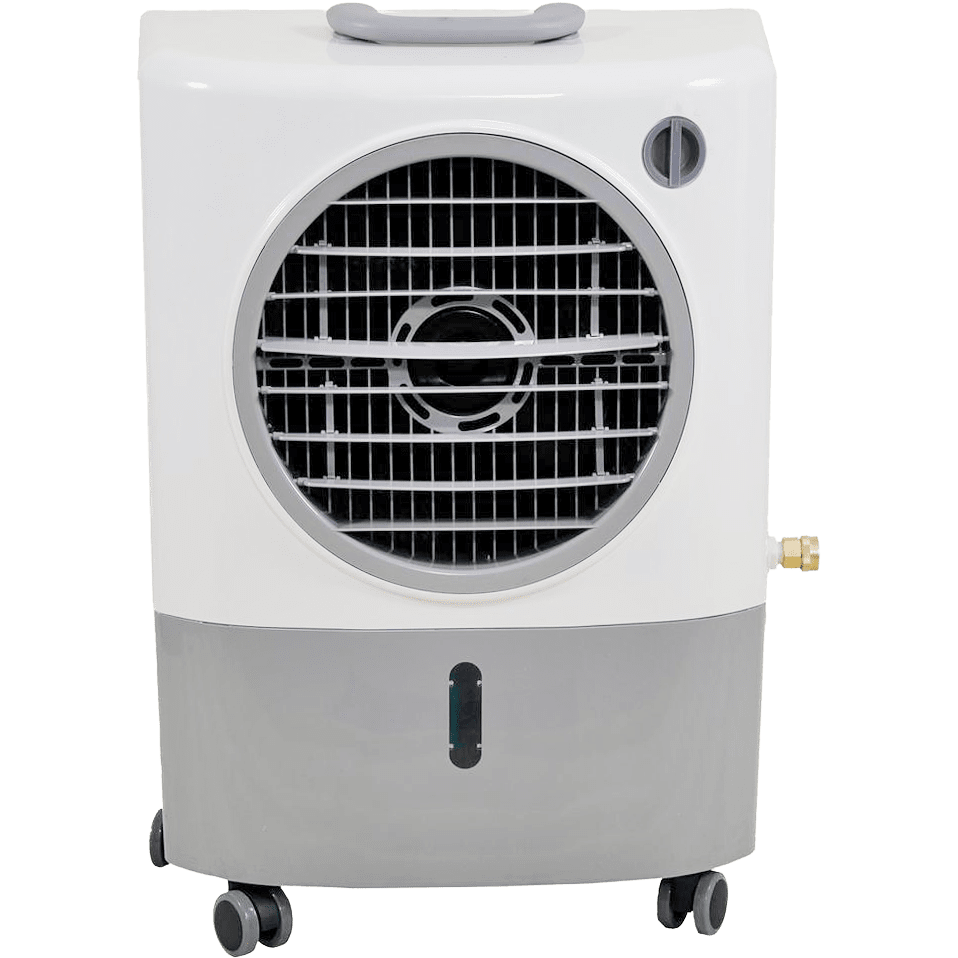
Hessaire MC18M Portable Evaporative Cooler
For readers evaluating the same basic cooling principle at a smaller scale, a portable evaporative cooler can be useful for patios, garages, workshops, or dry outdoor work areas. It still needs water, airflow, and suitable humidity conditions, so it is best treated as spot cooling rather than conventional air conditioning.
As an Amazon Associate I earn from qualifying purchases.
Why this matters for urban heat
Urban heat is not only a weather-app number. The broader issue is often described as the urban heat island effect, where built surfaces such as pavement, roofs, and concrete absorb and release heat differently than surrounding rural areas. The source cites European Commission research suggesting urban surfaces can be substantially hotter than nearby rural areas in summer, but that exact range should be treated as contextual background unless checked against the original study.
Heat risk is also a public-health issue, not just a comfort issue. The source references World Health Organization and U.S. Environmental Protection Agency statements about heat-related deaths and heat as a major weather-related hazard. Those claims align with the general public-health concern around extreme heat, but this article is not independently verifying those agency statistics.
The practical point is simpler: a person waiting outside does not benefit from a cooler building several blocks away. Delivery workers, students, older adults, transit riders, and outdoor staff may need relief at the street level. That is where a small, localized cooling structure could be useful if it performs reliably.
Where Bloc could make sense
Bloc’s most plausible use case is not a premium design object. It is a practical outdoor fixture for places where conventional air conditioning would be wasteful, impossible, or too expensive to operate. A solar-assisted evaporative wall could be especially relevant in hot, dry climates where evaporative cooling tends to work better.
Potentially sensible locations include:
- Bus stops and tram platforms with limited shade.
- Schoolyards, campus walkways, and outdoor waiting zones.
- Public plazas where people gather during the day.
- Worksites or civic spaces where temporary shade is not enough.
- Transit-adjacent areas where grid-powered cooling would be costly to install.
The idea is less convincing for humid climates, enclosed spaces, or areas where a steady water supply would be difficult. Evaporative cooling can lose effectiveness when the air is already carrying a lot of moisture, and any public installation that uses water needs maintenance planning from the start.
The buyer-aware tradeoffs
For a city, campus, or property manager, the main appeal is low-energy localized cooling. Bloc avoids refrigerant gases and does not appear to rely on grid electricity for airflow. That could matter in places where energy use, emissions, or operating cost are major concerns.
The tradeoff is that passive does not mean maintenance-free. A terracotta cooling wall would still need water management, cleaning, inspection, and protection from damage. Designers would also need to answer practical questions before procurement: how much shade it provides, how much water it actually uses, how it performs in humid weather, how easy it is to repair, and whether people will use it as intended.
What the related research does and does not prove
The source points to related engineering research on terracotta tube cooling systems. That kind of work supports the general idea that wet terracotta and airflow can reduce air temperature, particularly in suitable climates. It does not automatically prove that Bloc will deliver the same results on a sidewalk surrounded by traffic, dust, changing wind, and irregular maintenance.
That distinction matters. Lab results and material studies can validate the cooling principle. A public installation has to prove the whole system: ceramic geometry, fan performance, solar exposure, water storage, drainage, cleaning, user comfort, and durability over time.
What needs to happen next
The designers describe full-scale testing in real urban settings as the next step. That is the right test. Street furniture has to survive weather, dirt, impact, misuse, and long operating hours. It also has to deliver a noticeable benefit at the exact distance where people stand, sit, or wait.
The most useful future data would include measured air temperature before and after installation, humidity levels, water consumed per day, solar output, maintenance frequency, and performance across different climates. Without that information, Bloc should be viewed as a thoughtful prototype rather than a proven municipal cooling product.
The promise is still meaningful. A terracotta wall that breathes cooler air will not solve extreme urban heat by itself. But if real-world trials support the project’s claims, Bloc could become one more practical tool for the uncomfortable places where people spend the hottest minutes of the day.