

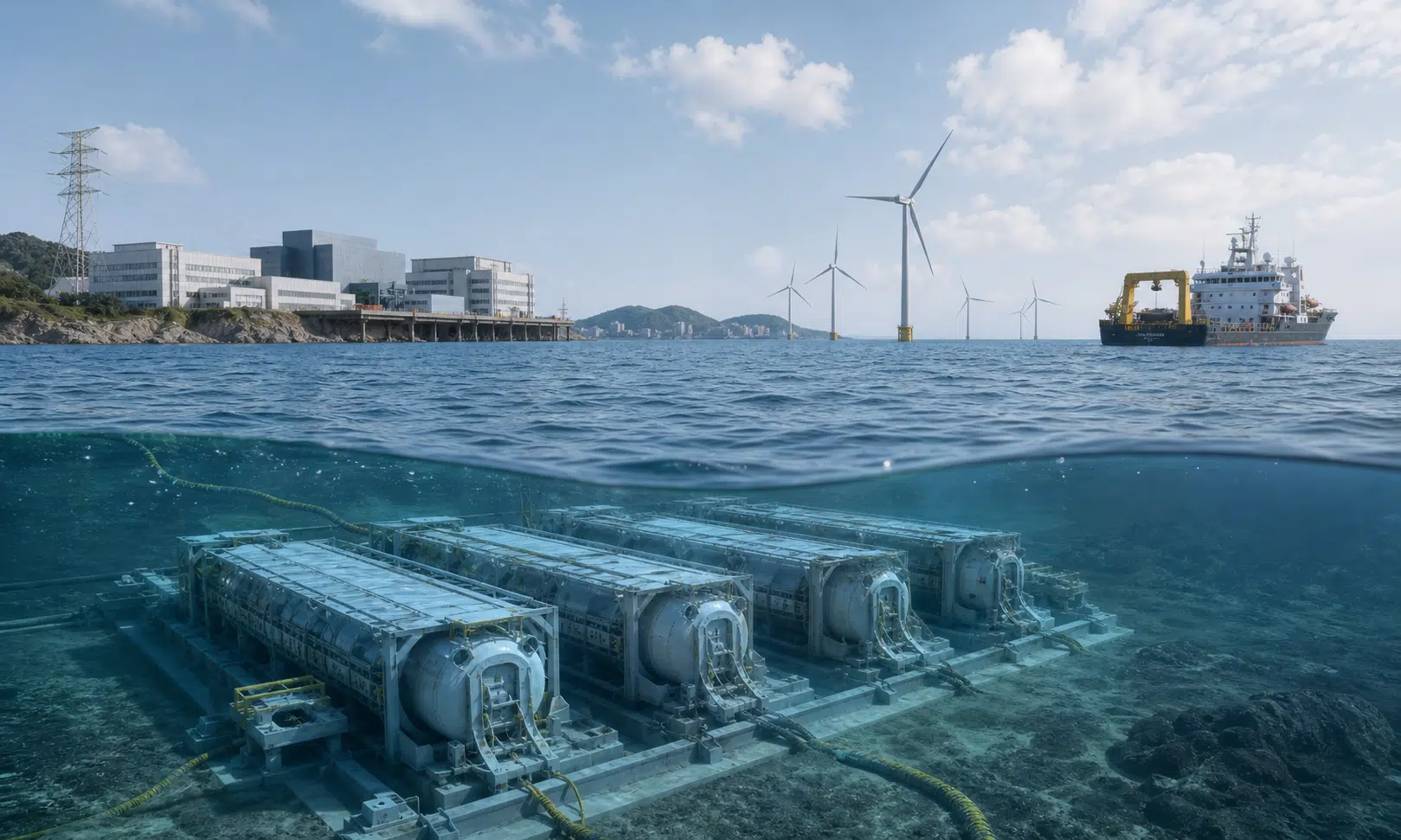

China’s reported offshore wind-powered underwater data center has moved into full commercial operation, according to Chinese media reports. The project, located off Shanghai’s Lingang Special Area, is being presented as a first-of-its-kind subsea facility that combines sealed server modules, ocean-water cooling, and nearby offshore wind generation.
For infrastructure buyers, the more useful question is not whether the project sounds futuristic. It is whether this kind of design solves enough real problems to justify the operating complexity.
On paper, the appeal is obvious. AI clusters produce enormous amounts of heat, and conventional data centers must spend heavily on chillers, pumps, air handling, water systems, and electrical support equipment. A data center placed underwater can use the surrounding sea as a heat sink, potentially lowering the amount of energy spent on cooling. Pair that with offshore renewable power, and the concept starts to look like a direct answer to two of the biggest constraints in AI infrastructure: electricity and thermal management.
But the Shanghai project should still be treated as an early commercial test case, not a settled blueprint. Several of the most important numbers, including its reported efficiency, server count, and power mix, come from media and project claims that have not been independently verified in the source material. That does not make the claims meaningless, but it does mean procurement teams, cloud buyers, and infrastructure investors should separate the engineering promise from the evidence available today.
What China says is operating off Shanghai
The facility has been described as a 24 MW underwater data center built off the coast of Shanghai’s Lingang Special Area. Reports say it was launched in June 2025, completed in October 2025, tested earlier in 2026, and has now entered full commercial operation.
The project is linked to a partnership involving Chinese government entities, HiCloud Technology, and state-backed telecom operators including China Telecom. The reported workload mix includes artificial intelligence, big data annotation, and 5G infrastructure services. The source material says the system houses nearly 2,000 servers, including GPU clusters associated with China Telecom and LinkWise, but that figure should be read as reported rather than independently confirmed.
The core design is straightforward in concept. Instead of putting servers in a land-based building and removing heat through conventional mechanical cooling systems, the servers are sealed inside pressure-resistant subsea modules. Reports place those modules roughly 35 meters below the surface. At that depth, the surrounding seawater is expected to absorb heat from the sealed computing equipment through the module structure and cooling interfaces.
That design is not new in principle. Microsoft’s Project Natick previously tested submerged data center capsules off Scotland and California. Those trials suggested underwater deployments could reduce some failure rates, partly because sealed environments can reduce human handling and airborne contaminants. Microsoft, however, did not turn Natick into a broad commercial deployment. That history matters: successful tests do not automatically translate into an operating model that cloud buyers can rely on at scale.
China’s project appears to go further by connecting the subsea concept to offshore energy infrastructure. Reports say the facility is connected to nearby offshore wind farms, allowing some of its electricity demand to be supplied from renewable generation. The size and consistency of that supply, and how much grid backup is needed, are not clear from the available source material.

FLIR TG268 Thermal Imaging Camera
A handheld thermal camera can help facilities teams document hot spots around racks, electrical panels, cooling paths, and backup systems during site assessments. It is most useful as an inspection aid, not a substitute for facility telemetry or engineering validation.
As an Amazon Associate I earn from qualifying purchases.
Why underwater cooling is attractive for AI workloads
Cooling has become one of the hardest practical problems in modern data center planning. Dense GPU racks can draw very large amounts of power, and nearly all of that power eventually becomes heat. Once rack densities rise, airflow-based cooling becomes harder to design, harder to operate, and more expensive to expand.
An underwater data center changes the thermal equation. The ocean provides a large, stable cooling environment, which can reduce dependence on industrial chillers and large HVAC systems. Chinese media reports claim the Shanghai facility achieves a Power Usage Effectiveness below 1.15. That number has not been independently verified in the source, but if accurate, it would put the facility in a highly efficient range for a large computing installation.
PUE is a useful but limited metric. It compares total facility power to IT equipment power. A lower number means less overhead is being spent on cooling, power conversion, lighting, and other non-compute systems. Traditional enterprise data centers are often described as operating closer to 1.5 or higher, though that varies heavily by age, climate, design, utilization, and measurement method.
For buyers, the more important point is not the exact PUE claim. It is whether the underwater design can maintain low overhead under real production conditions, across seasons, maintenance cycles, component failures, and changes in server load.
| Decision area | What underwater design may improve | What remains uncertain |
|---|---|---|
| Cooling energy | Seawater can act as a passive heat sink, reducing reliance on conventional chillers. | Reported efficiency figures need independent validation under production load. |
| Land use | Offshore deployment can reduce pressure on scarce coastal or urban land. | Permitting, marine access, and subsea cable routes can create new constraints. |
| Renewable power access | Nearby offshore wind could supply part of the facility’s demand. | The actual renewable share and backup power design are not fully clear. |
| Physical security | Sealed subsea modules may reduce casual access and environmental contamination. | Repairs require specialized retrieval or subsea service processes. |
| Expansion | Modular capsules could be added over time in theory. | Scaling depends on cable capacity, maintenance economics, and marine conditions. |
The buyer case: where this model could make sense
An underwater data center is not a general replacement for conventional colocation space. It is more likely to make sense where a specific mix of conditions exists: high cooling costs, access to offshore energy, expensive land, predictable workloads, and tolerance for a more specialized maintenance model.
That points toward a narrower buyer profile. A telecom operator, government-backed cloud provider, or AI infrastructure consortium may be better positioned than a typical enterprise buyer. These organizations can absorb long planning cycles, coordinate with energy and marine authorities, and build redundancy across multiple sites.
For AI workloads, the best fit may be batch-heavy or infrastructure-oriented jobs rather than workloads that require frequent physical hardware changes. Big data annotation, offline inference, some training support, and telecom infrastructure workloads may fit better than fast-changing lab environments where technicians need constant hands-on access to servers.
A buyer evaluating this kind of infrastructure should look for evidence in five areas:
- Verified operating efficiency across realistic workloads, not only headline PUE figures.
- Documented failure rates for sealed modules over multiple operating cycles.
- Clear procedures and costs for retrieving, replacing, or servicing failed hardware.
- Independent reporting on the actual share of energy supplied by offshore wind.
- Network latency, cable redundancy, and failover performance under production use.
The maintenance question is especially important. In a conventional data center, a technician can walk to a rack, replace a failed component, and return a system to service quickly. In a subsea deployment, failed hardware may need to be tolerated until a maintenance window, routed around through redundancy, or handled through a more complex module-retrieval process. That does not make the model unworkable, but it changes the economics.

Fluke 117 Electrician’s Multimeter
A reliable multimeter is useful for field checks around power distribution, backup equipment, and lab-scale infrastructure evaluations. Enterprise buyers should still rely on qualified electrical teams and facility-grade monitoring for production systems.
As an Amazon Associate I earn from qualifying purchases.
The engineering risks are not small
Saltwater is a hostile environment for infrastructure. Corrosion, pressure sealing, cable integrity, marine growth, and storm exposure all introduce risks that land-based facilities do not face in the same way. Even if the servers themselves are sealed, every connection point and support system must remain reliable over time.
The design also shifts the maintenance philosophy. Operators must assume that physical intervention is expensive and slow compared with standard data center service. That means the business case depends on redundancy, remote monitoring, predictive maintenance, and hardware configurations that can keep running even when individual components fail.
The source material says the Shanghai modules are deployed roughly 35 meters below the surface and that stable ocean temperatures continuously absorb heat from the computing hardware. That description fits the basic theory of underwater cooling, but buyers should still ask for temperature data, module-level telemetry, and service records before treating the design as proven.
Subsea cable reliability is another practical concern. A data center is useful only if power and network connections are resilient. Offshore wind integration can help with energy sourcing, but it does not remove the need for grid balancing, backup power, and carefully designed transmission links. AI workloads can be power hungry and sensitive to interruption, so renewable supply claims need to be evaluated alongside uptime architecture.
The biggest unknown is lifecycle cost. Lower cooling energy could be offset by higher engineering, deployment, insurance, monitoring, retrieval, or replacement costs. Until there is more operating history, it is difficult to compare the total cost of ownership against advanced land-based designs using liquid cooling, free-air cooling in favorable climates, or direct access to low-cost renewable power.
How this compares with other ocean-based data center ideas
The Shanghai project is part of a wider search for ways to place computing closer to abundant cooling and energy resources. Microsoft’s Project Natick showed that submerged capsules could operate successfully in test conditions, but Microsoft did not pursue the concept commercially at broad scale. That decision remains an important caution for buyers reviewing new subsea claims.
Other companies are exploring related ideas. Panthalassa, a startup backed by Peter Thiel, has been reported to be developing wave-powered floating data centers that would operate far offshore, using ocean water for cooling and onboard renewable systems for power. That approach differs from a fixed subsea facility, but it reflects the same pressure in the market: AI infrastructure needs more power, more cooling, and more locations where both can be delivered economically.
The ocean-based category now includes several distinct concepts:
- Submerged sealed modules, like the reported Shanghai facility and earlier Microsoft tests.
- Floating data centers that use seawater cooling while remaining serviceable at the surface.
- Offshore renewable-powered compute platforms designed around wind or wave generation.
- Hybrid coastal facilities that stay on land but use seawater or nearby renewable power for cooling and electricity.
Each model has different serviceability and risk tradeoffs. Submerged systems may offer strong thermal benefits and physical isolation, but they are harder to access. Floating systems may be easier to service but more exposed to weather and motion. Coastal systems are less radical but may face land, permitting, and water-use constraints.
For most commercial buyers, the practical comparison is not underwater versus traditional. It is underwater versus the best available land-based alternative for the same workload, power contract, latency requirement, and service-level agreement.
Photonics and networking may become the next bottleneck
The source article also points to a related issue inside AI infrastructure: moving data fast enough between chips, memory, switches, and racks. Power and cooling receive most of the attention, but networking can become a hard limit as AI clusters scale.
Executives from silicon-photonics companies quoted in the source argue that larger models and agentic AI workloads are pushing data centers toward optical interconnects. Their view is that copper links will struggle to keep up with the bandwidth and latency demands of large distributed AI systems. Those claims are directionally consistent with the industry’s interest in silicon photonics, co-packaged optics, and optical circuit switching, though specific market forecasts and timelines should be treated as estimates rather than settled facts.
The buyer implication is simple: cooling innovation alone is not enough. A data center built for AI must also solve power delivery, network latency, bandwidth, memory movement, and hardware availability. An efficient subsea facility could still be constrained if its internal network, external connectivity, or upgrade path cannot keep pace with GPU cluster requirements.
That is one reason the Shanghai project should be viewed as part of a larger infrastructure experiment. It addresses a real cooling problem, and possibly a real energy-sourcing problem, but it does not remove the other constraints around AI computing.
Verdict: promising infrastructure, not yet a copy-and-paste model
China’s reported offshore underwater data center is significant because it moves the subsea concept beyond a small research capsule and into a commercial AI infrastructure setting. The combination of sealed server modules, ocean cooling, and offshore wind access is exactly the kind of unconventional design the market is likely to keep testing as AI demand rises.
But buyers should not treat the headline claims as a procurement case on their own. The reported PUE below 1.15, the server count, and the renewable power contribution all need independent operating evidence before they can support serious comparisons with land-based alternatives.
This model is most relevant for governments, telecom operators, hyperscale infrastructure teams, and AI compute providers that can manage specialized engineering risk. It is less relevant for ordinary enterprises looking for flexible capacity, hands-on serviceability, and predictable vendor accountability.
The practical takeaway is balanced: underwater data centers may become a useful tool for specific high-density workloads in coastal or offshore energy environments. They are not yet a general answer to the AI data center crunch. The Shanghai project is worth watching closely, but the next useful milestone will be transparent performance data, not another headline about where the servers are sitting.

APC Back-UPS Pro 1500VA UPS
A desktop UPS can keep routers, monitoring stations, or small lab systems online through short interruptions while teams evaluate failover behavior. It is not sized for production data center loads.
As an Amazon Associate I earn from qualifying purchases.