
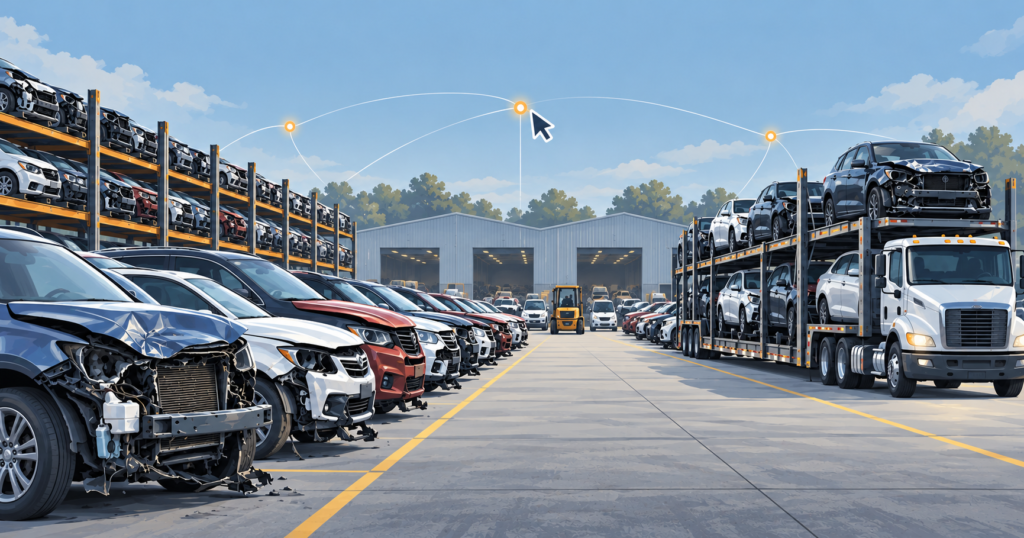
Copart introduced its VB2 online auction platform in 2003, according to the company’s technology timeline, moving its salvage vehicle business toward Internet-only bidding. Its fiscal 2004 annual report records the conversion of all its salvage auction facilities to the system, which opened sales to registered buyers with Internet access around the world.
The transition changed how buyers participated in vehicle auctions while retaining the storage yards and processing services behind each sale. Copart’s business connected vehicle suppliers, principally insurers, with buyers seeking damaged vehicles for dismantling, rebuilding or resale.
From a California yard to a national business
Copart’s published history dates its founding by Willis Johnson to 1982, with one salvage yard in Vallejo, California. The company went public in 1994. Copart says the offering raised capital for expansion across the United States, and its timeline identifies 1995 as the year it established a nationwide presence.
The move online developed over several years. Copart launched its website in 1996. A company technology timeline presented to investors in 2016 dates the introduction of online bidding to 1998 and its earlier real-time virtual bidding product, VB1, to 2001. VB2 followed in 2003.
Expansion also required integrating acquired facilities. In its fiscal 2006 annual report, Copart described introducing its pricing structure and operating procedures at acquired yards, alongside its management software. A dedicated integration team helped locations adopt the company’s systems.
That software connected the facilities operationally. Copart said its Copart Auction System tracked vehicles through the sales process and had been implemented across its salvage storage facilities. Suppliers could use online information to monitor vehicles from collection through sale and buyer settlement.
How VB2 moved bidding online
Copart’s fiscal 2009 annual report describes VB2 as a two-stage auction system. Buyers could first submit preliminary bids online or at a bidding station at a storage facility. They entered a maximum price, and the platform’s BID4U feature placed incremental bids on their behalf.
An Internet-only auction followed, allowing participants to compete with one another and with the highest preliminary bidder. This made online vehicle auctions accessible without requiring buyers to travel to the sale location, according to Copart’s description of the system.
The rollout also extended beyond North America. Copart’s fiscal 2009 report records the conversion of North American sales during fiscal 2004 and UK sales during fiscal 2008. Those dates distinguish the platform’s introduction from its subsequent implementation across different markets.
In its fiscal 2005 annual report, Copart said it believed VB2 had enlarged the pool of buyers and that increased competition had raised the amounts they were willing to pay. The company also attributed operational efficiency improvements to the technology.
Copart qualified that assessment in the same filing. It warned that improvements in operating results might not continue at the rates experienced during the preceding year. The reported benefits therefore represented management’s assessment of the rollout, with an explicit limit on expectations for further gains.
Fees tied to vehicle sale prices
Copart’s percentage-based fee model linked part of its revenue to auction results. Its fiscal 2004 annual report described a Percentage Incentive Program under which it sold a supplier’s salvage vehicles in a specified market for an agreed share of their selling price.
Copart said this arrangement gave it an incentive to increase sale proceeds. The program included vehicle transport, storage for up to 90 days and title processing at Copart’s expense.
Fixed-fee arrangements remained part of the business. The same report said approximately 65% of salvage vehicles were processed under the percentage program in fiscal 2004, with the remainder handled under fixed-fee agreements. The two approaches coexisted, giving suppliers different arrangements for processing and selling their vehicles.
The physical network behind the auctions
Physical facilities remained central to the online sales model. In its 2016 investor presentation, Copart identified appropriately permitted yards near major metropolitan areas as a barrier to entry. It also emphasized the need for multiple locations across a region to provide the scale vehicle suppliers required.
That presentation described operational demands extending beyond auction software, including coordinating transport providers and handling vehicle documentation across jurisdictions. The network combined online bidding with the work of moving, storing and processing vehicles.
Copart continued investing in facilities after the auction conversion. Its fiscal 2006 annual report recorded the acquisition of seven salvage storage sites and the opening of four others during that year. The company described acquisitions and new facilities as complementary routes for expanding its business.
Storage capacity also imposed limits. Copart’s fiscal 2005 annual report warned that severe weather could fill yards and restrict the acceptance of additional vehicles while existing inventory was processed. It said zoning restrictions and difficulties obtaining permits could constrain expansion, and insufficient capacity could damage relationships with insurers and other suppliers.