

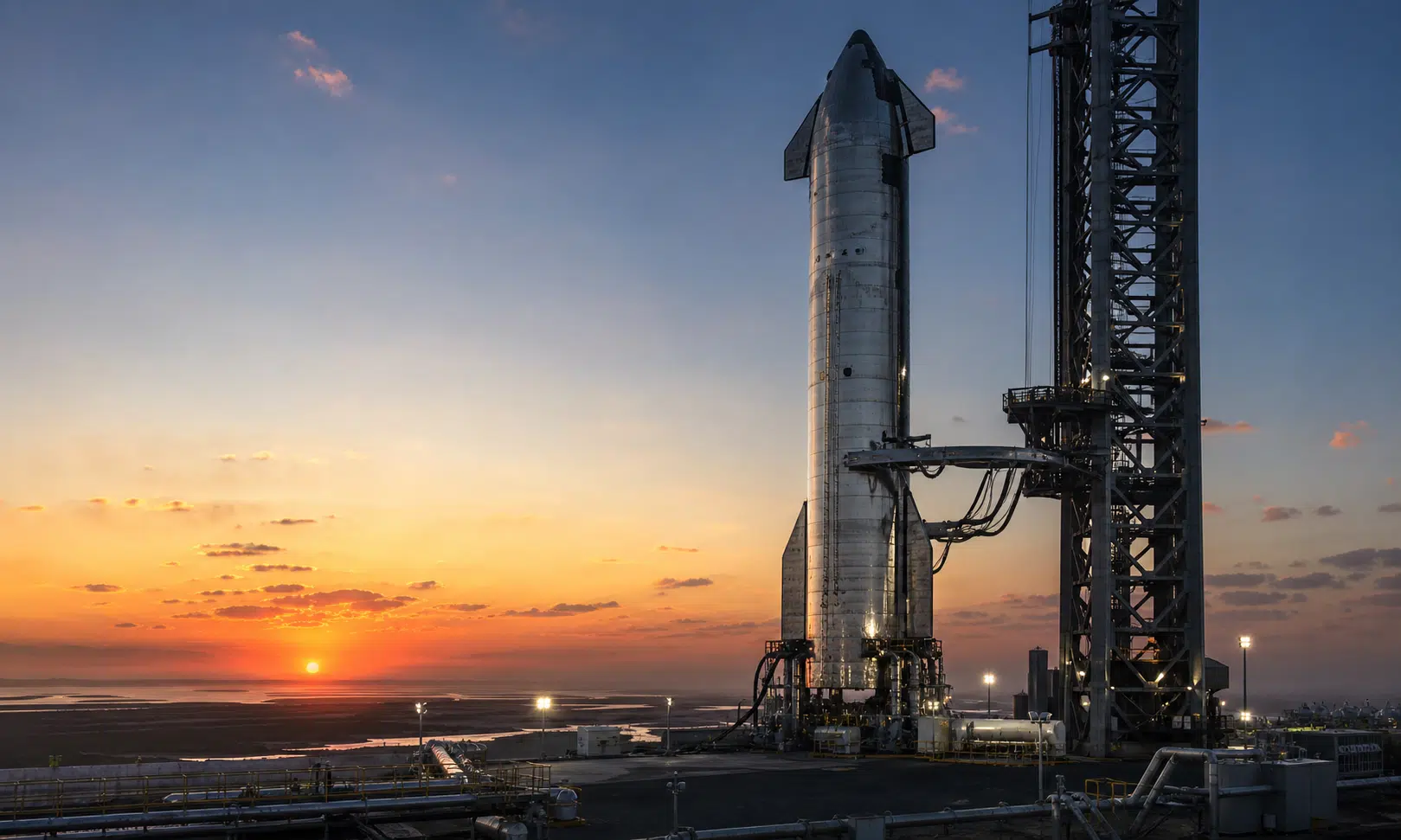

Welcome to this week’s Rocket Report, where the biggest story is not a liftoff but a hold. SpaceX came close to launching the first flight of its larger Starship V3 vehicle from South Texas, then stopped the countdown inside the final minute because of a ground-system problem.
That kind of delay is not unusual when a company is trying to fly new rocket hardware from a newly configured pad. It still matters. Starship is carrying more than SpaceX’s internal test objectives. NASA’s lunar plans, Starlink expansion, direct-to-cell service, and a large part of the commercial space industry’s lower-cost launch thesis all depend on Starship becoming reliable, reusable, and fast to turn around.
This week also brought a wider view of the launch market: Firefly is expanding its Texas manufacturing footprint, a German launch company may play a role in Canada’s effort to build sovereign launch capability, China’s commercial launch sector continues to raise money, and United Launch Alliance is working through the review process needed to bring Vulcan fully back into national security service.
Starship V3 Waits After a Late Countdown Scrub
SpaceX reached the final minute of the countdown for Starship Flight Test 12 on Thursday at Starbase, Texas, before the launch sequence stopped at about T-minus 40 seconds. The company made several attempts to resume the count, but the automated launch system held again each time. After five holds, SpaceX called off the attempt.
Elon Musk later attributed the scrub to a hydraulic pin on the tower arm that failed to retract. The arm connects ground equipment to the rocket before launch, and the issue left SpaceX with a practical choice: push through a risky first flight of new hardware, or reset and try again after the ground system could be checked.
The next opportunity was expected to open Friday evening, with a 90-minute window. For SpaceX, the quick turnaround goal is part of the test. Starship is meant to become a frequently flown vehicle, not a rocket that requires months of work between attempts. But the scrub also shows how much of that ambition depends on the pad, tower, plumbing, quick-disconnect systems, and software that support the vehicle before the engines ever light.
This test flight is especially important because it is not just another repeat of previous Starship flights. The vehicle is a taller and more powerful V3 configuration, and it is using a new launch pad at Starbase. SpaceX wants data on the vehicle, the booster, the upgraded upper stage, and the ground systems that must work together during fueling, ignition, liftoff, and post-launch operations.
Why This Starship Flight Carries So Much Weight
SpaceX can describe the mission as a test flight, and that is accurate. Test flights are supposed to reveal problems. But the industry consequences are larger than usual because Starship is now tied into so many future plans.
NASA is relying on a Starship-derived human landing system for Artemis lunar missions. Starlink’s next stages, including larger satellites and direct-to-cell capacity, become easier if Starship can loft much larger payloads at lower cost. SpaceX’s long-range plans for Mars and orbital infrastructure require a vehicle that can be reused quickly and repeatedly.
The company’s newly disclosed financial picture also raises the stakes. SpaceX has filed a detailed S-1 document ahead of a planned public offering, giving investors a closer look at a business that now spans launch, satellite internet, human spaceflight, and artificial intelligence through its recent xAI acquisition. The filing reported $18.67 billion in 2025 revenue, up from $14.02 billion the previous year, but also showed a $4.94 billion loss in 2025 after a small profit in 2024. Much of that loss was tied to AI development spending.
That makes Starship more than a technical program. It is part of the story SpaceX is telling investors about future capacity, lower launch costs, and new markets that are difficult to serve with existing rockets. If Starship performs, it strengthens that story. If it struggles, the company still has Falcon 9, Falcon Heavy, Dragon, and Starlink, but the most ambitious parts of its valuation case become harder to support.
Firefly Builds Out Its Texas Production Base
Firefly Aerospace announced an expansion of its Central Texas operations, including a new headquarters, more cleanroom space, and an innovation lab. The move adds two buildings next to its existing spacecraft facility in Cedar Park, creating a combined campus of 144,000 square feet.
The expanded site is intended to support spacecraft assembly and testing, mission control, avionics and component production, engineering, and business operations. Firefly says the new campus is roughly twice the size of its previous Cedar Park facilities.
The location also keeps the company close to its Rocket Ranch in Briggs, Texas, less than 30 miles away. That 200-acre site includes six test stands and 217,000 square feet of facilities used for launch vehicle engineering, manufacturing, and integration.
The point is scale. Firefly has moved from proving out vehicles and missions toward a more production-oriented phase, where facility layout, cleanroom capacity, and integration flow matter as much as individual engineering milestones. That is a familiar transition in commercial space: the hard part is not only designing a vehicle that can work once, but building an organization that can produce and support it repeatedly.
Isar Aerospace Could Support Canada’s Launch Ambitions
A more unusual space story came from the defense side. TKMS, the German maritime defense company competing for Canada’s submarine procurement, has announced cooperation with German launch services provider Isar Aerospace around Canadian space-launch capability.
The pairing looks odd at first glance: submarines and small launch vehicles do not obviously belong in the same proposal. The connection appears to be industrial cooperation. Large defense bids often include broader commitments to domestic industry, technology transfer, jobs, or strategic capability. In this case, TKMS is presenting space launch as part of a wider sovereignty package.
A firm timeline for Isar’s role has not been publicly confirmed. The available information points to a possible support role rather than a direct attempt to replace Canadian launch startups.
Canada has recently put more emphasis on domestic access to space. Its Launch the North initiative includes a planned $105 million over three years to establish small-lift launch capability by the end of 2028. Early awards have included funding for Reaction Dynamics, Canada Rocket Company, and NordSpace.
Within that context, Isar may be best understood as a potential industrial and technical partner. The company has been developing its Spectrum launch vehicle in Europe, and its experience could be relevant to launch infrastructure, operations planning, supplier development, or integration support. What has not been established is exactly how that would work, which Canadian firms would benefit, or whether the cooperation would become a central part of Canada’s launch strategy.
China’s Zenk Space Raises Money Before First Orbital Attempt
China’s commercial launch sector continues to add capital and hardware. Zenk Space has secured 180 million yuan, about $26 million, ahead of the planned debut of its Zhihang-1 rocket. The company’s first orbital launch attempt could take place in June.
Zhihang-1 is a kerosene-liquid oxygen rocket measuring 49.8 meters long and 3.35 meters in diameter. It is designed to carry up to 4,000 kilograms to a 500-kilometer Sun-synchronous orbit.
One notable feature is that the rocket draws on existing Chinese aerospace supply chains. It uses YF-102 kerosene-liquid oxygen engines from CASC’s Academy of Aerospace Liquid Propulsion Technology. Other Chinese commercial rockets, including CAS Space’s Kinetica-1 and Space Pioneer’s Tianlong-2, also use the YF-102. Zenk Space is also sourcing propellant tanks from commercial supplier R-Space.
That approach may reduce some development risk compared with designing every major subsystem from scratch. It also shows how China’s commercial launch firms are building around a mix of state-backed engine technology, private capital, and new vehicle integration.
SpaceX Opens Its Books Ahead of a Public Offering
SpaceX’s S-1 filing is one of the most consequential business documents the space industry has seen in years. The company has operated privately since 2002, and its finances have often been discussed through leaks, estimates, and secondary-market valuations rather than public disclosures.
The filing showed a company with fast-growing revenue and expanding ambitions, but also a business carrying heavy investment costs. SpaceX reported $18.67 billion in 2025 revenue, compared with $14.02 billion in 2024. It posted a small profit in 2024, then moved to a $4.94 billion loss in 2025, largely because of artificial intelligence development spending after the xAI acquisition.
The filing did not appear to change the basic picture of SpaceX’s launch business: Falcon 9 remains a dominant commercial and government launch vehicle, Dragon remains central to crew and cargo transport, and Starlink is a major revenue engine. What changed is the level of detail now available to investors and competitors.
For the launch industry, the filing matters because SpaceX’s public-market story will likely affect how capital is allocated across the sector. A successful offering could reinforce investor interest in launch, satellite connectivity, and space infrastructure. A skeptical reception could make investors more selective, especially toward companies that have not yet reached steady flight operations or revenue scale.
Russia Turns Rocket Advertising Into a Revenue Experiment
Roscosmos has begun placing more advertising on Russian rockets after legal changes approved last year allowed ads on spacecraft. Since the start of 2026, Russian launch vehicles have carried large advertisements for banks, restaurants, media groups, and other organizations, along with public service messages.
The policy is meant to create a new revenue stream at a time when Roscosmos has faced financial pressure and reduced access to Western partnerships after sanctions. The early financial upside appears limited. Annual revenue from rocket advertising may amount to only a few million dollars, which is small compared with the broader funding needs of a national space program.
Still, the shift is notable. Rockets have always carried national branding, mission patches, and customer logos. Russia is now testing whether launch vehicles can also function as premium advertising surfaces. The practical ceiling is probably low, but the change says something about the pressure on traditional state space agencies to find money outside normal government budgets.
ULA Moves Through Vulcan Booster Review
United Launch Alliance has reported progress toward returning Vulcan to its next phase of flights after a solid rocket booster issue on a February mission for the US Space Force. During that launch, one of the four Graphite Epoxy Motor 63XL solid rocket boosters attached to Vulcan suffered a nozzle problem before booster separation, and the rocket rolled more than intended.
Northrop Grumman has since completed a static fire test of a GEM 63XL booster. The test was described as a milestone in the review process, including work tied to nozzle design enhancements and advanced propellant technology.
The US military review remains important because Vulcan is expected to carry national security payloads. Certification and return-to-flight confidence depend not only on whether the rocket completed the earlier mission, but on whether the booster issue is understood and addressed.
Vulcan’s next flight is expected to be for Amazon, which needs launch capacity for its Kuiper broadband constellation. That makes ULA’s schedule important beyond government missions. Amazon is trying to deploy a large satellite network under regulatory deadlines, and Vulcan is one of the vehicles expected to help carry that load.
Workplace Fatality Reported at Starbase
A contractor working at SpaceX’s Starbase complex in Texas died after a workplace accident, according to local officials and reporting on the incident. Cameron County authorities responded, and people familiar with the matter said the person died after a fall.
Brownsville’s fire department was initially dispatched, but the request was canceled before personnel were sent to the site. SpaceX and the city of Starbase did not provide immediate public comment in the available reporting.
The incident adds a serious note to a week otherwise focused on flight tests, funding, and industrial expansion. Starbase is not only a launch site. It is a large construction, manufacturing, and operations complex, and its safety systems now have to cover both high-energy rocket activity and the day-to-day risks of a rapidly expanding industrial site.
Next Three Launches
| Date | Vehicle | Mission | Launch site | Time |
|---|---|---|---|---|
| May 22 | Starship | Flight Test 12 | Starbase, Texas | 22:30 UTC |
| May 24 | Falcon 9 | Starlink 17-37 | Vandenberg Space Force Base, California | 14:00 UTC |
| May 24 | Long March 2F | Shenzhou 23 | Jiuquan Satellite Launch Center, China | 15:08 UTC |
Launch schedules can shift quickly, especially after scrubs or range delays. This week’s list is a good example: Starship’s next opportunity depends first on whether SpaceX can clear the ground-system issue that stopped the countdown.