Creative’s Sound Blaster AE-X combines stereo RCA outputs, a discrete headphone amplifier and virtual 7.1 surround processing in an internal PCIe sound card. Its connection layout supports analog and digital audio, but it does not provide the separate analog outputs required for a 5.1 or 7.1 speaker system with individual channel inputs.
Creative advertises a DAC dynamic range of 130 dB, PCM playback at up to 32-bit/384 kHz and native DSD256 support. Those specifications sit alongside several connection-specific limits: the coaxial digital output has a lower maximum PCM resolution, while the front-panel headphone connection carries substantially lower power ratings than the rear jack.
The card also separates digital input and output between two connector types. Its coaxial S/PDIF connector is an output, whereas the optical TOSLINK connector is an input. That distinction determines how it can connect to external digital sources and playback equipment.
Stereo outputs and separate digital connections
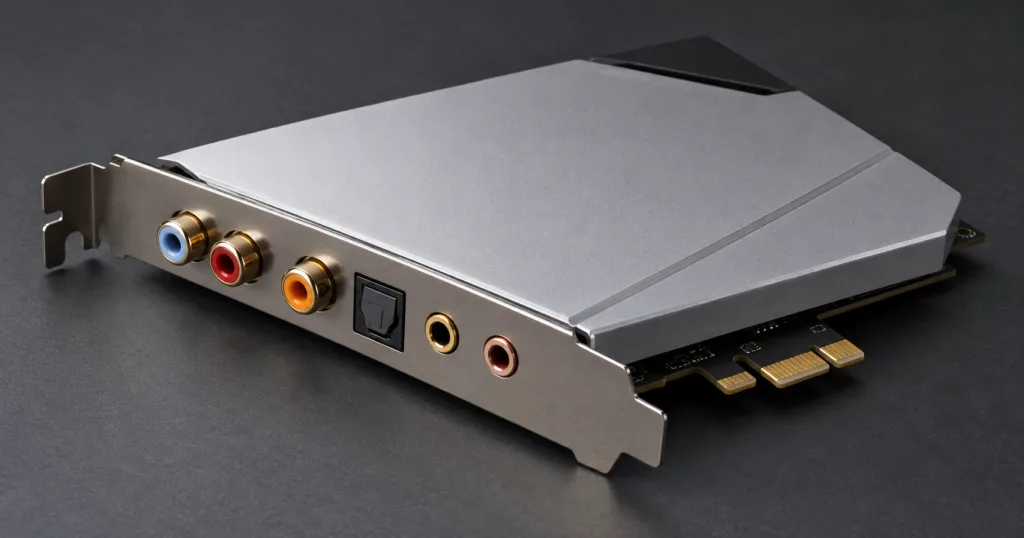
The AE-X provides two RCA sockets for left and right analog line output. These connect to an amplifier, active speakers or another device accepting an analog stereo signal. Each channel has its own socket, avoiding the need to split a shared 3.5 mm stereo output into two RCA connections.
The RCA sockets are color-coded, with light blue identifying the left channel and red identifying the right. They provide unbalanced audio connections. The card does not have balanced line outputs, and the two sockets carry a stereo pair rather than additional surround channels.
Digital output uses the orange coaxial S/PDIF socket. Creative specifies support for PCM at up to 24-bit/192 kHz through this connection. That ceiling is separate from the higher PCM specification advertised for the card’s high-resolution playback capabilities; the 32-bit/384 kHz figure does not apply to every connector.
The neighboring optical TOSLINK socket accepts digital audio from an external source. It does not transmit an optical output signal. An AV receiver or other playback device therefore cannot receive optical audio directly from that socket; the AE-X’s digital output connection is coaxial.
Analog recording uses a combined microphone/line input on a 3.5 mm jack. Depending on its selected use, this connection accepts a microphone signal or an analog stereo line signal. A separate 3.5 mm headphone output sits on the rear bracket, keeping headphone playback and microphone input on different sockets.
This arrangement places stereo playback, headphone use and a limited set of recording connections on the same bracket. There is no bank of analog sockets for separate front, rear, center and subwoofer speaker channels. The advertised virtual 7.1 feature consequently needs to be distinguished from physical multichannel connectivity.
Rear and front headphone outputs have different ratings
The rear headphone jack connects to the AE-X’s more powerful amplifier section. Creative specifies a maximum output of 350 mW into a 32-ohm load and an output impedance of 1 ohm. The company describes the headphone amplifier as a discrete design.
Creative also specifies four gain levels to accommodate headphones with different requirements, ranging from sensitive in-ear models to high-impedance headphones. The maximum stated output voltage is 6 V RMS. That voltage is not a promise of the same output into every load and should be considered separately from the power rating given at 32 ohms.
Inside the PC, a 10-pin HDA front-panel header allows the card to connect to the audio sockets on a suitably equipped case. The case’s headphone socket then provides another access point, but its electrical specifications differ from those of the rear output.
| Specification | Rear headphone output | Front-panel headphone output |
|---|---|---|
| Maximum output at 32 ohms | 350 mW | 40 mW |
| Output impedance | 1 ohm | 10 ohms |
The shared 32-ohm load condition makes the two published power figures directly distinguishable: Creative rates the front connection at 40 mW, compared with 350 mW at the rear. The front connection also has a higher stated output impedance.
Moving headphones between the front and rear sockets therefore changes more than their physical connection point. The front-panel header does not provide an electrically equivalent extension of the rear headphone output, despite both connections serving headphone playback.
These figures describe the manufacturer’s stated operating limits. They do not establish measured distortion, noise or output behavior with every headphone load. The power, voltage and impedance specifications also describe different aspects of the output and should not be treated as interchangeable measures of performance.
Internal USB audio and high-resolution playback
The AE-X connects to the motherboard through a PCIe x1 connector, but its internal audio architecture uses USB audio technology. Audio communication is routed through that internal arrangement rather than being handled entirely by a native PCIe sound processor.
The USB architecture remains inside the computer. The card still installs in a compatible PCIe slot and receives its power through that slot. It does not require a separate external power supply or an additional internal power connector.
Creative advertises PCM support at up to 32-bit/384 kHz and native DSD256 playback. The company also lists ASIO 2.3 support. These are format and interface specifications, distinct from the analog amplifier’s power ratings and from the resolution supported by the coaxial digital output.
The advertised 130 dB dynamic-range figure is identified as a DAC specification. It should not be read as a measurement applying equally to the microphone input, front-panel headphone connection and every other signal path on the finished card.
A component’s specification and the performance of a complete audio device describe different things. The surrounding analog circuitry, amplification and chosen connection remain part of the signal path. The DAC figure alone does not establish the AE-X’s measured recording performance or its headphone output under load.
The board’s layout allocates a substantial area to the analog output circuitry, with the main components concentrated on one side of the PCB. That physical arrangement describes how the card is built; component count and occupied board area do not by themselves demonstrate better sound or lower distortion.
Virtual surround and audio software
Creative advertises virtual 7.1 playback alongside its Nexus software. Its advertised processing features include Acoustic Engine, Scout Mode and CrystalVoice. These software capabilities are separate from the number and type of physical audio connections on the card.
Virtual surround operates through the available stereo outputs or headphones. It does not add discrete analog channels to the rear bracket. A speaker system that requires separate analog inputs for each of its 5.1 or 7.1 channels cannot obtain those connections from the AE-X’s stereo RCA pair.
The distinction also applies to the product’s surround labeling: support for virtual 7.1 describes audio processing, not eight independently wired analog speaker outputs. The card’s physical output layout remains centered on stereo line playback, headphones and a coaxial digital connection.
Software is supplied through installation rather than on an included driver USB stick. The package does not contain a physical software drive. The advertised software features should also be kept separate from claims about measured audio quality; their presence does not establish the performance of the underlying analog circuitry.
Physical design and installation
The AE-X measures 179 × 126 × 18 mm and uses a PCIe x1 connector. It occupies an internal expansion position and is secured at the case through its slot bracket. Its dimensions describe a full card assembly rather than a small external adapter or a connector-only bracket.
A silver-colored, shaped sheet-metal cover conceals much of the main component side. A black insert with diagonal texture and smaller geometric details forms part of the exterior. The design does not include conspicuous RGB lighting.
The cover provides a physical barrier over the electronics. Its presence alone does not establish the effectiveness of electromagnetic shielding, which depends in part on how the metal is electrically connected to ground. A metal enclosure and a demonstrated reduction in interference are separate matters.
The same distinction applies to cooling. A cover cannot be assumed to function as a heatsink simply because it is metal; that role would require a suitable thermal connection to heat-producing components. The external construction therefore does not, by itself, establish a particular cooling capability.
The reverse side has a black PCB, much of which is concealed by the rear protective structure. Product and certification markings appear on that side, together with the screws holding the cover in place. No large active components are visible there; the main circuitry is concentrated on the opposite surface.
The internal HDA header adds a connection for a compatible case audio panel alongside the rear bracket’s sockets. It does not remove the need to distinguish between the rear amplifier and the lower-rated front-panel headphone output when describing the card’s specifications.
Included adapter and accessories
The package contains the sound card, a printed quick-start guide and a short headset adapter. The adapter has a four-pole 3.5 mm socket for a headset with a combined headphone-and-microphone plug. At the other end, two separate 3.5 mm plugs divide those signals between the card’s headphone output and microphone input.
That accessory addresses the difference between a headset using one combined connector and the AE-X’s separate rear sockets. It separates the existing headphone and microphone connections; it does not add another recording input or change the card’s output capabilities.
No additional audio connection cables are included. In particular, the package does not supply the analog cable needed to connect the RCA line outputs to an amplifier or active speakers. There is also no external power supply, consistent with the card taking its power from the PCIe slot.
Inside the packaging, a fitted cardboard insert holds the card in its own recess. Folded cardboard sections secure it against movement, while the accessories are stored separately. The internal packaging uses mostly cardboard rather than an elaborate plastic tray, with the supplied contents limited to the card, guide and headset adapter.