

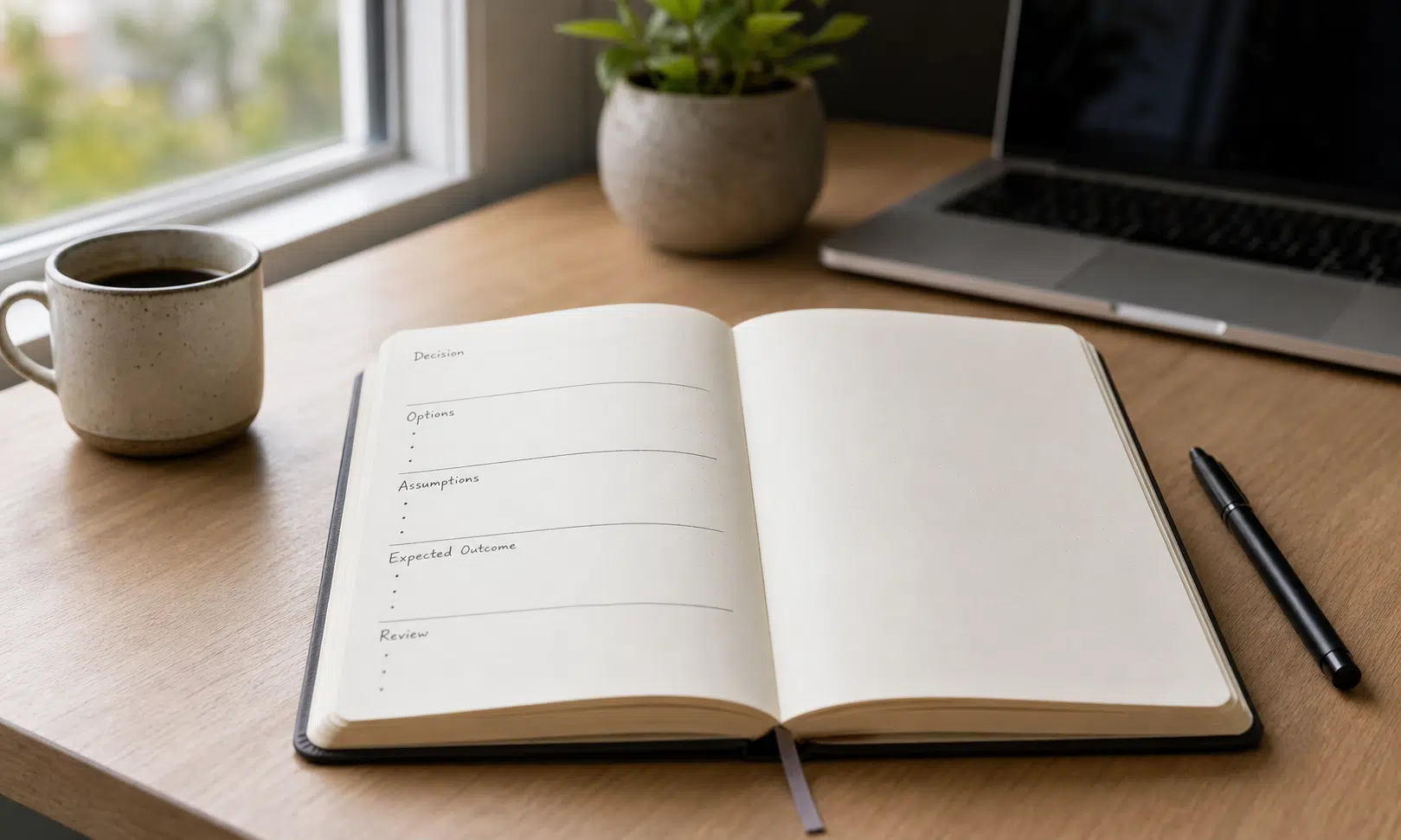

A decision journal is not a productivity app, a life dashboard, or another place to perform self-improvement theater. At its best, it is much simpler than that: a record of what you knew, what you cared about, and why you made a choice before hindsight gets involved.
That makes it useful for a very specific kind of problem. Big decisions are rarely clean. A career move can be smart and still land badly. A risky choice can work out for reasons that had little to do with judgment. If every decision gets graded only by the result, it becomes harder to learn from the process.
A decision journal gives you a way to separate the two. It does not promise certainty, and it will not make hard tradeoffs disappear. But for people who tend to second-guess themselves after the fact, it can create a more honest record of how a decision actually looked in the moment.
Verdict: simple, useful, and easy to overcomplicate
The appeal of a decision journal is that the tool barely matters. Apple Notes, Google Docs, Notion, a dedicated journaling app, or a paper notebook can all work. The value is in the forced clarity: writing down the decision, the options, the priorities, the known facts, the assumptions, and the expected outcome.
That makes the system especially useful for high-consequence personal decisions, including work, money, location, relationships, health, and major lifestyle changes. It is much less useful for everyday choices. Logging what to eat for lunch would turn the system into a chore. Logging whether to leave a job, move cities, start a business, or make a major financial commitment is the better fit.
The main tradeoff is discipline. A decision journal only helps if it is used before the decision and reviewed later with some honesty. If it becomes a place to justify what you already wanted to do, it loses much of its value.
How the system works
A good decision journal entry should be short enough that you will actually write it, but structured enough to capture the thinking that matters. The basic format can be reduced to a handful of prompts:
- What choice am I facing?
- What realistic options are available?
- What am I optimizing for?
- What do I know right now?
- What am I assuming?
- Why am I choosing this option?
- What do I expect will happen?
The most important prompt may be the second one in disguise: what are you optimizing for? A decision can look irrational if the real priority is hidden. Someone optimizing for income may make a different call than someone optimizing for stability, flexibility, health, family time, or creative growth. Naming that priority makes the eventual review more fair.

Moleskine Classic Hardcover Ruled Notebook
A plain ruled notebook works well for decision journaling because it keeps the system focused on the entry, not the tooling. Use dated pages for the decision, options, assumptions, and later review notes.
As an Amazon Associate I earn from qualifying purchases.

Leuchtturm1917 A5 Dotted Notebook
A dotted notebook with numbered pages is useful if you want one place for major decisions and follow-up reviews over time. It adds light organization while staying flexible enough for short, plain entries.
As an Amazon Associate I earn from qualifying purchases.
The setup should stay deliberately plain. Create one dedicated place for entries and resist the urge to build a complex template with tags, dashboards, charts, and categories. A simple document or notebook with dated entries is enough.
What to include in a first entry
For a first entry, pick one decision that is large enough to matter but not so emotionally loaded that writing about it becomes impossible. The goal is not to produce a perfect essay. The goal is to make the current state of your thinking visible.
A useful entry might include:
- The decision in one sentence
- The options that are realistically on the table
- The priority you are optimizing for
- The strongest reasons for the option you are choosing
- The strongest reasons against it
- The information you wish you had but do not
- The outcome you expect, and when you expect it to be clear
There is also value in separating emotion from evidence. If a choice feels urgent, frightening, exciting, or exhausting, write that down. Feelings can be legitimate signals, but they should not be mistaken for facts.
Maintenance is the whole point
The review is where the system becomes more than journaling. After making a major decision, set a reminder for a future point when the outcome is likely to be easier to evaluate. For some decisions, that may be a few months. For others, it may take closer to a year.
When the reminder arrives, read the original entry before deciding whether the choice was good or bad. The better questions are narrower:
- What did I understand correctly?
- Which assumptions turned out to be wrong?
- What information would have changed the decision?
- Did the outcome reflect the process, or did circumstances shift?
- What would I tell a friend making the same decision today?
That last question matters because it changes the posture of the review. People are often harsher with their own past decisions than they would be with someone else working from the same information. A decision journal can make that double standard easier to spot.
Who should use a decision journal?
A decision journal is a good fit for people who make occasional high-stakes choices and want a clearer way to learn from them. It is also useful for anyone who tends to rewrite the past after an outcome is known, either by blaming themselves too quickly or by giving themselves too much credit when luck helped.
It is not a great fit for people who already over-document their lives or turn every small choice into an analysis project. The system works best when used sparingly. A few serious entries a year may be enough.
The practical verdict is straightforward: a decision journal is low-cost, low-maintenance, and surprisingly resistant to tool obsession if you keep it plain. Its value is not that it makes every decision better in the moment. Its value is that it gives your future self a cleaner record to learn from, without letting the outcome rewrite the entire story.