Quaise Energy announced on Nov. 17, 2026, that Google had signed a power purchase agreement for 50 megawatts of superhot geothermal electricity from Project Obsidian, a facility under development near Newberry Volcano in central Oregon. Quaise said deliveries could begin as early as 2030. The electricity is intended to support Google’s three data center campuses in The Dalles and communities on the regional grid.
Quaise, based in Houston, identified Google as the project’s first customer and put the total value of the agreement at more than $500 million. The contract term and the price per unit of electricity were undisclosed in the announcement.
Geothermal plants draw on underground heat and can generate electricity around the clock regardless of weather. That makes them a potential source of firm, low-carbon electricity for data centers, where computing and cooling equipment need a continuous supply of power. Google has backed geothermal power for data centers elsewhere. In 2023, a project it developed with Fervo Energy began supplying electricity to the Nevada grid that serves Google’s data centers there.
Conventional wells for the first phase
Project Obsidian sits on the southern flank of Newberry Volcano, south of Bend, on federal geothermal leases in the Deschutes National Forest. Quaise said it began drilling its first resource confirmation well in July 2026. The company set a target depth of about 15,000 feet, or 4.6 kilometers, for that well to measure underground temperatures and examine rock properties.
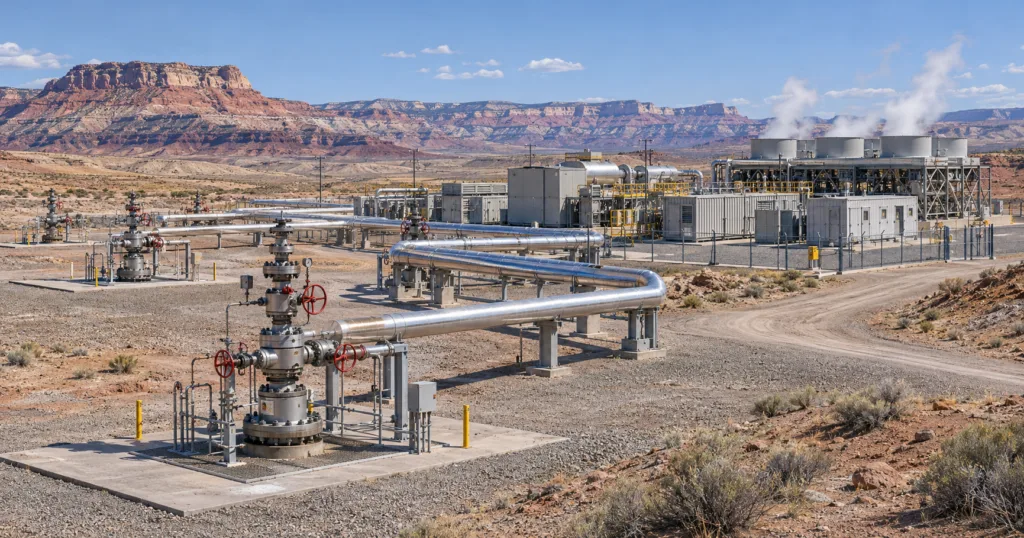
Quaise plans to use conventional drilling for the initial development. Its first-phase design calls for two reservoirs with target average temperatures of 315 and 365 degrees Celsius. Each reservoir would be served by one injection well and two production wells. Quaise plans to use the confirmation well to monitor underground conditions during circulation tests. The results will help determine whether the reservoirs can sustain the flow and heat needed for power generation.
An enhanced geothermal system uses wells and fractures in the rock to circulate water underground. At Obsidian, injected water would absorb heat as it moves through the rock. Production wells would bring the heated fluid to the surface, where its heat would be used to generate electricity.
Millimeter-wave drilling in the expansion
Quaise plans to introduce millimeter-wave drilling in the second phase to reach deeper, hotter rock. A device called a gyrotron generates the millimeter waves at the surface. The drilling system directs the waves down the borehole, where they heat and vaporize rock. Quaise says its system drilled 118 meters through granite in a Texas quarry in 2025. The company expects the Oregon expansion to be the technique’s first commercial deployment.
Quaise aims to add 200 megawatts in the second phase, bringing the project’s total capacity to 250 megawatts. A possible third phase could take capacity above 1 gigawatt. Google’s purchase agreement covers the initial 50 megawatts.
Permitting and transmission before delivery
The Bureau of Land Management issued a decision in 2025 covering exploration and a resource confirmation well. The agency described it as an interim step in the drilling approval process. The timetable for supplying electricity also depends on permitting and environmental review, as well as a new transmission line to connect the site to a substation in La Pine.
Quaise said it closed a $180 million equity round in August 2026 to help fund Project Obsidian and develop its drilling technology. The U.S. Department of Energy selected Quaise for up to $25 million to support work on the first set of wells. Quaise said the full value of that proposed funding depended on award negotiations.