Morgan Stanley analysts have highlighted enhanced geothermal power as a potential source of reliable electricity for AI data centers, identifying opportunities for Ormat Technologies, Fervo Energy and oilfield-services companies.
The bank’s assessment centers on drilling techniques adapted from the oil and gas industry. Those methods could expand geothermal development beyond the locations suitable for conventional plants, although broader deployment still depends on construction, financing and lower costs.
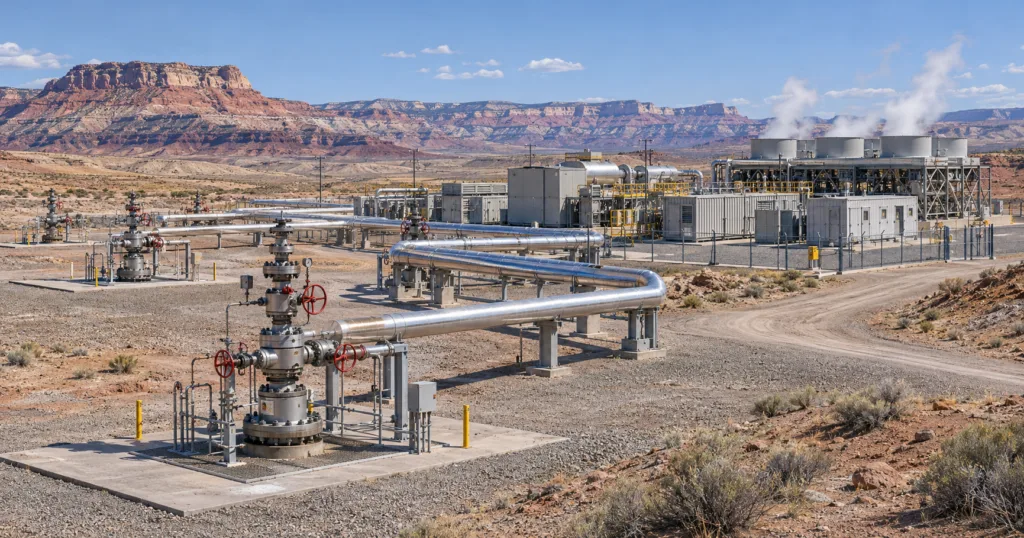
Fervo’s Cape Station development in Utah illustrates the industry’s progress. The company announced a 396-megawatt power purchase agreement with Google in September 2026 and declared commercial operation of its first generating unit, with 33 MW of net output, that month.
Drilling technology expands geothermal access
Geothermal plants use underground heat to generate electricity. Conventional projects depend on naturally occurring reservoirs with sufficient heat, fluid and permeable rock, limiting where developers can build.
The U.S. Energy Information Administration describes enhanced geothermal systems, or EGS, as using technologies such as horizontal drilling and hydraulic fracturing to create reservoirs where suitable natural ones do not exist. Water circulates through hot rock, carrying heat to the surface for electricity generation.
Unlike wind and solar generation, geothermal power can operate around the clock without depending on weather. That characteristic is relevant to data centers seeking a continuous electricity supply.
The industry’s existing contribution remains small. EIA figures put geothermal at about 0.4% of U.S. utility-scale electricity generation in 2025. The Energy Department’s market report records approximately 4 gigawatts of installed nameplate capacity in 2024.
An Energy Department analysis identified potential for at least 90 GW of geothermal electricity-generating capacity by 2050 if enhanced geothermal systems achieve aggressive cost reductions. That conditional estimate describes a possible development path rather than capacity already financed or under construction.
Google agreements support Cape Station development
Fervo announced its 396 MW Google agreement on September 1, 2026. Its securities filing dates the contract’s signing to August 26 and specifies a 15-year delivery term, with target commercial operation dates beginning in the third quarter of 2028.
The electricity is intended to support a potential Google data center in Utah. Fervo said the arrangement requires it to offer Google an option for approximately 600 MW of additional capacity, potentially taking Google’s commitment to nearly 1 GW by June 2030. Expansion requires Google’s acceptance and a definitive agreement; the data center plans also remain subject to engineering feasibility, approvals and commercial conditions.
The arrangement follows a 115 MW agreement involving Fervo, Google and NV Energy announced in June 2024. The two agreements concern different commitments and delivery periods.
Separately, Fervo reported 658 MW of signed power purchase agreements and other power-sale arrangements as of June 30, 2026, representing approximately $7.2 billion in potential revenue backlog. Those figures predate the September Google announcement and describe prospective sales, rather than revenue already earned.
Fervo said Cape Station’s first generating block synchronized with the grid on September 24 and reached commercial operation on September 30, producing 33 MW net. That operating milestone is distinct from the future capacity covered by the Google agreement.
Financial and reservoir risks remain
Morgan Stanley highlighted Ormat’s established geothermal operations and also identified possible opportunities for SLB, Halliburton and Baker Hughes as geothermal drilling expands. Ormat develops and operates power plants and manufactures equipment, while services suppliers participate through drilling and related work.
Fervo’s financial results show the difference between securing future contracts and earning revenue from operating assets. The company reported a $55.9 million net loss for the second quarter of 2026 and approximately $2.1 billion in cash and cash equivalents as of June 30, following its May initial public offering.
Fervo said it expected Cape Station Phase II to achieve an all-in construction cost of $5,500 per installed kilowatt. That figure is a development target, rather than a demonstrated cost for every subsequent generating block.
Reservoir performance is also disputed. In an October 6 report, Morpheus Research alleged that Fervo had understated water losses, declining reservoir temperatures and seismicity-related equipment damage. Morpheus disclosed a short position in Fervo shares.
CEO Tim Latimer disputed Morpheus’ characterization, while Fervo said its Project Red demonstration recovered 70% of its water.