

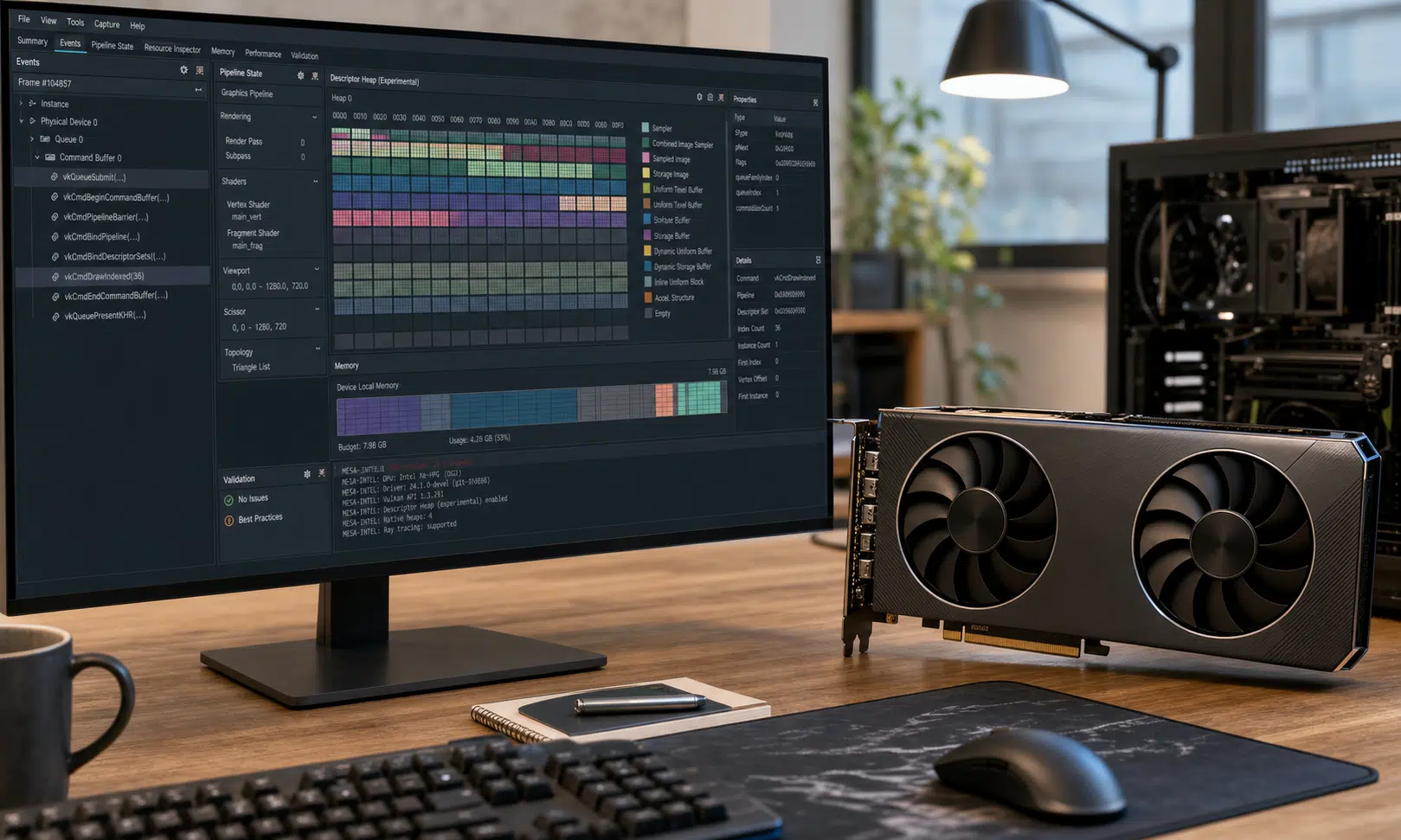

Intel ANV Moves Descriptor Heaps Into Experimental Support
Intel’s open-source ANV Vulkan driver for Linux is now advertising support for descriptor heaps through the VK_EXT_descriptor_heap extension, although the feature is still being treated as experimental for now. The work has landed for Mesa 26.2, putting Intel’s driver on track to join other major Vulkan driver stacks that have already started exposing the extension.
For Linux users with Intel Arc Graphics, the important detail is not that this instantly changes game performance today. It is that one more low-level Vulkan feature needed by modern translation and rendering paths is now present in Intel’s open driver stack, even if it still needs testing before regular users should expect it to appear by default.
Descriptor heaps are tied to how Vulkan applications manage descriptors and the memory used for descriptors. In plain terms, descriptors are part of how a graphics API tells the GPU where to find resources such as buffers, textures, and related state. Giving applications more explicit control over that area can reduce driver-side work in some rendering paths and can better match how newer graphics APIs organize resource binding.
That is why the extension matters to Linux gaming watchers. VKD3D-Proton, the Direct3D 12 to Vulkan translation layer used by Steam Play, is one of the projects that may benefit from cleaner support for this kind of descriptor management. The practical impact will depend on the game, driver maturity, GPU, Mesa version, and whether the support is enabled without experimental flags later.
Why VK_EXT_descriptor_heap Matters For Linux Gaming
VK_EXT_descriptor_heap was introduced with the Vulkan 1.4.340 specification update in January. The extension is meant to give applications explicit management of descriptors and descriptor memory. That does not make it a simple performance switch, but it does give Vulkan software another tool for reducing overhead and mapping modern rendering behavior more directly onto Vulkan.
For buyers or builders comparing Linux-ready graphics options, this is worth reading as a driver maturity signal rather than a shopping trigger by itself. Intel’s Arc hardware has often depended on rapid open-source driver progress to improve real-world Linux behavior, and new Vulkan feature support can matter over time for game compatibility, frame pacing, shader-heavy titles, and translation layers.
The key buyer-aware takeaway is straightforward: if you already own Intel Arc hardware and use current Mesa builds, this is a positive development to watch. If you are buying a GPU specifically for Linux gaming today, this single merge should not be treated as proof that Intel has closed every Vulkan or Steam Play gap. It is one piece of a broader driver roadmap.

Intel Arc B580 Graphics Card
Intel Arc B-series cards are a natural fit for readers following ANV and Mesa driver progress. They make the most sense for users comfortable tracking kernel, firmware, and Mesa updates.
As an Amazon Associate I earn from qualifying purchases.
AMD’s RADV driver already had descriptor heap support merged for Mesa 26.1, while NVIDIA’s proprietary Vulkan driver line includes descriptor heap support in its R595 series. Intel ANV gaining experimental support in Mesa 26.2 narrows that feature gap, but the implementation status still differs across vendors and driver families.
That distinction matters for system builders. A Vulkan extension being present, experimental, hidden, or enabled by default are different states. The best experience usually comes when a feature is exposed normally, tested broadly, and exercised by real games or translation layers over time.
Still Hidden Behind An Experimental Flag
The current Intel ANV implementation is not being presented as a fully enabled default feature. As reported for the Mesa 26.2 merge, the support is gated behind the ANV_DEBUG=experimental environment variable, meaning the extension is otherwise not advertised in normal use.
That kind of flag is common for early driver support. It gives developers and testers a path to exercise the feature without promising that it is ready for every user, every title, or every code path. For most Linux gamers, that means the sensible move is to wait for regular Mesa releases and driver notes rather than forcing experimental behavior on a primary gaming system.
There are still reasons advanced users may care right away:
- Developers can test descriptor heap behavior against Intel’s Vulkan stack before it is enabled by default.
- VKD3D-Proton and graphics debugging users can watch for compatibility changes as Mesa 26.2 develops.
- Arc owners can track whether future Mesa builds promote the extension from experimental status.
- Linux distribution maintainers and performance testers can compare Intel’s implementation against RADV and NVIDIA drivers.
The merge request that landed the support also appears to have involved earlier parser issues around untyped descriptor pointers. That detail is mainly useful as context for why this driver work can take time: adding a Vulkan extension is not only about exposing a name in a capabilities list. It must fit into compiler, parser, memory management, and hardware-specific driver code.
What This Means For Intel Arc Owners
For Intel Arc users on Linux, the near-term message is cautious but positive. Mesa 26.2 is expected to contain Intel ANV descriptor heap support, but regular users should assume it remains experimental unless release notes or driver behavior show otherwise. The feature may become more relevant once applications and translation layers start depending on it more directly.
It also reinforces a broader buying consideration around Intel Arc on Linux. Arc can be an appealing option for users who value open-source driver development, media capabilities, and competitive pricing, but the experience is closely tied to kernel, Mesa, firmware, and distribution freshness. Users on rolling distributions or newer Mesa stacks generally see driver improvements sooner than users on conservative long-term support distributions.
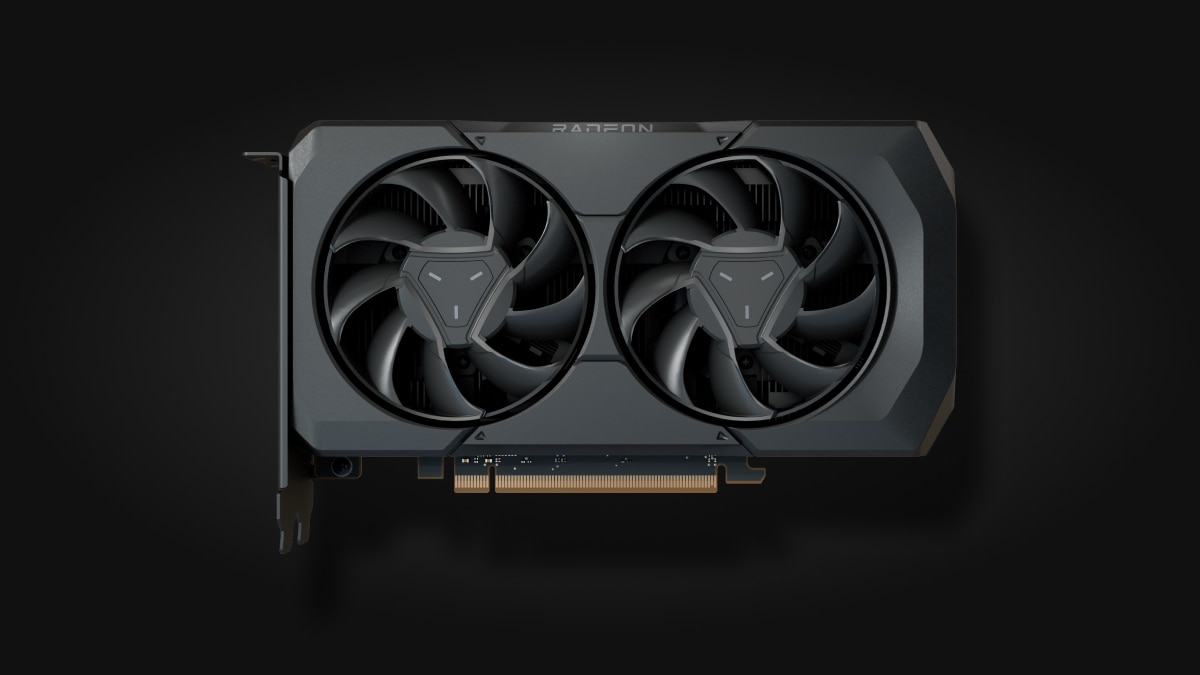
AMD Radeon RX 7600 Graphics Card
A Radeon card gives readers a practical comparison point for the open-source RADV driver stack. It belongs in this section as a Linux gaming alternative rather than a direct substitute for Intel driver testing.
As an Amazon Associate I earn from qualifying purchases.
If you are evaluating hardware for a Linux gaming PC, descriptor heap support should be one checkbox in a larger comparison. Look at the distribution you plan to run, the Mesa version it ships, whether you are comfortable using newer kernels, and how well your preferred games behave through Steam Play. A driver feature can matter a lot, but it rarely matters in isolation.
For developers and testers, the feature landing in ANV is more immediately useful. It provides a path to test Intel’s behavior against VK_EXT_descriptor_heap and compare it with RADV and NVIDIA implementations. That feedback is usually what turns experimental driver support into something users can rely on.
The Bottom Line
Intel ANV gaining VK_EXT_descriptor_heap support is a meaningful step for the open-source Vulkan driver used on Intel Linux systems. It brings Intel closer to feature parity with other major Vulkan drivers in an area that could matter for modern rendering and Direct3D 12 translation through VKD3D-Proton.
The important caveat is that this is still experimental. For most users, the practical advice is to watch Mesa 26.2 development, avoid treating the feature as a finished performance upgrade, and wait for broader testing before drawing conclusions about game-level benefits.
For Intel Arc owners, though, this is another sign that the Linux Vulkan stack is still moving in the right direction. The value will become clearer once the implementation is tested more widely and, if it proves stable, exposed without the experimental flag.

ASUS Dual GeForce RTX 5060 8GB
An RTX 5060 card fits readers who prefer NVIDIA’s proprietary driver stack and want to compare it against Intel ANV and AMD RADV. It should be framed as a driver-family choice, not as a descriptor-heap shortcut.
As an Amazon Associate I earn from qualifying purchases.