

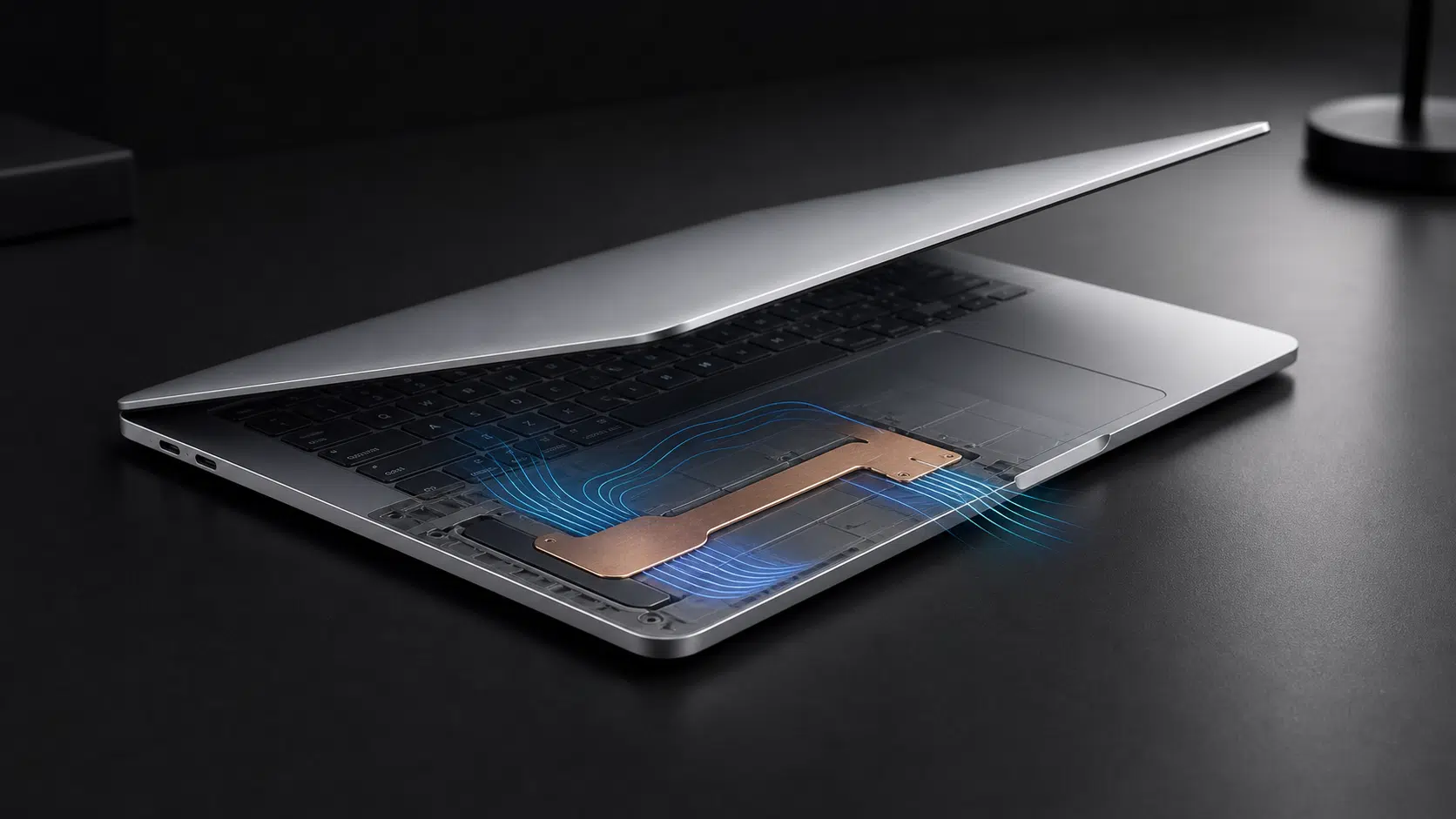

Apple’s next major MacBook Pro redesign is already expected to bring bigger visible changes, including a thinner body and OLED display on higher-end models. A newer rumor, however, points to a less glamorous upgrade that may matter just as much for buyers who push their laptops hard: a new cooling system.
The latest claim is that Apple’s redesigned 14-inch and 16-inch MacBook Pro models with M6 Pro and M6 Max chips could move from the current heatpipe-style cooling approach to a vapor chamber design. Apple has not confirmed the change, and the rumor appears to come from online supply-chain chatter rather than an official source, so it should be treated as possible rather than settled.
Why A Vapor Chamber Would Make Sense
The current Apple Silicon MacBook Pro design has delivered strong performance, but sustained workloads are where cooling still matters. Video exports, software builds, 3D rendering, local AI tasks, and long gaming sessions can all keep the CPU, GPU, memory, and storage under load for extended periods. When heat builds up faster than the chassis can move it away, clock speeds can become harder to sustain.
A vapor chamber would not automatically make the M6 MacBook Pro faster in every task. Short bursts already favor Apple Silicon because the chips can ramp quickly and finish light work before thermals become a problem. The more interesting question is whether a new cooling layout could help the laptop hold higher performance for longer when the system is under pressure.
That possibility lines up with the broader redesign rumors. Thinner laptops have less internal volume to work with, which can make thermal design more difficult. A vapor chamber can spread heat across a wider area than a narrow pipe, potentially giving the fans and chassis more surface area to work with.
The Upgrade May Not Come To Every M6 MacBook Pro
Reports around the M6 MacBook Pro lineup have repeatedly suggested that Apple may split the redesign by tier. The base M6 MacBook Pro is expected by some reports to keep a more familiar design and mini-LED display, while the M6 Pro and M6 Max versions may be the models that get the larger redesign, OLED screen, and thinner chassis.
If that split is accurate, the rumored vapor chamber may also be aimed mainly at the higher-performance configurations. That would make practical sense. The Pro and Max chips are the models most likely to be bought by users who sustain heavy workloads, connect external displays, edit large media projects, or run demanding developer and creator workflows.

Apple 14-inch MacBook Pro with M5 Pro
The 14-inch MacBook Pro with M5 Pro is the most natural current alternative for developers, editors, and creators who need a capable portable Mac now. It keeps the focus on sustained professional workloads without jumping straight to the largest chassis.
As an Amazon Associate I earn from qualifying purchases.
For buyers, the important point is simple: do not assume every laptop with an M6 badge will share the same thermal design. Apple often separates features by chip tier, and the cooling system could become another difference between the entry model and the more expensive professional configurations.
What It Could Mean For Real-World Performance
A better cooling system would be most useful in areas where heat builds gradually. The potential benefits are not just about benchmark peaks, but about stability during long tasks.
- More consistent CPU and GPU performance during sustained workloads
- Less aggressive throttling when exporting video, compiling code, or rendering graphics
- Better thermal headroom in a thinner chassis
- Potentially improved cooling for nearby board components, depending on the final design
The original rumor also raises the possibility of board-wide thermal improvements, including better handling of heat from fast SSD components. That detail has not been independently confirmed, so it is better read as an expectation around what a more ambitious cooling system could address, not as a known Apple specification.
There is also discussion around improved thermal interface materials, including phase-change pads such as PTM7950. Those materials are known in enthusiast laptop circles, but there is no reliable confirmation that Apple plans to use a specific compound or pad in future MacBook Pro models.
Worth Waiting For?
For most everyday users, the current MacBook Pro lineup is already fast enough that a cooling redesign alone should not drive an upgrade decision. The rumor matters more if your work keeps the machine hot for long periods or if you are already waiting for the expected OLED redesign.
The safer buyer takeaway is to wait for confirmed teardown details and sustained-performance testing before treating vapor chamber cooling as a guaranteed feature. If Apple does make the change, it could be one of the more meaningful upgrades in the M6 Pro and M6 Max generation, even if it is hidden inside the chassis.
Apple 16-inch MacBook Pro with M5 Pro
The 16-inch MacBook Pro with M5 Pro is a better fit if your work benefits from a larger display and a bigger professional laptop chassis. It is the closest current match for readers weighing sustained performance over maximum portability.
As an Amazon Associate I earn from qualifying purchases.