


For anyone considering Meta smart glasses, the privacy question is no longer only about cameras in eyewear. It is also about what the required companion app may already contain on the phone paired with those glasses.
A recent technical analysis attributed to security researcher Buchodi, alongside related reporting, says Meta’s Stella companion app for Ray-Ban and Oakley smart glasses included components that resemble a dormant facial-recognition system. The reported findings include on-device AI models, database structures for person profiles, a faceprint-style vector index, and notification text that would tell a wearer when a person had been recognized.
Those details have not been independently verified by this article. They should be treated as reported findings from app reverse engineering, not as a confirmed statement that Meta has enabled face recognition for ordinary users.
That distinction matters for buyers. A feature can be present in code without being active in the product. But presence still changes the trust calculation, especially when the product is eyewear that can record people in public.
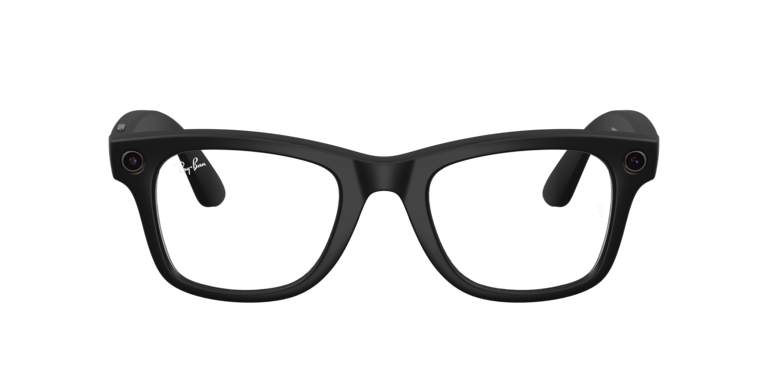
Ray-Ban Meta Wayfarer Gen 2 Smart Glasses
Ray-Ban Meta Wayfarer Gen 2 is the current mainstream Meta smart-glasses option for hands-free photos, video, calls, audio, and Meta AI features. Before buying, review the companion app requirements, camera indicators, data controls, return policy, and whether the glasses fit the places you plan to use them.
As an Amazon Associate I earn from qualifying purchases.
Buyer Verdict
If you are buying Meta smart glasses mainly for hands-free photos, video, calls, music, or AI assistance, the reported face-recognition code does not prove that those glasses are currently identifying people around you. The available reporting says the feature was not active on a standard account and that the relevant user-facing interface did not appear for unenrolled users.
That is the strongest reason not to overstate the finding.
But if your buying decision depends on privacy, workplace compliance, family use, travel, schools, events, or public-facing environments, the reported code is significant enough to pause over. The concern is not simply whether the feature is live today. The concern is whether the product ecosystem has already been engineered to support a feature many people would expect to be disclosed before it reached their phones.
For privacy-sensitive buyers, the practical verdict is straightforward: treat Meta smart glasses as a camera-enabled wearable from a company actively exploring face-recognition use cases, and do not buy them unless you are comfortable with that direction.
What Was Reported Inside the App
The technical report says the Android build examined was version 273.0.0.21 of Stella, the app used with Meta’s Ray-Ban and Oakley smart glasses. According to that analysis, the app package contained three AI models associated with a face-recognition pipeline.
The models were described as SCRFD, for detecting faces; KPSAligner, for aligning a detected face using facial keypoints; and SFace, for converting an aligned face into a numeric biometric embedding. The analysis also described the SFace model in Stella as larger than a public reference version and producing a 2048-dimension output. Those model names, sizes, and dimensions are reported technical findings and have not been independently reproduced here.
The same report says the app contained a database namespace called person_profiles, stored under Meta’s cross-device sync framework, RLDrive. The reported schema included named person records, face records linked to people, and a vector table dimensioned for 2048 floating-point values using cosine-distance search.
In plain terms, the reported design would be capable of storing a mathematical representation of a face, comparing a new face against stored representations, and returning a matching person’s name. That is not the same as proving the system was active for consumers, but it is more specific than a stray label or unused string.
| Reported component | Reported role | Buyer relevance |
|---|---|---|
| Face detection model | Finds a face in an image frame | Suggests the system is built around people, not only general scene understanding |
| Face alignment model | Crops and normalizes a detected face | Prepares images for more reliable comparison |
| Face embedding model | Creates a numeric face representation | Raises biometric-data concerns if used with real people |
| Person profile database | Links face records to names | Points toward identity-based recognition rather than anonymous detection |
| Recognition notification | Alerts the wearer after a match | Shows how recognition could surface in the product experience |
What The Report Does Not Prove
The most important limit is activation. The researcher reportedly did not see the face-recognition feature appear on a normal unenrolled account, and did not observe Meta pushing face data into the reported person_profiles database during testing.
That means the finding should not be described as proof that every Meta smart glasses user has been running active face recognition in the background. The better reading is narrower: the app reportedly contained a coherent set of inactive components that could support such a feature.
Meta’s reported response was that the findings reflected development work, not a shipped consumer feature, and that no final decision had been made. The company was also reported as saying it was not secretly building a central biometric database of users’ faces. Those statements are attributed to Meta in the underlying reporting, but this article has not independently verified the full exchange.
For buyers, this is the key line: dormant is not the same as active, but dormant is also not the same as absent.
Why This Matters More With Smart Glasses
Face recognition on a phone is sensitive. Face recognition on glasses is different because the camera points wherever the wearer looks. People nearby may not notice the camera, may not know whether recording is happening, and may have no meaningful way to consent to identification.
That is why the reported feature matters even before any public launch. A pair of smart glasses is not only a personal gadget. It is a device used around coworkers, children, strangers, customers, patients, students, and bystanders. The privacy issue belongs not only to the buyer, but also to everyone the buyer may record.
The source material also places the report in a longer history. Meta previously shut down Facebook’s photo-tagging face-recognition system and announced the deletion of more than one billion faceprints. The company has also faced major biometric privacy settlements in Illinois and Texas. Separate reporting has said Meta considered face recognition for smart glasses years earlier and later revived planning around a feature reportedly known as NameTag.
Some of that surrounding history comes from earlier reporting and legal outcomes; some details about internal plans remain reported rather than confirmed by this article. Still, the broader pattern explains why a dormant implementation inside a widely distributed app would draw scrutiny.
What To Check Before Buying
A buyer does not need to reverse-engineer an Android app to make a practical decision. The questions are simpler.
- Do you trust Meta to give clear notice before enabling identity-related features on smart glasses?
- Would you use the glasses in places where people reasonably expect not to be identified or recorded?
- Are you buying for a workplace, school, clinic, event space, or regulated environment?
- Do you need smart glasses now, or can you wait until Meta clarifies whether NameTag or a similar feature will launch?
- Would the people around you be comfortable with the device if they knew facial-recognition infrastructure had reportedly been present in the companion app?
If those questions make the purchase feel complicated, that is useful information. Smart glasses are not only judged by camera quality, battery life, audio, and style. They also need to be judged by how clearly the company explains what the system can see, store, infer, and identify.
The Practical Privacy Tradeoff
Meta’s smart glasses are attractive because they make capture and assistance feel frictionless. That is the product promise. You can take a photo without pulling out a phone, record from a first-person view, listen to audio, take calls, and use AI features through eyewear that looks closer to normal glasses than a headset.
That same convenience is also the risk. The easier a camera is to wear, the more important disclosure and control become.
The reported Stella findings do not prove a live consumer face-recognition rollout. They do, however, suggest that buyers should think beyond the feature list printed on the product page. A privacy-conscious review has to include not only what the glasses do today, but what the surrounding software stack appears prepared to do later.
The most buyer-relevant question is not whether Meta can technically build face recognition into smart glasses. The reported code analysis suggests that capability is plausible. The better question is whether the company will make any such feature opt-in, visible, limited, locally controlled, legally compliant, and understandable to both wearers and bystanders.
Until Meta gives a clearer public answer, the cautious buying position is to assume that facial recognition remains an unresolved product risk, not a finished consumer benefit.