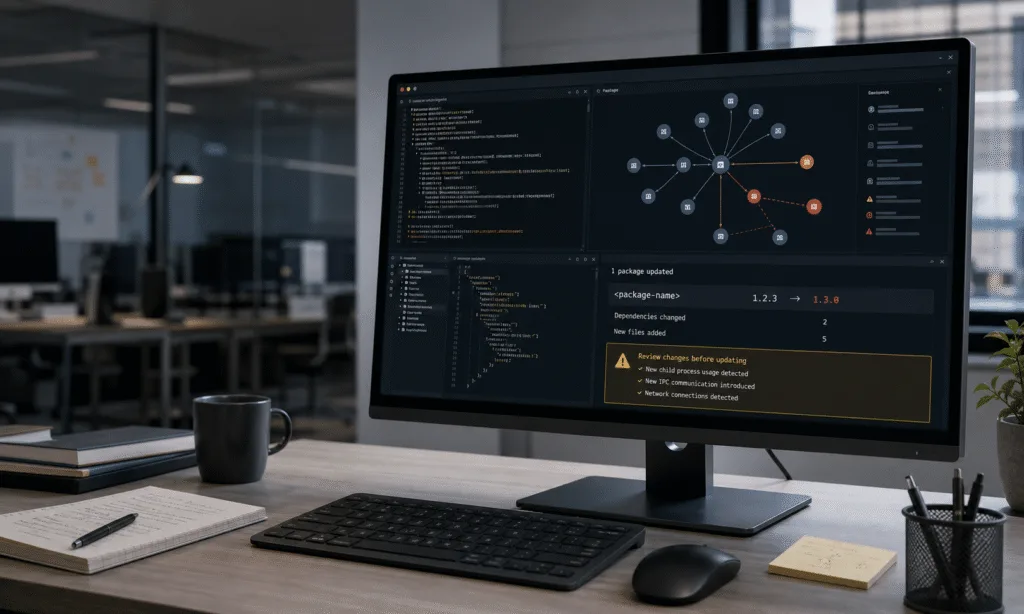
Security firms Socket and StepSecurity said three versions of the npm package node-ipc published on May 14, 2026, contained obfuscated credential-stealing code. The releases identified were 9.1.6, 9.2.3 and 12.0.1, with reported capabilities to collect sensitive files and environment variables and attempt to transmit them outside affected systems.
The reports concern updates to an established inter-process communication library for Node.js. Projects can include node-ipc directly or receive it through another dependency, extending the potential exposure to applications whose developers did not explicitly select the package.
Reported payload executes when the CommonJS bundle loads
The technical analyses describe malicious code appended to node-ipc.cjs after the legitimate bundled code. The reported execution path begins when an application loads that CommonJS file, including through require(‘node-ipc’). It does not depend on npm preinstall, install or postinstall scripts.
Socket said the package’s ES module entrypoint did not contain the appended payload. Exposure therefore depends on which file an application and its dependencies load. Using ES modules in an application does not establish that every dependency avoids the malicious CommonJS entrypoint.
The reported collection targets include cloud credentials, SSH keys, Kubernetes configuration, package-manager tokens, GitHub CLI settings, Terraform files, database configuration and shell history. Analysts also described collection of process environment variables and host information, with the gathered material packaged into a gzip-compressed tar archive.
Socket and Datadog’s security researchers described attempted transmission through DNS TXT queries carrying encoded archive data. Their analyses identified sh.azurestaticprovider.net:443 as a remote DNS endpoint. Port 443 carries DNS traffic in that execution path. The payload reportedly resolves the endpoint through public DNS resolvers before directing the data-bearing queries to the resulting address.
The analyses also describe a detached Node.js child process that allows collection to continue separately from the importing application. The reported trigger requires loading the malicious file; installation alone does not demonstrate that collection ran or that transmission succeeded.
A claimed execution restriction remains disputed. StepSecurity described a hash check as limiting execution in version 12.0.1, with broader execution in the two 9.x releases. Socket instead described an identical malicious CommonJS file across all three versions and a filename-dependent branch affecting module exports. These conflicting assessments do not establish that 12.0.1 executes only in one targeted environment.
Publishing access is under scrutiny
StepSecurity identified atiertant as the npm account used to publish the three releases. The account was listed as a co-maintainer but had no previous node-ipc publishing history in the records examined by researchers. It was separate from riaevangelist, the account associated with original author Brandon Nozaki Miller.
Depi proposed that an expired email domain could have enabled an account takeover. Its researchers linked the account’s contact address to atlantis-software.net, which they said had lapsed and been registered again with email reception configured. Their hypothesis was that control of the domain could have allowed someone to receive an npm password-reset message.
Depi explicitly said it had not observed a password reset or the suspected attacker’s mailbox. The mechanism by which publishing access was obtained, and the identity of whoever uploaded the payload, remain unconfirmed.
Package has a separate history of malicious releases
In March 2022, node-ipc versions 10.1.1 and 10.1.2 contained destructive code that overwrote files on systems identified as being in Russia or Belarus. Original maintainer Brandon Nozaki Miller introduced that functionality during Russia’s invasion of Ukraine.
Subsequent releases, including 11.0.0 and 11.1.0, included the peacenotwar dependency and protest-related file-writing behavior. Those historical releases involved different behavior from the credential collection reported in May 2026.