RadianX says it has raised $5 million in seed funding to finance a commercial-volume production line for solar technology aimed at portable electronics and connected devices. The startup’s goal is to reduce charging needs by harvesting light both indoors and outdoors.
The company identified SOSV and Twynam as the round’s lead investors. It also named One Small Planet, Sachsen Ventures, Avila VC, California Innovation Fund, quantumEDGE, Riceberg Ventures and Alumni Ventures as participants.
Alongside the seed round, RadianX says Pacific Union Technology Precision Manufacturing is contributing $4 million in non-dilutive investment toward a dedicated production line. The manufacturing contribution is separate from the $5 million seed financing.
Indoor light harvesting is central to the plan
RadianX says it has developed a solar material from the perovskite family. The company claims the material performs as well outdoors as existing solar panels and is twice as effective at harvesting light indoors.
“We can harvest any kind of photon, whether it’s an outdoor or indoor photon, and keep the device running longer — or running forever,” said Josh Douglas, RadianX’s co-founder and chief operating officer.
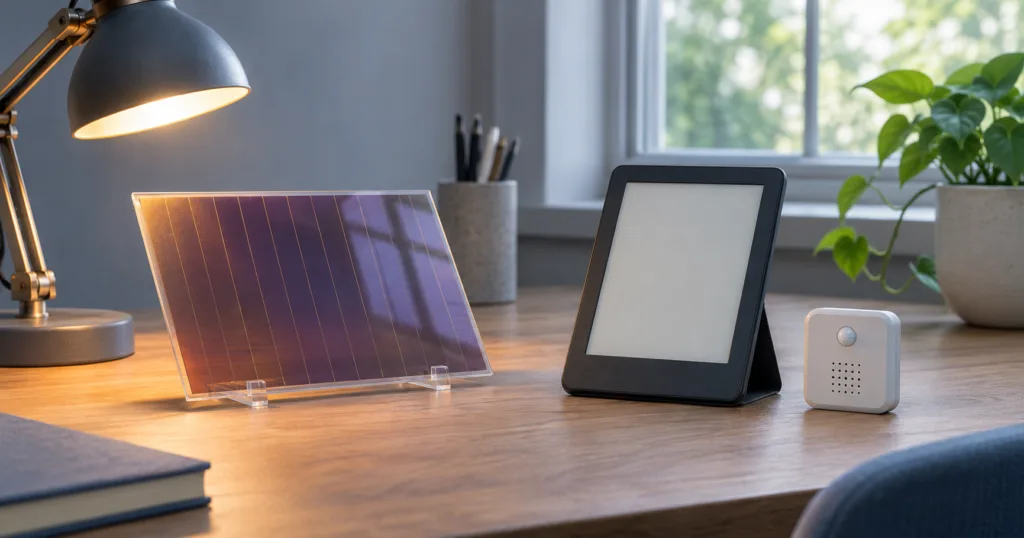
The company calls its approach “edge energy,” pointing to e-readers that could avoid recharging and Internet of Things sensors that could operate without battery swaps. Those are proposed applications of the technology, rather than guarantees for every portable device.
Solar-powered calculators have used light to operate for decades. Applying that approach to more demanding portable electronics has been harder because their power requirements can exceed what traditional solar panels supply.
“It’s power density,” said Vivian Qu, RadianX’s co-founder and chief executive. “The reason why perovskites have been so interesting is the high power density.”
Perovskites have nevertheless faced obstacles to wider adoption. Compared with conventional silicon-based solar panels, the material class has faced higher costs and durability limitations, even as the technology has improved.
Combining solar panels with power electronics
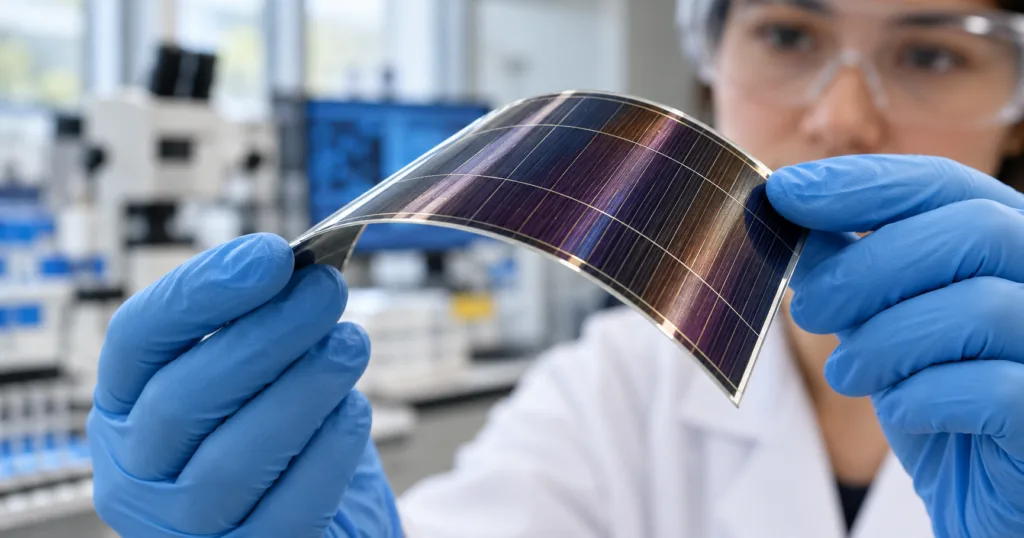
RadianX cites 22.33% conversion efficiency for a panel measuring 1.2 meters by 0.6 meters. The company also says its panels can be as thin as 0.7 millimeters and can be sized to fit different devices.
RadianX says it has met an industry durability standard. Its indoor focus could also limit wear and tear.
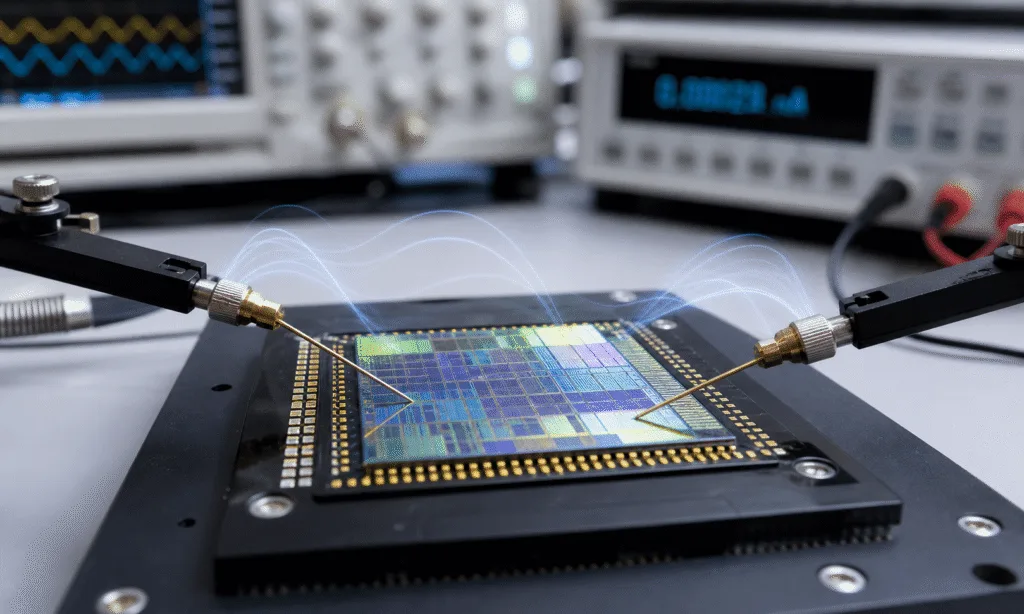
Alongside the solar material, RadianX says it is developing power electronics tailored to perovskites. Qu cited silicon’s different behavior in explaining that work: “silicon has a very different light-soaking characteristic,” she said.
Qu described a strategy of supplying integrated power packages to device makers, rather than selling bare panels. The planned offering would combine the solar material with the electronics being developed to manage its output.
“RadianX is trying to package all of this and sell this to device makers as something they don’t need to worry about,” Qu said.