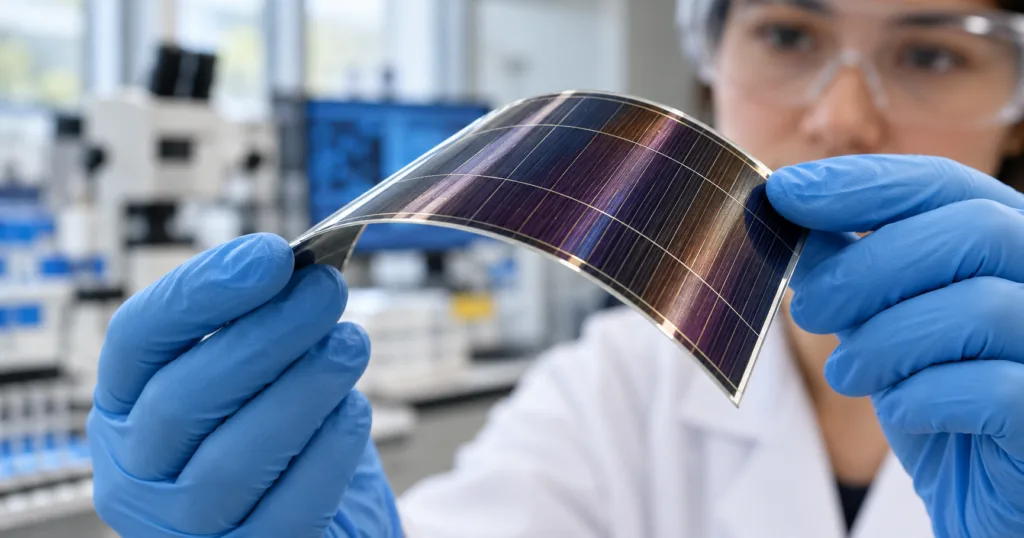
A research team led by Southeast University and Soochow University reports 26.86% power conversion efficiency for small-area flexible perovskite solar cells using a chemical additive designed to reduce interference during fabrication. The researchers describe the result as third-party certified and report efficiencies above 20% for larger flexible modules.
The approach, called decoupled co-deposition, addresses interactions between an ultrathin charge-transport layer and the light-absorbing perovskite material. The team says its additive helps both layers form more uniformly when deposited together on flexible substrates.
Controlling interactions during coating
The fabrication method combines a self-assembled monolayer, or SAM, with the material that forms the perovskite absorber. The SAM serves as a transport layer, while the perovskite captures light for conversion into electricity.
The researchers identify variations in surface roughness and hydroxyl-group density on flexible substrates as obstacles to uniform coating. In their account, depositing the transport-layer molecules and perovskite components together can improve how the coating solution wets the surface, but also creates unwanted chemical interactions.
Those interactions can interfere with the transport molecules attaching to the substrate and with the formation of perovskite crystals, the team says. Its proposed solution is to control those processes within the combined coating solution.
The researchers describe an additive containing ammonium and iodide ions and two sulfonate groups. They say it binds to the perovskite components, limiting their interaction with the SAM molecules.
That separation is intended to let the transport molecules attach to the flexible substrate while the perovskite layer forms. The team also attributes improved crystal growth and fewer defects in the absorber to the additive. These are the researchers’ proposed explanations for the reported device improvements.
Reported efficiency across module sizes
The team reports a small-area cell efficiency of 26.86%, which it describes as third-party certified. Its larger modules produced lower reported efficiencies, with results spanning three sets of dimensions.
| Reported module dimensions | Reported power conversion efficiency |
|---|---|
| 5 × 5 cm | 22.31% |
| 10 × 10 cm | 20.63% |
| 30 × 30 cm | 20.15% |
The 26.86% figure therefore applies to a small-area cell, while the largest listed module, measuring 30 × 30 cm, reached a reported 20.15%. Keeping those measurements separate is necessary when describing the performance of the technology at different sizes.
Power conversion efficiency measures the proportion of incident light power converted into electrical output. The cell and module figures describe efficiency, while the operating tests address how much performance the devices retained over time.
Durability under heat and humidity
For a 25-square-centimeter flexible device, the researchers report retention of 92.5% of its initial efficiency after 1,044 hours of maximum power point tracking at 85°C, equivalent to 185°F, and 65% relative humidity.
The device began that test at 22% efficiency. The reported 92.5% figure describes the share of initial performance retained; it is not a separate power conversion efficiency result. The starting value also differs from the 22.31% result listed for the 5 × 5 cm module.
The team additionally reports thermal cycling tests and says its flexible modules passed a stability testing series under IEC 63163. Those statements remain attributed research claims rather than independently established certification findings here.
The coating method targets a manufacturing problem: forming consistent transport and absorber layers over larger flexible surfaces. The reported module measurements and operating tests provide results for the devices examined, but do not establish reliable commercial-scale production or a timetable for deployment.