

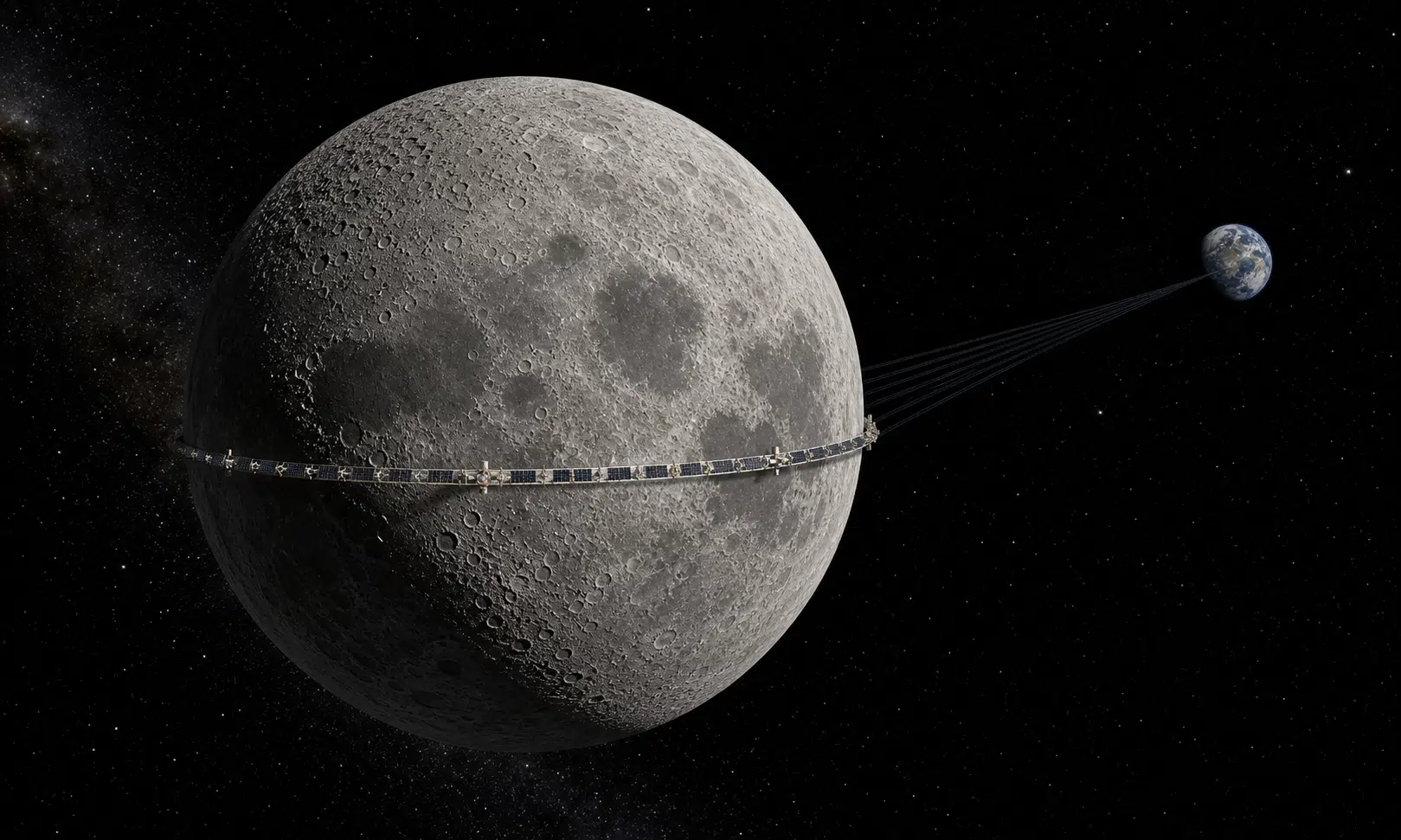

A Japanese construction company has proposed one of the boldest clean-energy ideas on the table: a solar power belt around the Moon’s equator that would collect sunlight and send usable energy back to Earth.
The idea is called Luna Ring. It is not a government-approved construction project, and it is not close to breaking ground. It is a concept from Shimizu Corporation, built around a simple but difficult question: if solar power on Earth is limited by night, weather, land use, and grid storage, could some of that work be moved into space?
The answer is not “yes” in any practical commercial sense yet. The plan depends on lunar construction, massive power transmission systems, robotics, receiving stations on Earth, and safety rules that do not currently exist at deployment scale. Still, the proposal keeps resurfacing because it sits at the edge of a serious field: space-based solar power.
What the Luna Ring concept actually proposes
The Luna Ring concept would place solar cells along the Moon’s equator. Shimizu describes a solar belt extending around roughly 11,000 kilometers of lunar equator, with a width that could range from a few kilometers to as much as 400 kilometers at its broadest point.
That scale is hard to translate into everyday terms. It is not a solar farm. It is a planetary infrastructure proposal.
The system would use lunar solar cells to generate electricity, move that power by cable to a transmission base on the side of the Moon facing Earth, and then convert the energy into microwave or laser beams. On Earth, receiving facilities would convert the beamed energy into electricity for the grid or use it to produce hydrogen for fuel and storage.
| Part of the concept | What it would do |
|---|---|
| Lunar solar belt | Collect sunlight along the Moon’s equator |
| Transmission cable | Move electricity across the lunar surface toward an Earth-facing base |
| Microwave antenna or laser base | Send energy toward Earth as a controlled beam |
| Earth receiving station | Convert the beam back into electricity or support hydrogen production |
The proposal also imagines using lunar materials where possible. Shimizu suggests that lunar sand and other surface resources could help make materials such as concrete, ceramics, glass, oxygen, water, and possibly solar-cell components. Those are concept claims, not proof that an industrial lunar supply chain is ready.
For households and businesses comparing clean-energy options today, the practical conversation is still much closer to Earth: solar panels, battery storage, demand management, and backup power. Luna Ring is more useful as a window into long-range energy planning than as a near-term buying decision.
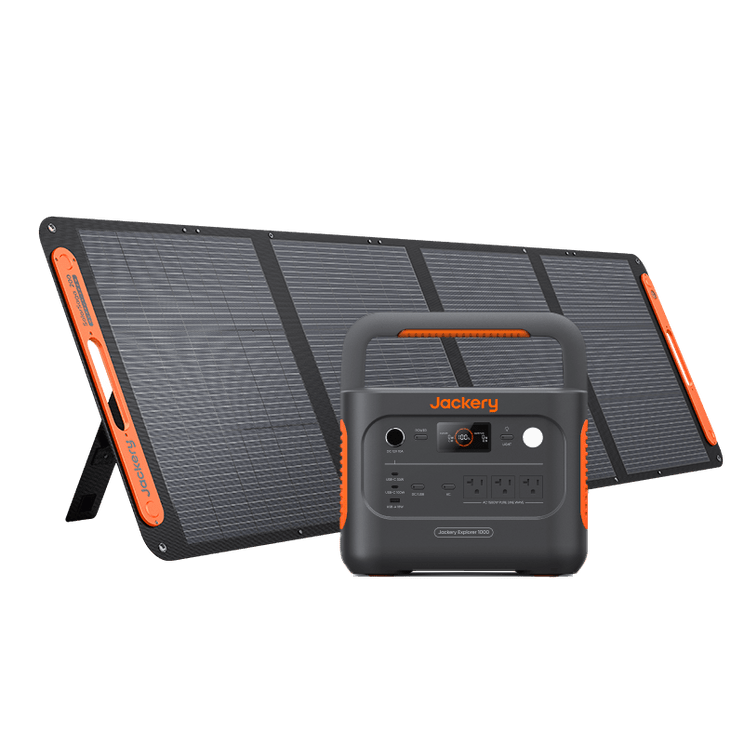
Portable Solar Generator Kit
A portable solar generator can keep small devices, routers, lights, or select appliances running during short outages or off-grid use. It is a realistic near-term option compared with speculative lunar power concepts.
As an Amazon Associate I earn from qualifying purchases.
How energy would be sent back to Earth
In the Luna Ring plan, making electricity on the Moon is only one piece of the problem. The more delicate step is transmission. The concept relies on wireless power transfer using either microwaves or laser beams, aimed at receiving facilities on Earth.
This is not a brand-new idea. Space solar power studies have discussed converting sunlight into electricity, then into microwaves, and sending it to a ground receiver called a rectenna for decades. Japan’s space agency has also studied space solar power systems, including microwave and laser transmission technologies.
Microwaves and lasers have different tradeoffs. Microwave transmission is often discussed because it can be received by large antenna arrays and is less affected by clouds than optical beams. Laser transmission can be more tightly focused, but that precision also raises hard questions about pointing accuracy, weather, aircraft, satellites, and safety controls.
None of this means a lunar power beam is ready for the commercial grid. A full system would need to prove that it can send energy efficiently, avoid unintended exposure, operate through atmospheric conditions, and shut down safely if alignment or equipment fails.
Why the Moon is attractive, and why it is awkward
Advocates point to the Moon because it lacks a substantial atmosphere. There are no clouds or storms in the terrestrial sense to interrupt sunlight at the surface. That makes the Moon appealing in theory for solar collection.
But the Moon is not a place of easy, constant sunlight for any one fixed location. A single area on the lunar surface has a long cycle of daylight and darkness, roughly two weeks of each. The ring design is meant to address that by spreading generation around the lunar equator, so the concept assumes some parts of the belt could be producing while others are dark.
That assumption creates its own engineering burden. If power is being generated far from the Earth-facing transmission base, the system needs long power lines, maintenance routes, and equipment that can survive lunar dust, radiation, temperature swings, and long periods without direct sunlight.
The Moon is also a difficult place to repair hardware. A failed inverter, cracked panel, damaged cable, or misaligned transmitter is routine work on Earth. On the Moon, the same problem becomes a robotics, logistics, and mission-planning problem.
The scale problem is bigger than the science
The biggest weakness in the Luna Ring idea is not that solar power is impossible in space. Solar panels already power spacecraft, and wireless power transfer has been demonstrated in experimental forms. The gap is scale.
Shimizu’s concept describes an equatorial solar belt thousands of kilometers long. It also describes a microwave transmission antenna 20 kilometers in diameter, along with laser transmission bases, receiving stations on Earth, transport routes, lunar robots, and some human involvement.
That is far beyond a laboratory demonstration. It would require low-cost space transportation, durable autonomous construction machines, large-scale lunar manufacturing, international agreements over energy beams, and commercial economics that can compete with other clean-energy options.
For grid operators, the benchmark is not whether the idea is impressive. It is whether delivered electricity can be safe, reliable, dispatchable, insurable, and affordable compared with terrestrial solar, wind, nuclear, geothermal, batteries, transmission upgrades, and other available tools.
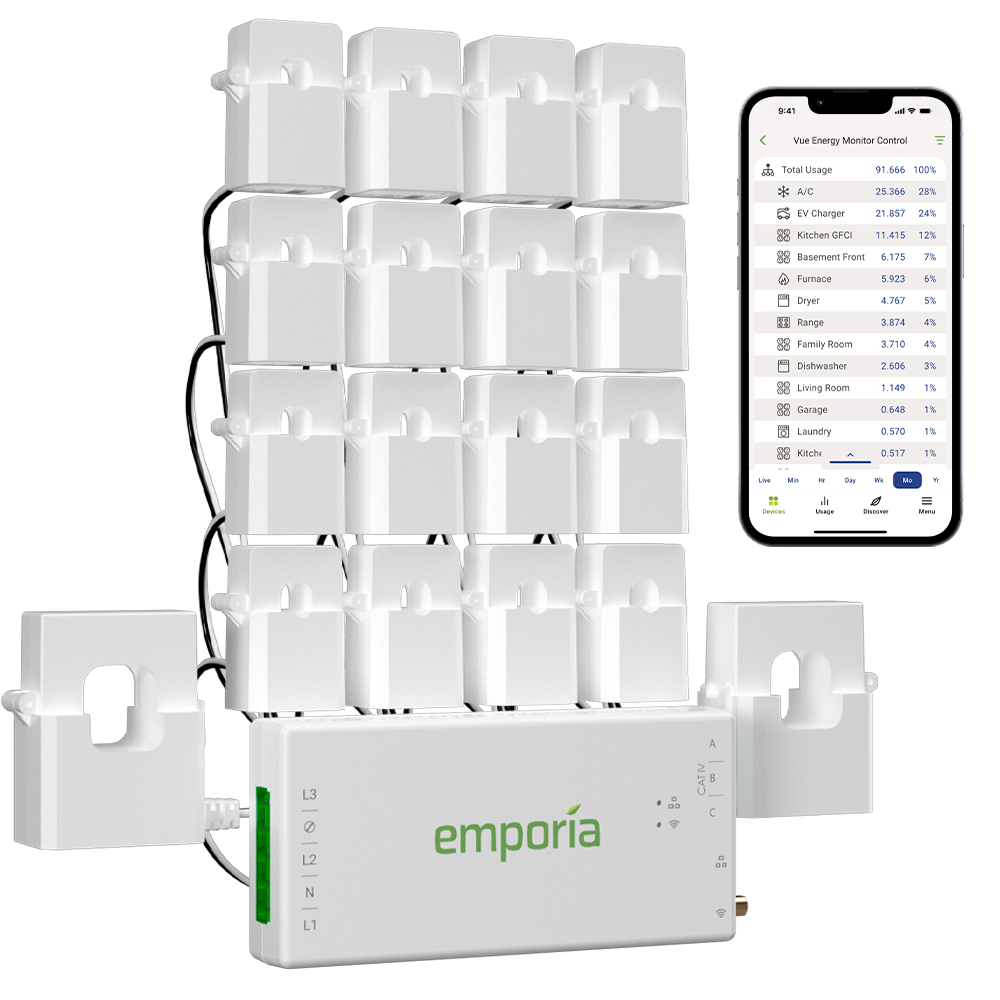
Home Energy Monitoring System
A whole-home energy monitor helps readers see how electricity is used across major circuits, which can support smarter load shifting and efficiency decisions.
As an Amazon Associate I earn from qualifying purchases.
What current space solar tests really show
Recent research makes the Luna Ring concept feel less like pure fiction, but it does not validate lunar construction at this scale.
Caltech’s Space Solar Power Demonstrator showed wireless power transmission in space and detected a small transmitted signal on Earth. That is an important milestone because it tests pieces of the wireless transfer problem in orbit. It is also tiny compared with a power plant.
The useful lesson is narrower: lightweight deployable structures, solar cells, and wireless transmission arrays are being tested in real space conditions. Those tests can inform future designs for orbital solar power systems. They do not show that a Moon-circling solar belt can be built, maintained, or priced for energy markets.
Europe has also been studying space-based solar power through ESA’s SOLARIS effort, with attention to technical feasibility, safety, economics, and how radio-frequency transmission would behave through the atmosphere. That kind of work matters because public acceptance and regulation could become as important as engineering.
What buyers and energy planners should take from it
The Luna Ring proposal is best read as a long-range infrastructure concept, not a coming utility product. It highlights real problems in clean energy: intermittency, storage, land constraints, and the difficulty of matching renewable supply to demand. It also shows how extreme the solutions become when planners try to remove weather and nightfall from the equation altogether.
For anyone making energy decisions now, the practical path remains grounded. Rooftop solar, community solar, utility-scale solar, batteries, heat pumps, efficient appliances, and smarter controls are available in a way lunar energy is not. Space solar may become part of the future research mix, but it is not a substitute for investments that can cut bills and emissions this decade.
The interesting part of Luna Ring is that it forces a useful distinction. The physics of collecting solar energy beyond Earth is plausible. The business case, construction plan, safety framework, and maintenance model for an 11,000-kilometer lunar solar belt are still unresolved.
That makes the proposal both fascinating and distant: not a hoax, not a project ready to power homes, and not something to treat as inevitable. It is a serious-looking sketch of a future energy system that would need many smaller breakthroughs before it could become more than an ambitious drawing.