

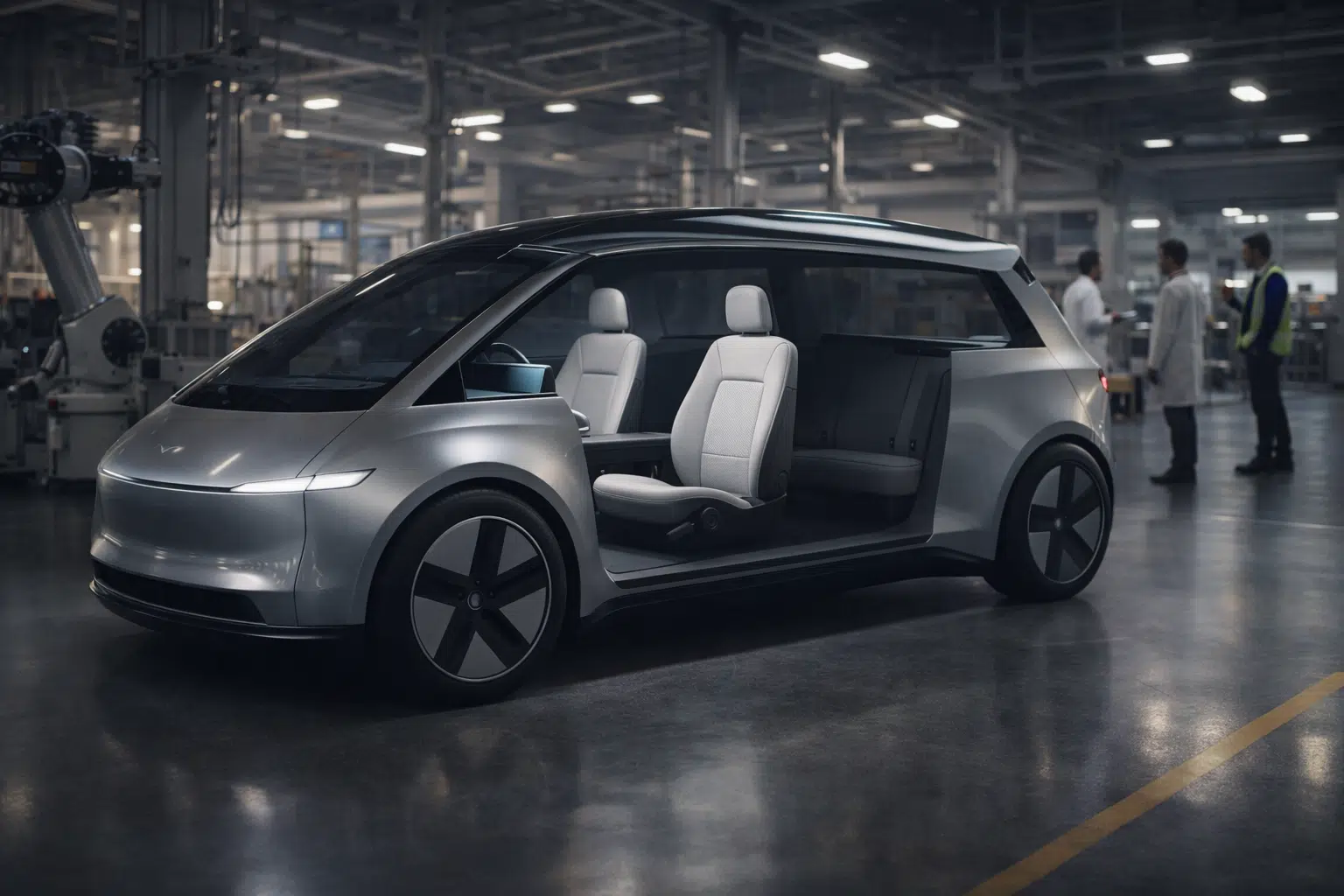

Tesla says it has built the first Cybercab at Gigafactory Texas, a milestone that puts the company one step closer to starting production of its autonomous two-seater in April 2026. The Cybercab—unveiled at Tesla’s robotaxi event in October 2024—is designed to operate without a steering wheel or pedals, making it Tesla’s boldest bet yet on fully driverless mobility.
Tesla’s official X account shared a photo showing employees gathered around the first Cybercab unit, and CEO Elon Musk congratulated the team on the achievement. Musk has also reiterated that Cybercab production “starts in April,” signaling that Tesla expects the vehicle to move from prototype showcase to real manufacturing cadence soon.
👉 Browse books on autonomous vehicles (Amazon search)
(Affiliate link: using this link may earn a commission.)
A vehicle designed to skip the driver entirely
The Cybercab’s defining feature isn’t its size—it’s the absence of traditional controls. Tesla’s vision is a car that relies on its camera-based autonomy stack rather than a human driver, eliminating the fallback of steering-wheel intervention. That approach is also what makes Cybercab such a high-stakes product: getting to a safe, regulator-approved “no driver” experience is far harder than shipping a new EV with a different body style.
Tesla has long argued it can achieve autonomy with a vision-first system. But how Cybercab’s launch unfolds will depend on more than hardware—it will hinge on software performance, operational safeguards, and the pace of approvals for truly driverless deployment.
Robotaxi ambitions, and a crowded competitive field
Cybercab is Tesla’s clearest shot at competing with dedicated robotaxi operators like Waymo, which already runs commercial autonomous ride services in select U.S. markets. Tesla has discussed and tested ride-hailing concepts for years, and while it has run limited pilots (with Austin often cited as a focal point), the company hasn’t yet rolled out a broadly available, fully driverless public service across multiple U.S. cities.
That’s why “first Cybercab built” matters: it’s a tangible step toward the vehicle Tesla wants at the center of its autonomy business—not just a software update riding on consumer cars.
“Unboxed” manufacturing, and why Tesla thinks this can scale
Musk has linked Cybercab to Tesla’s proposed “Unboxed” manufacturing approach, which would assemble large vehicle modules separately before integrating them, rather than relying on a traditional linear assembly line. Tesla’s pitch is that this could lower cost, shrink factory footprint, and accelerate output once the system is tuned.
Even so, Musk has also tried to temper expectations about early production. New vehicles typically ramp slowly, and Cybercab is especially unusual because so much of it—design, processes, and manufacturing steps—is expected to be new. The likely reality is a cautious early curve before Tesla attempts a faster scale-up once quality and throughput stabilize.
What to watch next
If Tesla does begin Cybercab production in April 2026, the next key questions will be practical ones:
- How quickly can Tesla build meaningful volumes?
- What operating model will it use for early deployments?
- How will it demonstrate safety and reliability without conventional driver controls?
- And how soon can Tesla translate a factory milestone into a real robotaxi service people can actually use?
For Tesla, Cybercab isn’t just another vehicle—it’s a proof point for the company’s entire autonomy thesis.