

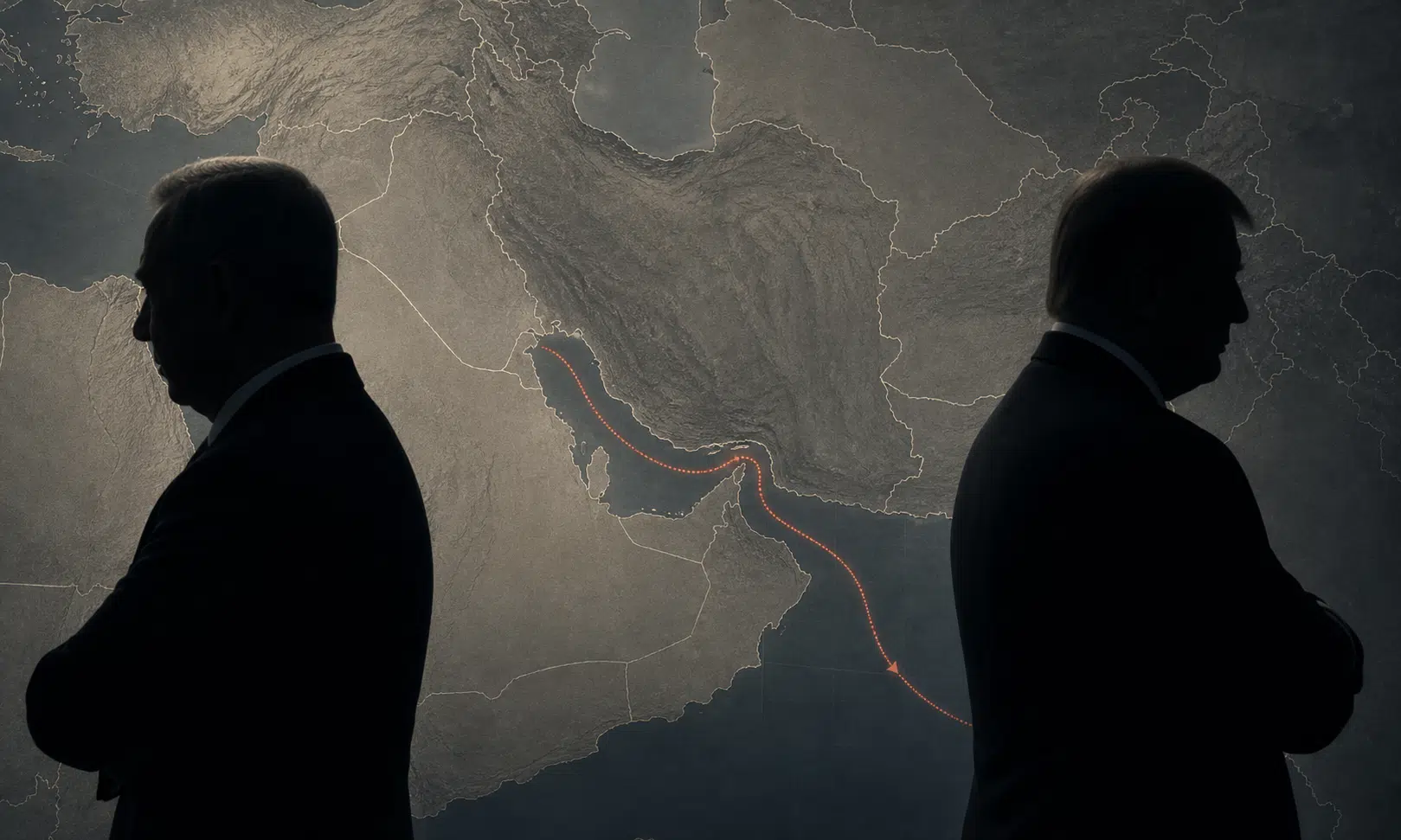

Donald Trump and Benjamin Netanyahu set out with a large ambition: to use military pressure against Iran to change the balance of power in the Middle East.
The region has been changing, but the source analysis argues that it has not moved in the way either leader expected. Instead of a clean strategic win, the conflict has created the risk of a prolonged cycle of pressure, retaliation, negotiation and renewed violence.
That conclusion should be treated as analysis rather than a settled fact. Several details in the original account, including claims about specific military incidents and private strategic intentions, have not been independently verified here. What can be said more carefully is that the article presents the Iran conflict as a test of a familiar assumption: that overwhelming force can quickly produce political results.
A War That Was Supposed to Change the Region
The source frames Trump and Netanyahu as leaders who believed Iran was vulnerable enough to be forced into a decisive retreat. Their shared bet, as described in the article, was that pressure from the United States and Israel could weaken the Islamic Republic and open the way to a new regional order.
That was always a high-risk proposition. Iran has been governed by the Islamic Republic since the 1979 revolution, and its leaders have spent decades preparing for pressure from outside powers. The source argues that Trump and Netanyahu underestimated that resilience. A safer way to put it is that the conflict has exposed the difficulty of turning battlefield strength into political control.
The article also describes both leaders as speaking early in the conflict as if a historic turning point was close. It says Trump addressed Iranians with language suggesting that their opportunity to change government had arrived. It says Netanyahu used similarly forceful language about striking Iran’s ruling system. Those claims about the tone and content of their remarks are presented in the source, but the specific wording should not be treated here as independently verified.
What matters for the analysis is the larger pattern: the campaign appears to have been built around expectations of speed, pressure and collapse. The source’s central argument is that those expectations have not been borne out.
The Strait of Hormuz Became the Central Pressure Point
A major focus of the article is the Strait of Hormuz, one of the world’s most strategically important waterways. The source says the waterway was closed after the US and Israel attacked Iran, and it presents that closure as a key reason the conflict became harder to contain.
Because the article’s specific timeline has not been independently verified here, the safest conclusion is narrower: the Strait of Hormuz is treated in the source as the conflict’s most important economic pressure point. Any disruption there would matter far beyond the immediate combatants because energy shipments and Gulf commerce depend heavily on the route.
The source argues that Iran’s leaders see control or disruption around the Strait as a form of deterrence. In that reading, Tehran’s goal is not only survival. It is also to persuade the United States, Israel and Gulf Arab states that future attacks would carry broad costs.
That argument is plausible as an interpretation, but it should remain an interpretation. The article does not provide independently verified evidence for every internal Iranian calculation it describes. A careful rewrite should therefore avoid stating as fact exactly what Iranian officials believe unless those statements are directly documented.
Why Military Superiority Did Not Settle the Outcome
The United States has unmatched global military reach, and Israel is the region’s dominant military power. The source says Trump and Netanyahu looked at Iran’s economic strain, sanctions pressure, internal unrest and weakened allies, then concluded that the regime was near a breaking point.
Some of those background factors are well established in broad terms. Iran has faced sanctions and economic pressure. Israel has fought Hamas in Gaza and Hezbollah in Lebanon since the Hamas-led attack on Israel on 7 October 2023. Bashar al-Assad’s role in Syria and Iran’s regional network are also part of the strategic picture described by the source.
But the article goes further, arguing that Trump and Netanyahu believed the killing of senior Iranian figures would cause the regime to collapse from within. That claim about their assumptions has not been independently verified here. It is better stated as the source’s interpretation of their strategy.
The broader lesson is less dependent on those disputed details. Wars often begin with a theory of victory that looks clearer before the first strike than it does afterward. Military force can destroy assets, impose costs and change calculations. It cannot always produce surrender, regime collapse or a stable political settlement on the timetable leaders prefer.
Lebanon and the Gulf Became Linked in the Source’s Analysis
The article also argues that Iran has tried to connect events in the Gulf with Israel’s campaign against Hezbollah in Lebanon. In this reading, Tehran’s message to Washington is that talks over the Gulf and Iran cannot be separated from Israeli action in Lebanon.
That linkage is central to the source’s explanation of why diplomacy has been difficult. It says Trump restrained an Israeli plan to attack Beirut because a deal was believed to be near, while Netanyahu rejected the idea that Lebanon and the Gulf should be treated as connected fronts.
Those operational claims have not been independently verified here, so they should be handled cautiously. The safer point is that the article portrays a widening conflict in which separate arenas are increasingly difficult to isolate. Once multiple fronts are tied together, a decision in one place can affect negotiation space somewhere else.
For Israel, that creates a strategic problem if its priority is to keep pressure on Hezbollah while Washington’s priority is to reduce the wider cost of the Iran conflict. For the United States, it creates a different problem: diplomacy with Iran may require constraints on an ally that has its own war aims.
Gulf States Face the Economic Fallout
The source gives particular attention to Gulf Arab states. These countries have built their future plans around stability, trade, tourism, finance, energy and large-scale investment. A prolonged regional crisis cuts directly against that model.
The article argues that the damage is not limited to lost revenue from oil, petrochemicals or related industries such as fertiliser. It is also reputational. Investors and tourists respond to risk, and a region marketed as a stable business hub becomes harder to sell when conflict threatens shipping lanes and nearby cities.
That is one of the strongest parts of the analysis because it does not depend entirely on knowing the private thinking of leaders. A long conflict in the Gulf would create costs for countries that depend on predictable movement of goods, capital and people.
The Core Risk Is a Crisis Without a Clean Exit
The article’s sharpest claim is that Trump and Netanyahu may have lost control of the consequences of the war. That should be softened. It is more careful to say that the conflict, as described in the source, appears to have produced consequences that are harder to manage than the original strategy assumed.
The source says Trump wants a way out that can be presented as victory, including some form of deal over the Strait of Hormuz and longer-term negotiations on Iran’s enriched uranium and nuclear plans. That claim about Trump’s intentions has not been independently verified here, but it fits the article’s wider argument: once a quick victory fails to materialize, leaders need a political exit that does not look like defeat.
Netanyahu’s position, as described by the source, is different. The article portrays him as committed to continuing pressure until Iran’s ruling system is badly weakened. Again, that is an interpretation of his strategy rather than a verified statement of intent.
What remains after those caveats is a clear editorial judgment: the campaign described in the source was built around ambitious assumptions, and the results have been messier than those assumptions allowed. Iran has not disappeared as a regional actor. The Gulf has become more exposed. Lebanon remains tied into the wider conflict. Diplomacy has not delivered a clean settlement.
For readers trying to understand the practical stakes, the point is not whether every prediction in the source proves right. The point is that a strategy built on rapid coercion can create a longer problem if the adversary absorbs the pressure, raises the cost of the conflict and forces negotiations onto a broader field.
That is the risk the article calls a permacrisis: not an endless all-out war, necessarily, but a rolling condition in which armed confrontation, economic pressure and diplomacy keep feeding into one another. The term is analytical, not a confirmed outcome. But it captures the central warning of the piece: Trump and Netanyahu wanted to reshape the Middle East through force, and the region may be reshaping itself in ways they cannot easily direct.