

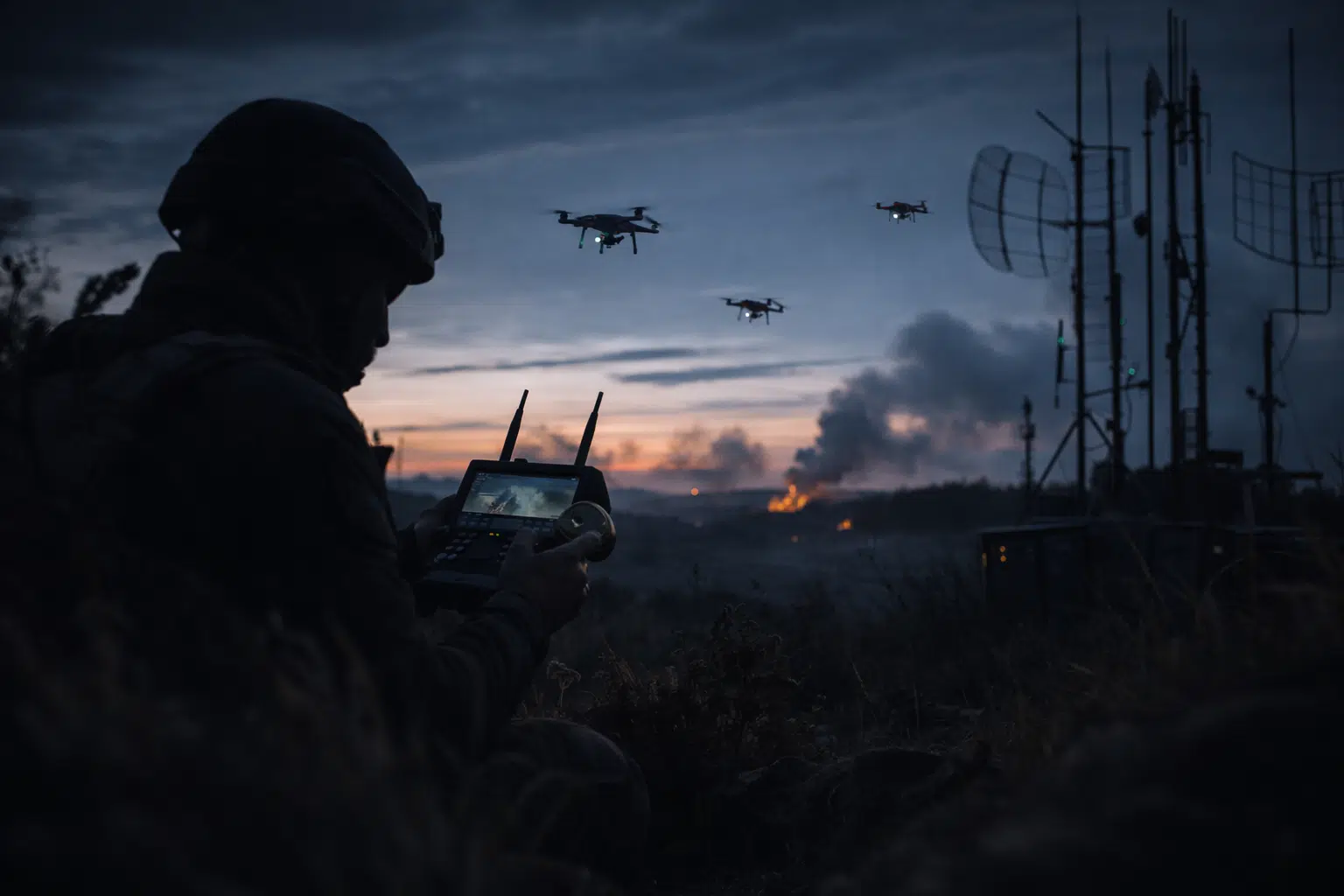

Ukraine’s top general says the country’s drone units are now inflicting losses on Russian troops at a pace that matches—at least by Kyiv’s accounting—Russia’s ability to feed new soldiers into the fight.
In a Telegram post on Tuesday, Ukraine’s commander-in-chief, Gen. Oleksandr Syrskyi, said December 2025 marked the first month in which Ukraine’s uncrewed systems units “neutralized” roughly as many Russian servicemen as Russia “called up” in a month. Syrskyi said Ukrainian video evidence confirmed about 33,000 Russian losses in December, adding that Russia’s “real losses” are higher. Ukraine did not publish the call-up figure Syrskyi referenced, and the claims can’t be independently verified.
What’s clear is that drones have become one of the defining weapons of the war—both sides rely on them heavily, and public assessments and frontline accounts increasingly describe drones as responsible for a very large share of battlefield casualties, though exact proportions vary by time, place, and methodology.
Drones as a workaround for shortages
Ukraine has leaned especially hard on inexpensive first-person-view (FPV) drones, which can be mass-produced, upgraded quickly, and used to strike both infantry and armored vehicles. In a grinding war where manpower and equipment constraints matter, FPV drones have become a practical way to generate effects that once required artillery, armor, or airpower.
Drones do more than direct attacks. They also provide reconnaissance and targeting that can amplify other fires, helping units spot movements, identify weak points, and guide strikes. Even relatively cheap systems can knock out expensive hardware—tanks, air-defense components, and logistics vehicles—when they find the right angle at the right time.
The numbers—and why they’re hard to pin down
Syrskyi’s post offered two key data points:
- ~33,000 Russian “losses” in December, which he said were video-confirmed
- A month-to-month comparison suggesting Ukraine’s drone forces “neutralized” as many Russian servicemen as Russia brought in
Ukraine did not provide the monthly intake number, and Russia does not publish regular, comprehensive casualty statistics for the full-scale war. That makes it difficult to validate the comparison Syrskyi is emphasizing, even if the underlying trend—high attrition driven by drone-centric combat—matches widespread reporting.
Estimates of Russia’s monthly force generation also vary depending on who is speaking and when. A U.S. assessment cited publicly in 2025 put Russian recruiting around 30,000 per month. Russian President Vladimir Putin later claimed the figure was roughly double that. Separately, Ukraine’s military intelligence chief has said Russia met a 2025 recruitment/mobilization target of 403,000, which would average more than 36,000 per month—again, an intelligence assessment rather than a verifiable public count.
Meanwhile, Russia’s manpower pool in Ukraine is typically described as a mix of contract volunteers drawn by pay and incentives, conscripts from draft cycles (with ongoing controversy over how they’re used), and other sources—including documented efforts to recruit from prisons earlier in the war.
“A breakthrough” year—and bigger plans for 2026
Syrskyi framed 2025 as a turning point for Ukraine’s drone war and said Kyiv intends to expand further in 2026.
He also cited internal Ukraine-reported performance increases: in December, he said the number of targets hit or destroyed by drones rose by 31%, and the number of Russian personnel hit rose by more than 25%.
Syrskyi has previously said uncrewed systems account for roughly 60% of enemy targets hit or destroyed (the exact wording varies by context and source), and the share can be higher in certain frontline sectors where drone density is extreme and traditional movement becomes punishingly visible.
A drone arms race in the sky
The drone fight is no longer just about who can build the most FPVs the fastest. It’s increasingly about:
- Electronic warfare and jamming
- Better navigation and anti-jam workarounds
- Smarter targeting and coordination
- Counter-drone defenses (from EW to kinetic intercepts)
Syrskyi warned Russia is scaling its own drone ambitions, saying Moscow has mirrored Kyiv by creating a dedicated branch or structure for uncrewed systems. He claimed Russia’s uncrewed forces total around 80,000 servicemembers, with plans to grow to 165,500 in 2026 and nearly 210,000 by 2030—figures that are not independently verifiable but underscore how seriously both militaries now treat the drone domain.
Ukrainian soldiers have described skies so saturated with drones that identification can be difficult in the moment—turning the air above trenches and treelines into a constant contest of detection, deception, and survival.