

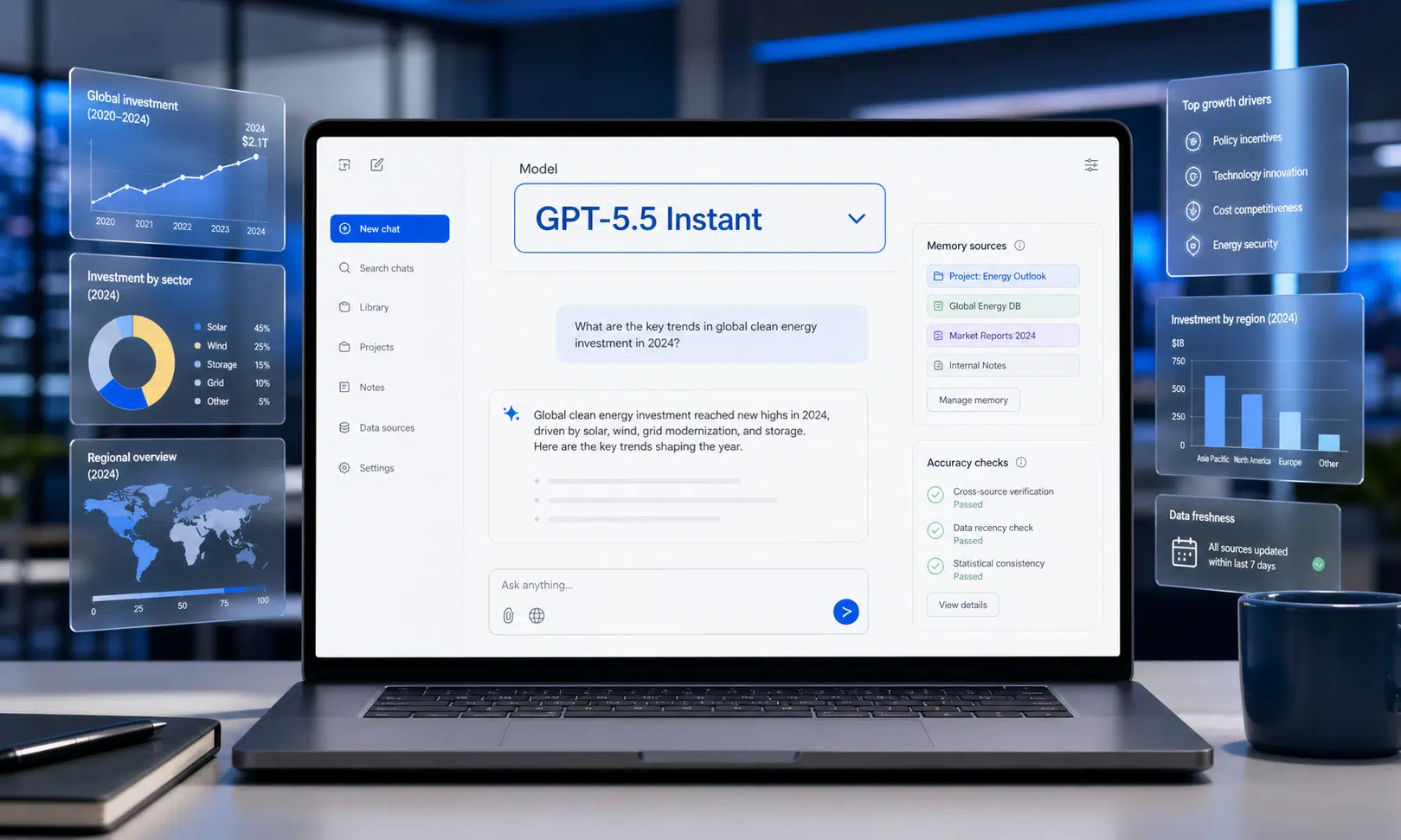

OpenAI is replacing ChatGPT’s default Instant model with GPT-5.5 Instant, a newer version designed to give shorter, more accurate, and more personally relevant answers for everyday use.
The change matters because Instant is the model most ChatGPT users encounter by default. It is the fast, general-purpose option people use for search-style questions, writing help, planning, document work, troubleshooting, and quick explanations. When OpenAI changes that default, it affects a very large share of ChatGPT sessions without users needing to manually choose a different model.
OpenAI says GPT-5.5 Instant is now rolling out to all ChatGPT users and replaces GPT-5.3 Instant as the default model. The company is also making it available through the API under chat-latest.
For paid ChatGPT users who still need the older behavior, GPT-5.3 Instant will remain available for three months through model configuration settings before being retired.
What changes with GPT-5.5 Instant
OpenAI is positioning GPT-5.5 Instant as a practical upgrade rather than a specialist model for only technical users. The main promise is that common ChatGPT responses should become more useful with less cleanup from the user.
The company highlights four areas of improvement:
- More accurate answers, especially in higher-stakes domains.
- More concise replies with less unnecessary structure.
- A more natural conversational tone.
- Better use of personal context when ChatGPT has access to relevant memories, past chats, files, or connected apps.
That last point is important for anyone using ChatGPT as a daily work assistant instead of a one-off chatbot. If the model can correctly reuse context from earlier projects, uploaded documents, or connected Gmail information, users may spend less time restating preferences, background details, and constraints.
The tradeoff is that personalization needs transparency. OpenAI is pairing the model update with new memory source controls so users can see some of the context used to personalize an answer and remove stale or unwanted information.
Accuracy is the headline claim
OpenAI says factual accuracy is one of the biggest improvements in GPT-5.5 Instant. According to the company’s internal testing, GPT-5.5 Instant produced 52.5% fewer hallucinated claims than GPT-5.3 Instant in medicine, law, and finance. That benchmark result has not been independently verified, so it should be treated as OpenAI’s claim rather than a neutral industry measurement.
Still, the areas named by OpenAI are the right ones to watch. Medicine, legal questions, and finance are domains where a confident wrong answer can cause real harm. For buyers and teams evaluating AI tools, fewer hallucinations are useful only if they show up in real workflows, not just benchmark summaries.
OpenAI also says GPT-5.5 Instant performs better on visual reasoning, math, and science tasks. The company reports scores of 85.6% on GPQA, 81.2% on AIME 2026, and 76% on MMMU-Pro. These figures suggest stronger performance on difficult science, math, and multimodal evaluation sets, but they do not remove the need to verify important outputs.
For practical use, the safer takeaway is simple: GPT-5.5 Instant may be better for drafting, analysis, and first-pass research, but users should still check answers before relying on them in regulated, financial, medical, legal, or operational decisions.

Verified by Mike Caulfield and Sam Wineburg
When ChatGPT gives a confident answer, the next step is often basic source checking. Verified is a useful companion for readers who want a structured way to evaluate claims, sources, and online evidence before acting on AI-generated output.
As an Amazon Associate I earn from qualifying purchases.
Personalization gets more visible
GPT-5.5 Instant is also meant to make better use of personal context. OpenAI says the model can draw on past chats, uploaded files, and connected Gmail accounts when that context would improve an answer.
For example, a user asking ChatGPT to draft an email, plan travel, compare software, or continue a project may get a more tailored answer if ChatGPT can connect the request to earlier conversations or available files. The goal is to reduce repeated setup work and make ChatGPT feel less like a blank slate every time.
OpenAI is also introducing memory sources across ChatGPT models. When a response has been personalized, users will be able to see some of the context behind that personalization, such as saved memories or relevant past chats. Users can then delete or edit outdated memory information.
That is a meaningful usability change because memory can be helpful and risky at the same time. A saved preference can make answers faster and more relevant, but an old job title, outdated project detail, wrong relationship context, or incorrect assumption can quietly distort future answers.
OpenAI says users remain able to manage saved memories, delete chats they do not want referenced, and use temporary chats when they do not want memory to apply.
Who gets the new model first
GPT-5.5 Instant is rolling out as the new default model for ChatGPT users. The enhanced personalization features are starting with Plus and Pro users on the web first.
OpenAI says mobile support is coming soon, with Free, Go, Business, and Enterprise users expected to receive expanded personalization in the coming weeks. Memory sources are rolling out across consumer ChatGPT plans on the web and are also planned for mobile.
Availability may vary by region and plan, especially for features tied to connected services such as Gmail. Business and Enterprise customers should also pay close attention to admin controls, data policies, and whether personalization features are enabled in their workspace.
For API users, the notable change is that GPT-5.5 Instant is available as chat-latest. That label is convenient for developers who want the current default chat model, but it also means behavior may change over time as OpenAI updates what chat-latest points to.
Teams that need predictable outputs should test before switching production workloads. A default-model upgrade can improve quality, but it can also change tone, formatting, refusal behavior, latency, or edge-case handling in ways that affect existing products.

AI Engineering by Chip Huyen
Model upgrades can change tone, formatting, latency, and edge-case behavior. AI Engineering is a practical fit for developers and product teams thinking through evaluation, deployment, and maintenance of foundation-model applications.
As an Amazon Associate I earn from qualifying purchases.
What buyers and teams should watch
For individual ChatGPT users, the upgrade should be mostly invisible. ChatGPT should simply feel a little sharper, shorter, and more aware of useful context when personalization is available.
For teams, the questions are more operational. A better default model can reduce review time, improve first drafts, and help with internal knowledge work, but only if the model behaves consistently enough for the team’s use cases.
Before relying on GPT-5.5 Instant for important workflows, buyers and admins should check:
- Whether the new model changes answer length or structure in existing prompts.
- How it handles sensitive or regulated topics.
- Whether memory and personalization are appropriate for the workspace.
- Which users can connect external sources such as Gmail.
- Whether older GPT-5.3 Instant behavior is still needed during the transition window.
- How API applications behave when pointed at chat-latest.
The most important point is that GPT-5.5 Instant is not just a benchmark upgrade. It is also a default behavior change for ChatGPT. That makes it worth testing in the places where users already depend on ChatGPT for repeatable work.
The bottom line
GPT-5.5 Instant is OpenAI’s new default ChatGPT model, replacing GPT-5.3 Instant for everyday use. OpenAI says the upgrade brings better factual accuracy, more concise answers, stronger image and STEM performance, and more useful personalization from past context.
The accuracy claims are promising, but they remain OpenAI’s own benchmark results. For casual users, the new model should mostly mean cleaner answers with less effort. For paid users, developers, and businesses, the rollout is a reason to review model settings, memory controls, connected data sources, and any workflows that depend on consistent ChatGPT behavior.