

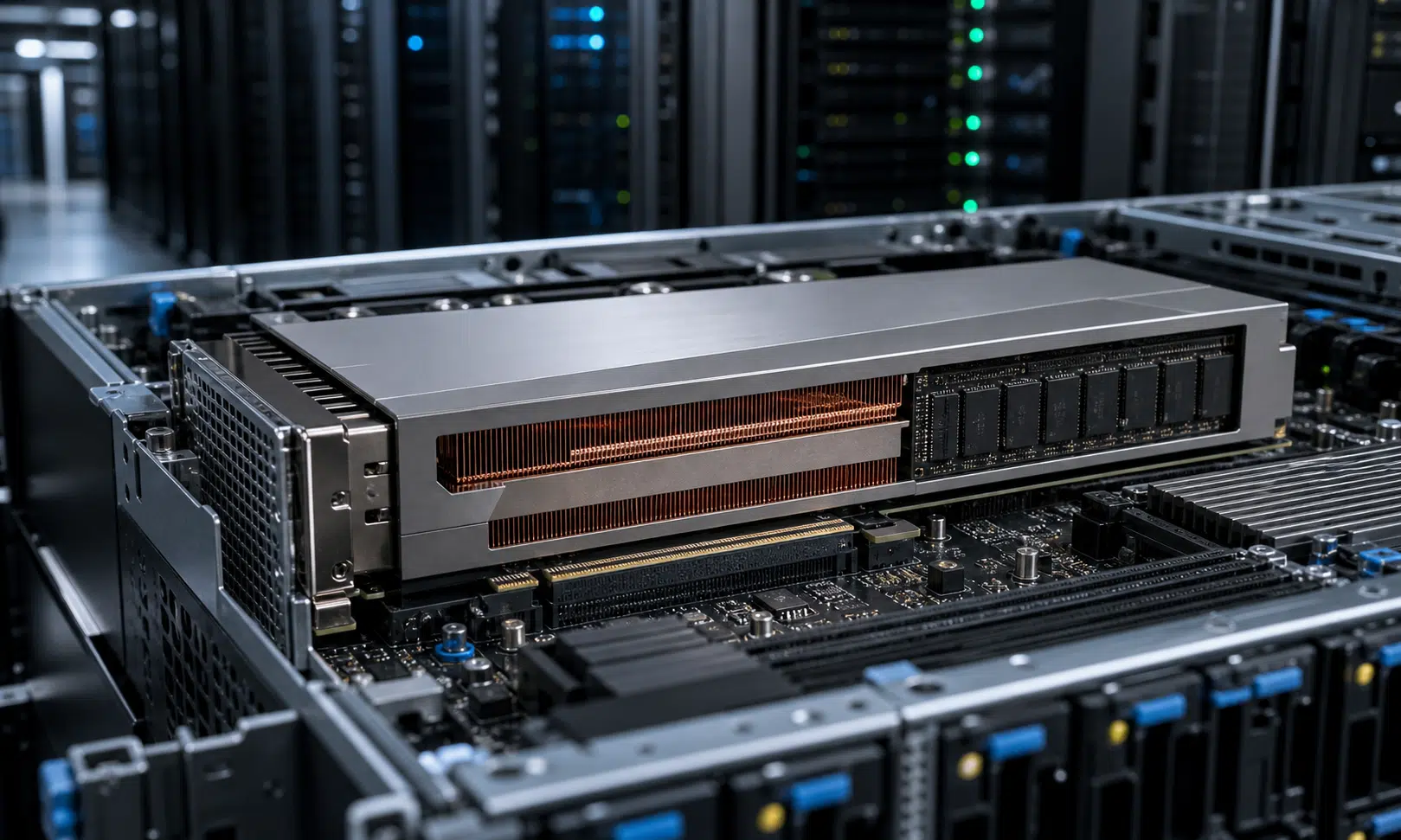

AMD has added a PCIe card to its Instinct MI350 family, giving server buyers a more conventional path into its latest CDNA 4 AI accelerator lineup. The new Instinct MI350P is built for rack servers that use standard PCIe accelerator slots rather than OAM modules, and it arrives with 144GB of HBM3E memory, a fanless dual-slot design, and a 600W power target.
That form factor matters. AMD already has higher-end MI350-series parts aimed at denser accelerator platforms, but the MI350P is meant for organizations that want to upgrade existing air-cooled servers without moving to a completely different system design. For buyers comparing AI hardware, the pitch is straightforward: newer AMD silicon, a large memory pool, and high low-precision throughput in a card that can fit into more familiar infrastructure.
What AMD Is Offering With the Instinct MI350P
The Instinct MI350P uses AMD’s CDNA 4 architecture and is manufactured using TSMC 3nm and 6nm FinFET process technology. The card includes 128 compute units, 8,192 stream processors, 512 matrix cores, and a maximum clock speed listed at 2.2GHz. AMD pairs the GPU with 144GB of HBM3E memory, 4TB/s of memory bandwidth, and 128MB of last-level cache.
Physically, the MI350P is a 10.5-inch dual-slot PCIe card. It uses a passive cooling design, which means the card itself does not rely on an onboard fan. Instead, it is intended for rack-mounted servers where chassis airflow handles cooling. AMD lists the card around a 600W power envelope, but it can also be configured for a lower 450W target in systems where thermals or power delivery are more constrained.
That lower-power option is important for deployment planning. A 600W PCIe accelerator is not a casual drop-in part for every server, even if the connector format is familiar. Buyers still need to confirm chassis airflow, slot spacing, cabling, power supply capacity, and validated server support. The 450W mode gives integrators more flexibility, although it may come with performance tradeoffs depending on workload and configuration.

Supermicro 4U Multi-GPU Server Barebone
A multi-GPU rack server barebone is the kind of platform buyers should evaluate before assuming a passive PCIe accelerator will fit an existing chassis. Check GPU compatibility lists, airflow requirements, power cabling, and BIOS support before purchasing.
As an Amazon Associate I earn from qualifying purchases.
How It Compares With AMD’s Larger MI350 Cards
The MI350P is not positioned as AMD’s absolute highest-performing MI350 product. Its published specifications are roughly half of what AMD lists for the MI350X and MI355X OAM accelerators. Those OAM parts are designed for denser platforms with more memory bandwidth and higher total throughput, while the MI350P is aimed at the PCIe server market.
That makes the MI350P easier to understand as a practical deployment part rather than a flagship-at-any-cost accelerator. It gives buyers access to CDNA 4 features and a large HBM3E memory pool, but in a form factor that can serve smaller clusters, inference servers, retrieval-augmented generation systems, and other AI workloads where PCIe expansion remains the preferred path.
| GPU | Architecture | Memory | Memory Bandwidth | FP16 Performance | FP8 Performance |
|---|---|---|---|---|---|
| Instinct MI350P PCIe | CDNA 4 | 144GB HBM3E | 4TB/s | 2.3 PFLOPS | 4.6 PFLOPS |
| Instinct MI350X OAM | CDNA 4 | 288GB HBM3E | 8TB/s | 4.6 PFLOPS | 9.2 PFLOPS |
| Instinct MI355X OAM | CDNA 4 | 288GB HBM3E | 8TB/s | 5 PFLOPS | 10.1 PFLOPS |
AMD also says up to eight MI350P cards can be used in a single system. That gives system builders room to scale performance inside a PCIe server, although multi-GPU performance will depend heavily on server topology, interconnect design, software support, and the workload being run.
Low-Precision AI Performance Is The Main Selling Point
Like the MI350X and MI355X, the MI350P supports lower-precision formats including MXFP6 and MXFP4. These formats are relevant for large language model inference and other AI workloads where reduced precision can improve throughput and efficiency while preserving acceptable model quality.
AMD claims the MI350P can reach about 2,299 TFLOPS and up to 4,600 peak TFLOPS when using MXFP4. Those are peak theoretical numbers, so they should not be read as a direct promise of real-world application performance. Actual results will vary by model, batch size, memory behavior, framework support, kernel maturity, and how well the software stack maps a workload to the hardware.
Still, the numbers explain where AMD is aiming. The MI350P is not a general enthusiast GPU or workstation graphics card. It is a data center accelerator for AI inference, RAG pipelines, and other workloads where memory capacity, memory bandwidth, and tensor performance matter more than graphics features.
The Nvidia H200 NVL Comparison
The most direct competitive angle is Nvidia’s H200 NVL, currently one of the strongest PCIe AI accelerator options in Nvidia’s lineup. AMD’s MI350P is based on a newer architecture and, on published theoretical figures, is positioned ahead of the H200 NVL in several compute formats.
According to the supplied comparison, AMD’s card offers 20% higher FP64 theoretical performance, 43% higher FP16 theoretical performance, and 39% higher FP8 theoretical performance than the H200 NVL. Those comparisons are useful for a first-pass hardware evaluation, but they are not the same as application benchmarks. Nvidia’s biggest advantage remains its mature CUDA ecosystem, broad framework support, and long-standing position in AI infrastructure.
That software reality is central to any buying decision. A card can look stronger on a specification table and still be harder to adopt if an organization’s models, tools, deployment scripts, and engineering expertise are already tuned around Nvidia hardware. AMD continues to develop ROCm as its competing software stack, but buyers should validate their own workloads before treating peak compute comparisons as the final answer.
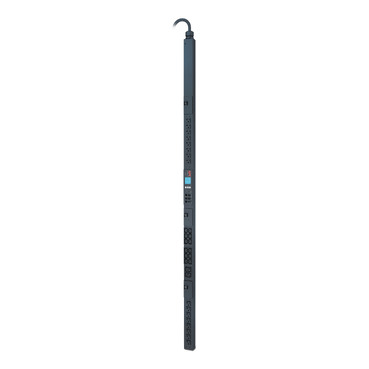
APC NetShelter Metered Rack PDU
A metered rack PDU helps teams track power draw when planning servers with high-wattage PCIe accelerators. It is most useful when paired with proper electrical planning and validated server power supplies.
As an Amazon Associate I earn from qualifying purchases.
Why The PCIe Form Factor Matters For Buyers
The MI350P gives AMD a clearer answer for organizations that want high-memory AI accelerators without committing to a more specialized OAM platform. PCIe systems remain common in enterprise data centers, and many buyers prefer incremental upgrades when possible. A standard accelerator card can reduce platform friction, especially for teams testing AMD hardware before committing to larger deployments.
The 144GB HBM3E memory capacity is also significant. Large memory pools help with bigger models, larger context workloads, and inference setups where keeping more data on-device reduces pressure on system memory and interconnects. The MI350P has less memory and bandwidth than AMD’s MI350X and MI355X OAM parts, but it still lands far above consumer and workstation GPUs in memory capacity.
For small and midsize AI deployments, that may be the more relevant comparison. The question is not simply whether MI350P is faster than another accelerator in peak math. It is whether it fits the server, runs the required software stack, supports the target models, and delivers enough performance per watt and per dollar to justify a migration or a mixed-vendor deployment.
Bottom Line
AMD’s Instinct MI350P fills an important gap in the company’s AI accelerator lineup. It brings CDNA 4, 144GB of HBM3E, high low-precision throughput, and a PCIe form factor to data center buyers that may not be ready for OAM-based systems.
The card looks especially relevant for inference and RAG workloads where memory capacity and PCIe server compatibility are key requirements. Its theoretical performance claims put pressure on Nvidia’s H200 NVL in the PCIe category, but the practical buying decision will still come down to software maturity, workload validation, server compatibility, and total platform cost.
For organizations already evaluating alternatives to Nvidia’s AI hardware, the MI350P gives AMD a more direct PCIe option. For everyone else, it is a card worth watching closely, but not one to buy on peak TFLOPS alone.

NVIDIA RTX 6000 Ada Professional GPU
A professional workstation GPU can be useful for smaller-scale model testing, CUDA workflow validation, and development before committing to data-center accelerator purchases. It is not a substitute for benchmarking the exact MI350P or H200-class hardware targeted for production.
As an Amazon Associate I earn from qualifying purchases.