

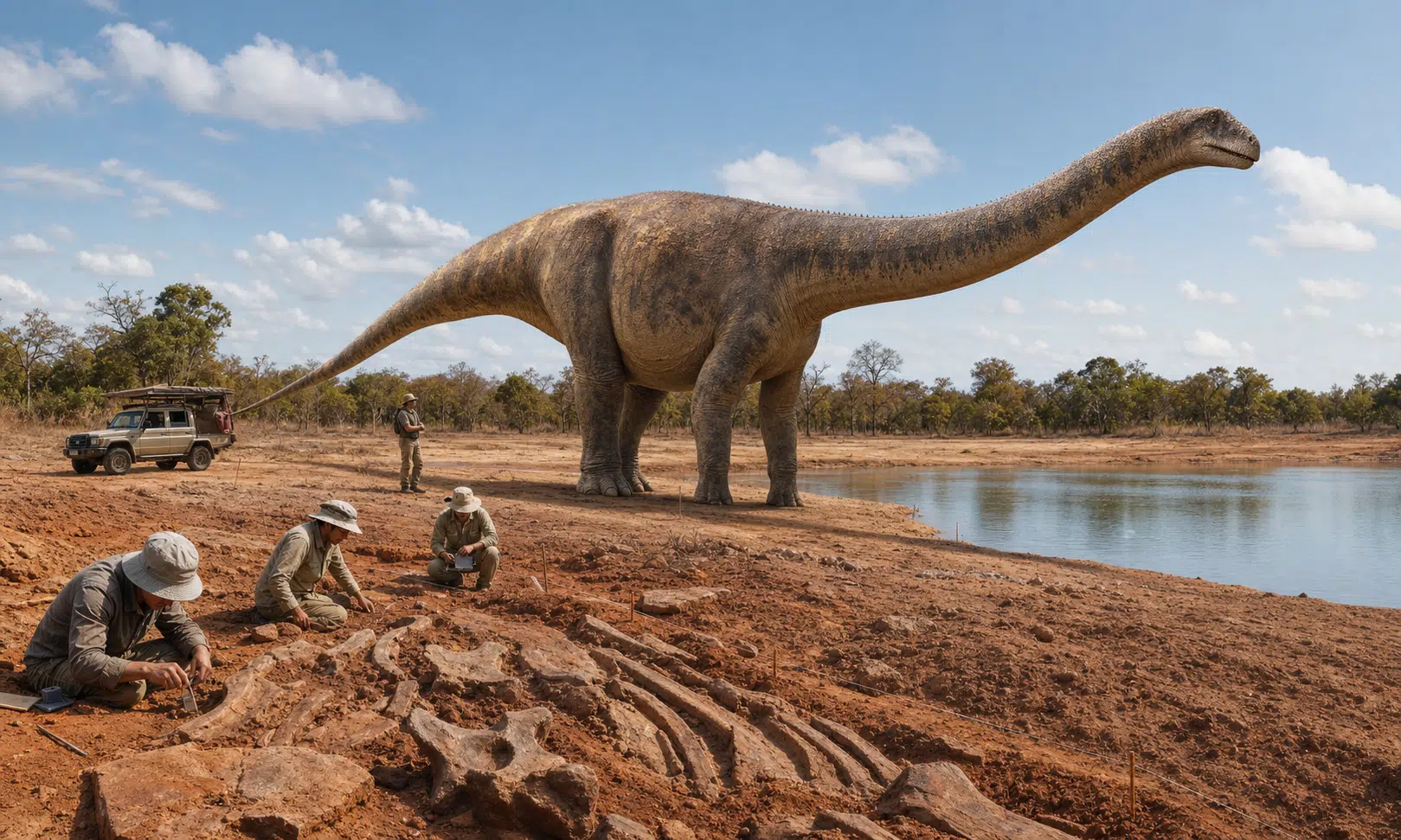

A handful of large bones noticed beside a pond in northeastern Thailand in 2016 have now been identified as a new species of giant sauropod: Nagatitan chaiyaphumensis. The animal was about 27 metres long, weighed around 27 metric tonnes, and is currently regarded as the largest dinosaur known from Southeast Asia.
That headline is accurate, but it needs careful handling. Nagatitan was enormous by regional standards, and it is a major addition to Thailand’s fossil record. It was not, however, the largest dinosaur ever found anywhere in the world. For readers trying to understand the discovery, the useful comparison is not just “big” versus “bigger.” It is where the fossil was found, how much of the skeleton was preserved, what the researchers could reasonably infer, and why the geological setting makes the find unusually important.
What Was Found In Chaiyaphum
The fossils were first noticed during the dry season, when lower water levels exposed the edge of a communal pond in Chaiyaphum province. The visible bones were large enough to draw attention, and the report eventually led to paleontological fieldwork.
The identification did not happen quickly. Excavations and follow-up work stretched across years, with the recovered material needing to be prepared, stabilized, measured, compared with related sauropods, and interpreted through peer review. That long timeline matters because it explains why a discovery made in 2016 became a named species only in 2026.
The material assigned to Nagatitan includes parts of the spine, ribs, pelvis, and limbs. One of the most striking elements is a front leg bone, the humerus, measuring about 1.78 metres. The skull and teeth were not recovered, so details about the animal’s feeding are based on broader sauropod biology rather than direct evidence from its mouth.
Nagatitan was a sauropod, the long-necked, long-tailed group of plant-eating dinosaurs that includes some of the largest land animals ever known. The published estimate puts it at roughly 27 metres in length and about 27 tonnes in body mass. A simple way to read that number is that Nagatitan was comparable in length to a very large modern whale, while still weighing far less than the heaviest whales and the largest known sauropods.

The Sauropod Dinosaurs: Life in the Age of Giants
This sauropod-focused reference gives readers more context on long-necked dinosaur anatomy, growth, feeding, and fossil evidence. It is best suited to older readers, teachers, and adults who want more depth than a general dinosaur encyclopedia.
As an Amazon Associate I earn from qualifying purchases.
How Nagatitan Compares With Other Giant Dinosaurs
The discovery is easiest to understand through two separate comparisons: regional scale and global scale. Regionally, Nagatitan is exceptional. Globally, it belongs among large sauropods, but not among the heaviest dinosaurs currently discussed in the fossil record.
| Dinosaur | Approximate size noted in source material | Best way to interpret the comparison |
|---|---|---|
| Nagatitan chaiyaphumensis | About 27 metres long; around 27 tonnes | Largest dinosaur currently known from Southeast Asia |
| Patagotitan | About 60 tonnes | More than twice Nagatitan’s estimated mass |
| Ruyangosaurus | About 50 tonnes | A larger Asian sauropod outside Southeast Asia |
| Argentinosaurus | Possibly more than 70 tonnes in some estimates | Part of the global upper range of giant sauropod estimates |
That table shows why the wording matters. “Largest dinosaur in Southeast Asia” is a strong regional claim. “Largest dinosaur” without qualification would be misleading. Nagatitan’s importance comes from its place in the Southeast Asian record, not from beating the biggest South American titanosaurs.
For a reader comparing dinosaur discoveries, three decision points are useful:
- Geography: Nagatitan expands what is known about large sauropods in Southeast Asia.
- Evidence: The species is based on a partial postcranial skeleton, meaning bones from the body rather than the skull.
- Scale: Its 27-tonne estimate is huge regionally, but below the largest sauropod mass estimates worldwide.
What The Name Means
The name Nagatitan chaiyaphumensis links the animal to both mythology and place. “Naga” refers to a mythological serpent associated with Thai and wider Southeast Asian tradition. “Titan” points to the giants of Greek mythology. The species name “chaiyaphumensis” means “from Chaiyaphum,” identifying the province where the fossils were found.
The name therefore does more than label a specimen. It places the animal in a local cultural and geographic setting while still following the standard structure of scientific naming. That matters in a discovery like this because the fossil was not found in isolation from people or place. A local resident noticed the bones, Thai institutions helped lead the work, and the species now carries the province’s name into the scientific record.
The research team involved Thai paleontologists and international collaborators, including researchers connected with institutions in Thailand and the United Kingdom. The result is both a taxonomic description and a record of how local discovery, museum work, university research, and field geology come together over many years.
Why Researchers Call It A “Last Titan”
Nagatitan was recovered from the Khok Kruat Formation, a dinosaur-bearing rock unit in Thailand dated to the late Early Cretaceous, roughly 100 to 120 million years ago. The formation is important because it is among the youngest dinosaur-bearing deposits in the country.
That geological context is the reason the phrase “last titan” has been attached to the discovery. The idea is not that Nagatitan was literally the final sauropod alive in Southeast Asia. It is that the rock record may make later large sauropods from the region difficult, or perhaps impossible, to find in the same way.
After the period represented by these terrestrial deposits, parts of the region’s geological history shifted toward shallow marine conditions. Land animals can only become fossils where the right environments preserve their remains. If later habitats were not preserved as accessible land-animal fossil beds, then similar large dinosaurs may have lived without leaving a recoverable record.
That is a subtle but important distinction. Fossils do not show every animal that existed. They show the animals that died in the right place, were buried under the right conditions, survived deep time, and were later exposed where people could find them. Nagatitan matters partly because it may sit near the edge of what Thailand’s preserved dinosaur record can reveal.
Dinosaur and Other Prehistoric Creatures Atlas
A dinosaur atlas helps connect prehistoric animals to real regions, fossil sites, and changing continents. That makes it a good fit for readers interested in why a Thai sauropod discovery matters regionally.
As an Amazon Associate I earn from qualifying purchases.
What Buyers And Readers Should Take From The Discovery
This is not a product story in the usual sense, but it is still a comparison story. Readers deciding which dinosaur books, museum materials, classroom resources, or fossil-focused travel content to trust should look for sources that keep the scale claims precise.
A useful resource should make the following distinctions clear:
- Nagatitan is the largest dinosaur currently known from Southeast Asia.
- It is not the largest dinosaur known globally.
- The species was identified from body bones, not a complete skeleton.
- The 27-metre and 27-tonne figures are estimates, not direct measurements of a fully preserved animal.
- The discovery’s importance depends on geology, regional fossil history, and the decade-long research process.
That last point is easy to miss. Popular dinosaur coverage often treats naming a new species as a single dramatic event. In practice, the public announcement is usually the end of a much longer process. Bones have to be excavated without destroying them, prepared in a lab, compared with known species, and described in enough detail for other specialists to evaluate the claim.
For parents, teachers, and general readers, the best takeaway is not simply that Thailand had a very large dinosaur. It is that Southeast Asia’s dinosaur record is still developing, and careful fieldwork can change the map of where major dinosaur groups are known to have lived.
The Bottom Line
Nagatitan chaiyaphumensis was a giant long-necked dinosaur from what is now northeastern Thailand. It measured about 27 metres long, weighed around 27 tonnes, and lived during the Early Cretaceous. Its fossils were first noticed near a pond in Chaiyaphum province in 2016 and were formally described as a new species in 2026.
The most accurate way to describe the discovery is also the most interesting one: Nagatitan is the largest dinosaur currently known from Southeast Asia, a major Thai fossil find, and a reminder that scientific discoveries often arrive after years of slow, exacting work. Its size makes the headline. Its setting, preservation, and regional context make the discovery matter.

National Geographic Little Kids First Big Book of Dinosaurs
This introductory dinosaur book is better for early readers who need clear species facts and large-format visuals. It works as a starting point before moving into more technical fossil and sauropod resources.
As an Amazon Associate I earn from qualifying purchases.