The James Webb Space Telescope combines solar electricity with largely passive cooling to observe the universe in infrared light. In a commissioning assessment dated 12 July 2022, the mission team reported that Webb was generating 1.5 kilowatts to match its electrical load, with generating capacity above two kilowatts.
Webb operates in a halo orbit around the Sun–Earth L2 point, roughly 1.5 million kilometres, or about one million miles, from Earth. Its electrical system supplies four science instruments, communications, onboard electronics and other spacecraft systems.
Before launch, NASA described expected power use of about one kilowatt and a solar array capable of generating nearly twice that amount to accommodate degradation in space. That prelaunch description and the commissioning assessment refer to different stages of the mission.
Cooling for infrared observations
Webb’s mirrors and instruments must remain cold enough to detect faint infrared signals. Heat emitted by the observatory itself can interfere with those measurements, while temperature changes can affect the alignment of its optics.
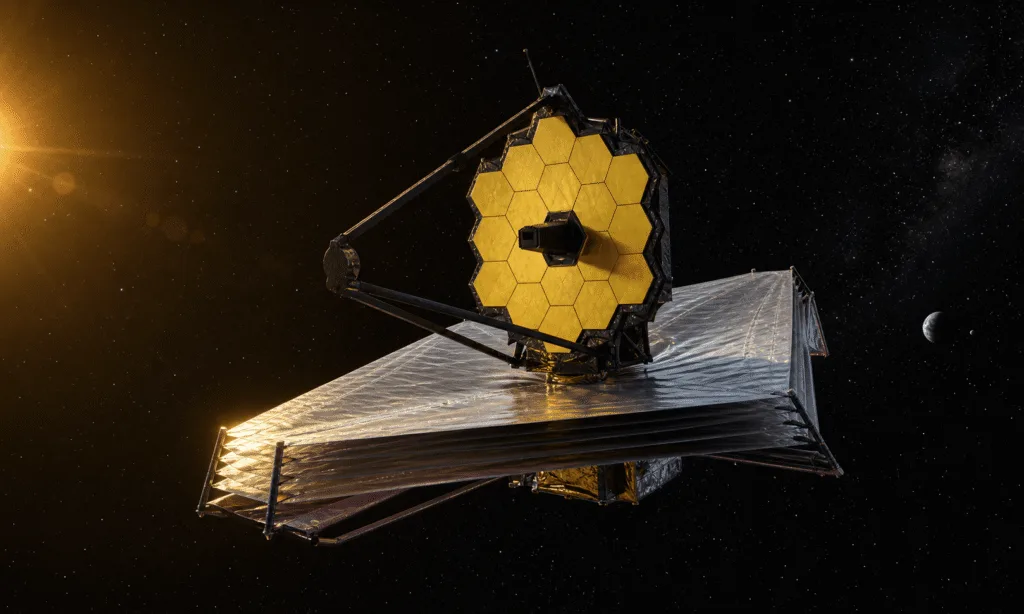
The five-layer sunshield protects the telescope from light and heat from the Sun, Earth and Moon, as well as heat from the spacecraft. It measures about 21 metres by 14 metres and consists of separated layers of thin Kapton film with reflective coatings. Heat radiates into space from between the layers, while the gaps provide insulation.
NASA describes the near-infrared instruments as operating at about 39 kelvins through passive cooling. The Mid-Infrared Instrument, or MIRI, requires an electrically powered cryocooler to reach temperatures below seven kelvins. Webb’s cooling system therefore combines passive thermal protection with powered refrigeration for its coldest instrument.
Unfolding the observatory
Webb launched on 25 December 2021 with its sunshield folded inside the rocket’s nose cone. Deployment began on 28 December, and the five layers were fully tensioned on 4 January 2022. Support structures had to unfold, covers release and booms extend before the membranes could be separated and pulled into position.
NASA said unfolding and tensioning the sunshield involved 139 of Webb’s 178 release mechanisms, 70 hinge assemblies, eight deployment motors, roughly 400 pulleys and 90 individual cables. Completing that sequence allowed the telescope and instruments to continue cooling toward their operating temperatures.
The mission team’s July 2022 assessment listed 344 single-point failure risks at launch, almost all related to deployments, and said 49 remained. Such risks concern components or mechanisms whose failure lacks a redundant recovery path; the count does not mean those failures occurred.
Hubble received Space Shuttle servicing visits in low Earth orbit. Webb’s original design did not provide comparable servicing at L2. NASA says early studies concluded that the potential benefits of servicing Webb did not justify the additional mission complexity, mass and cost.
Aligning the segmented mirror
After deployment, Webb’s 18 hexagonal primary mirror segments had to be aligned to function as a single 6.5-metre mirror. Actuators attached to the back of each segment adjust its position and curvature so the telescope can focus light into its instruments.
NASA announced completion of telescope alignment on 28 April 2022, ahead of the remaining science instrument commissioning work. Maintaining alignment during operations requires continued monitoring and small corrections to the mirror segments when needed.