

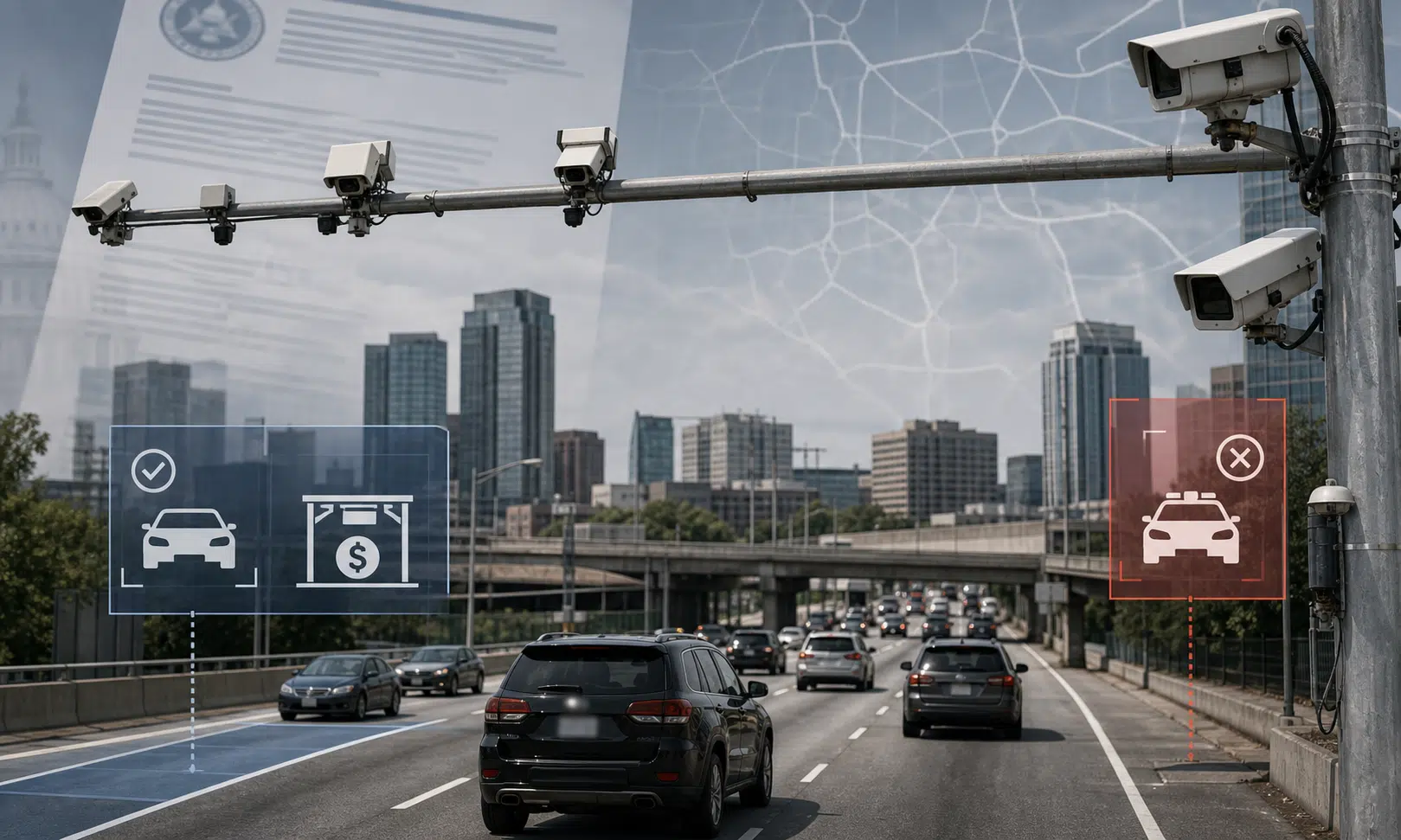

A proposed amendment to a major federal transportation bill would put one of the country’s fastest-growing police surveillance tools on unusually direct notice: use automated license plate readers only for tolling, or risk federal highway funding.
The proposal is short enough to read in one breath. Its effect, if adopted and enforced broadly, could be much larger. Automated license plate reader systems, often called ALPRs, are now used by police departments, sheriff’s offices, regional task forces, tolling agencies, and private camera networks to record vehicle plates, locations, and timestamps. The amendment would condition Title 23 highway funding on a restriction that says recipients may not use ALPRs for any purpose other than toll collection.
That would not be a narrow procurement rule. Title 23 money supports a substantial share of public road work in the United States, including state, county, and local transportation projects. Because most states and municipalities rely on federal transportation funds in some form, the proposal could force many agencies to reassess whether police plate-reader programs are worth the funding risk. The exact reach would depend on the final bill text, agency guidance, and enforcement decisions, but the signal is clear: Congress is being asked to treat routine plate tracking as a transportation-funding problem, not only a police-technology problem.
What the Amendment Would Do
The amendment is aimed at recipients of federal highway assistance under Title 23 of the United States Code. Its core language would bar those recipients from using automated license plate readers for anything other than tolling.
In practical terms, that could put state and local governments in a difficult position. A city using ALPR cameras for stolen-car alerts, warrant hits, investigative searches, or regional data sharing might have to shut those uses down, separate them from federally funded road programs, or risk a challenge to its funding eligibility. A county using cameras at intersections or on patrol vehicles could face the same basic question. Tolling systems would be treated differently because the amendment leaves room for that use.
The proposal appears designed to avoid the slower and less predictable path of constitutional litigation. Courts have not yet settled, in a categorical way, whether all ALPR database searches amount to Fourth Amendment searches. Some rulings have leaned on the idea that drivers expose their plates on public roads. Critics argue that the modern issue is not a single officer seeing a single plate, but a searchable record of where vehicles have been over time.
By using spending power, Congress could apply pressure without waiting for a final Supreme Court rule on the technology. That is why the amendment matters even before any final vote. It reframes ALPR policy as a condition attached to federal money, the same kind of lever Congress has used in other transportation and public-safety areas.
Why Police Plate Readers Are Under Pressure
ALPR systems are not new, but their scale has changed. Cameras mounted on poles, patrol cars, traffic infrastructure, and private properties can scan passing vehicles automatically. The resulting records typically include the plate number, time, location, and image data. Depending on the system, those records can be searched locally, shared with nearby agencies, or made available through wider law-enforcement networks.
Supporters say the cameras help police find stolen vehicles, locate suspects, respond to violent crime, and generate leads more quickly than manual investigation. That argument has political force, especially in cities where officials are under pressure to show visible action on car theft, retail crime, shootings, and repeat offenders.
Privacy advocates see a different risk. They argue that large ALPR networks can become a location-tracking system for ordinary drivers, including people who are not suspected of any crime. The concern grows when plate data is retained, pooled, and searched across jurisdictions. A single scan may reveal very little. Months of scans can reveal patterns around work, medical visits, religious activity, political meetings, or personal relationships.
Several public controversies have pushed those concerns into the mainstream. In Illinois, the secretary of state’s office said an audit found that Flock Safety allowed U.S. Customs and Border Protection to access Illinois license plate camera data, which the office described as a violation of state law. The office ordered access shut off. Flock later said it had paused federal pilot programs, including arrangements involving federal agencies.
That Illinois dispute matters because it illustrates a recurring ALPR problem: even when a city or police department believes it controls its own camera network, data-sharing settings, outside access, and platform design can complicate that control. Local officials may buy a tool for one purpose, then discover that the surrounding data network creates legal or political exposure they did not fully anticipate.
The Flock Safety Factor
Flock Safety is central to the national debate because it operates one of the country’s largest ALPR platforms. Its cameras are used by many local law-enforcement agencies, homeowners associations, businesses, and municipalities. That scale is part of the sales pitch: more cameras and more shared data can make the network more useful for investigations.
It is also part of the criticism. A platform that spans jurisdictions can make local safeguards harder to understand and harder to audit. If one department’s data can be searched by another agency, the policy question becomes bigger than whether the first department installed cameras properly. It becomes a question of who can search the system, under what justification, for how long, and with what consequences if the rules are broken.
Flock and police supporters have pointed to cases where ALPR alerts were used to identify or apprehend suspects. In the Austin, Texas, area, police advocates have cited nearby criminal investigations as examples of why they believe the technology should remain available. Austin officials, however, had already moved away from using Flock cameras after privacy objections and public debate.
That split captures the buyer-side dilemma facing local governments. ALPR systems can produce real investigative leads. They can also create data-governance obligations that many cities are not staffed to manage. The federal amendment would make that tradeoff sharper by adding transportation funding to the list of risks.
What Cities and Agencies Would Need to Review
For city managers, police chiefs, county boards, and transportation officials, the amendment is not just an ideological fight. It is a procurement and compliance problem. Any agency using ALPR technology would need to understand how the cameras are funded, where they are installed, who owns the data, and which other agencies can search it.
A useful first review would include the following questions:
- Are any ALPR cameras, poles, networks, or road projects connected to federal highway funds?
- Is the system used for tolling, law enforcement, parking enforcement, traffic management, or mixed purposes?
- How long is plate data retained, and who can change that retention period?
- Which outside agencies can search the data, and are those searches logged in a usable way?
- Do vendor contracts allow federal, state, or out-of-state access that conflicts with local policy or state law?
- Can the agency separate tolling use from police use if federal rules require it?
Those questions matter even if the amendment never becomes law. ALPR contracts often sit at the intersection of police policy, IT security, transportation infrastructure, privacy law, and vendor management. That makes them easy to approve in pieces and hard to govern as a whole.
| Stakeholder | Main concern | Decision pressure |
|---|---|---|
| Police departments | Keeping investigative tools available | Showing public-safety value while limiting misuse |
| City and county governments | Funding, contracts, and liability | Understanding whether ALPR use could threaten federal money |
| Privacy advocates | Mass location tracking | Reducing retention, sharing, and warrantless searches |
| Vendors | Platform access and customer confidence | Proving that controls, audits, and permissions match legal promises |
| Drivers | Unseen collection of travel records | Knowing whether routine travel is being stored and searched |
San Jose Shows the Litigation Risk
The legal fight is already moving on a separate track. In California, the Institute for Justice filed a federal class-action lawsuit against San Jose and its police department over the city’s ALPR network. The complaint alleges that the system includes 474 cameras and that the city reported more than 360 million ALPR photographs in 2024. It also alleges heavy search activity by police users across California. Those figures come from the complaint and should be read as allegations in an active case, not as judicial findings.
San Jose has also faced a separate state-court challenge involving ALPR use. Mayor Matt Mahan has supported the city’s camera network, while civil-liberties groups have argued that the system amounts to suspicionless tracking. The city’s full legal response in the federal case will matter because it may show how municipalities intend to defend large ALPR systems when plaintiffs focus on scale, retention, and searchable travel history.
For other cities, the San Jose litigation is a warning about documentation. Agencies that use ALPRs should expect questions about camera placement, retention periods, audit logs, search reasons, vendor access, and how often the database is queried. The more a system looks like a citywide archive of vehicle movements, the more likely it is to attract legal and political scrutiny.
Verdict: A Small Amendment With Large Procurement Consequences
For readers deciding how seriously to treat this proposal, the answer is: very seriously, even though it is not yet law. The amendment would not merely regulate a niche police device. It would attach ALPR limits to a funding stream that state and local governments depend on for roads and transportation infrastructure.
For privacy advocates, the proposal is a direct route to a national restriction that local campaigns have struggled to achieve city by city. For law enforcement, it threatens a tool many agencies now consider part of everyday investigative work. For vendors, it raises the possibility that customers will demand cleaner separation between tolling, public-safety, and data-sharing functions. For local governments, it turns ALPR oversight from a police-board discussion into a budget and compliance issue.
The key buyer-aware takeaway is simple: any public agency considering ALPR expansion should pause before signing a long-term contract. The political and legal environment around plate readers is changing quickly. A system that looks affordable on a per-camera basis can become expensive if it creates funding exposure, litigation risk, or public backlash.
Who should be paying attention now
- Municipal officials reviewing police technology contracts.
- Transportation agencies that rely on Title 23 funding.
- Police departments using shared ALPR databases.
- Privacy, civil-rights, and community oversight groups.
- Vendors selling plate-reader systems to public agencies.
The amendment may change, fail, or be narrowed as the transportation bill moves through Congress. But the debate around it is already useful. It forces a question that many ALPR programs have avoided: should the government be able to build searchable records of ordinary driving as a condition of modern policing, or should plate scanning be limited to narrower transportation functions such as toll collection?
That is no longer only a courtroom question. It is now a federal funding question, and that makes it much harder for cities and states to ignore.