

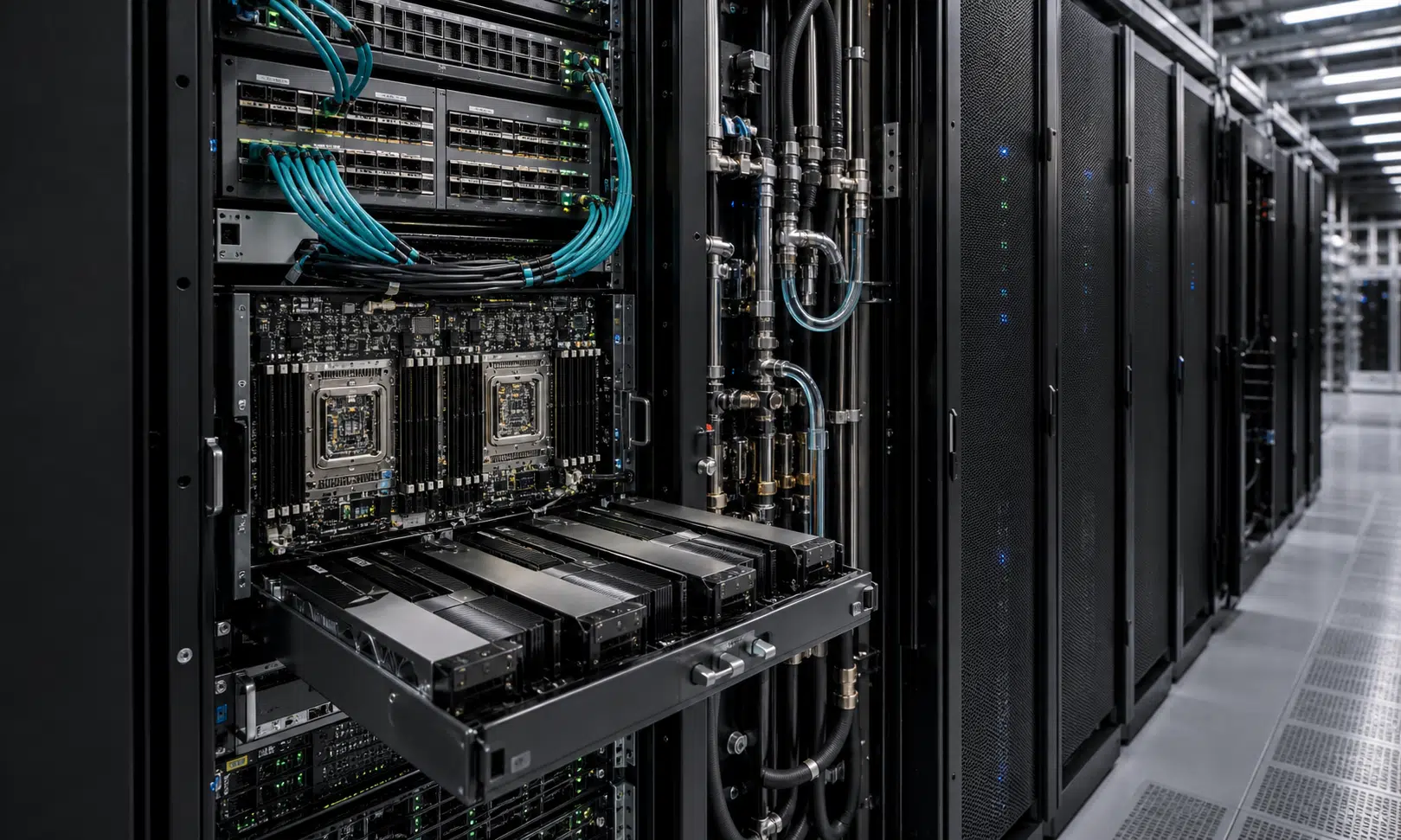

Nvidia is no longer just selling the accelerators that sit beside server CPUs. It is increasingly selling the platform around them, and that shift could put the company in direct commercial conflict with Intel Xeon and AMD EPYC in a much larger way.
After reporting record fiscal Q1 2027 revenue of about $81.6 billion, Nvidia told investors that it sees nearly $20 billion in CPU revenue this fiscal year from Grace and Vera-related products. That figure does not mean Nvidia is suddenly replacing the full x86 server market in unit share. Vera is an Arm-based data center CPU, and Nvidia’s revenue includes processors sold as part of broader systems and superchip configurations.
Still, the number matters. If Nvidia can attach high-value CPUs to its AI racks and platforms at scale, it may become one of the largest server CPU suppliers by revenue without competing in the traditional one-socket-at-a-time way Intel and AMD have long defined the market.
Why the $20 billion CPU target matters
Nvidia’s chief financial officer Colette Kress described Vera as opening a new total addressable market for the company, with major hyperscalers and system makers already lined up around deployment. Nvidia later clarified that its CPU revenue view includes Grace and Vera processors sold in several forms, including Superchip combinations, NVL72 systems, and standalone CPU offerings for AI and related data center workloads.
That distinction is important for buyers. Nvidia is not merely trying to sell a loose processor into the same procurement lane as a Xeon or EPYC server chip. Its strongest position is in complete AI platforms, where the CPU, GPU, networking, software stack, and rack architecture are bundled into a larger system decision.
Intel’s data center and AI business and AMD’s data center business each generated revenue in the mid-teens of billions of dollars in their most recently cited annual periods. Those segment totals include more than server CPUs alone, but they still frame the scale of Nvidia’s claim. A $20 billion CPU-related revenue run would put Nvidia in the same commercial conversation as the incumbent server CPU vendors.
The traditional x86 server CPU market has been estimated at roughly $30 billion. On that basis, Nvidia’s CPU revenue target would be comparable to about two-thirds of that market by revenue, though not equivalent to two-thirds of x86 CPU shipments. That difference matters because Nvidia’s processors may carry much higher average selling prices when attached to high-end AI systems.
| Company or market | Relevant figure from the source | What it signals |
|---|---|---|
| Nvidia Grace and Vera CPU revenue target | Nearly $20 billion this fiscal year | Nvidia expects CPUs to become a major data center revenue line |
| Estimated x86 server CPU market | About $30 billion | Nvidia’s target is large relative to the established server CPU pool |
| Estimated Vera CPU price in VR200 NVL72 systems | About $5,000 per CPU | High platform pricing could offset lower unit volume versus Xeon and EPYC |
| Estimated EPYC and Xeon SP shipments in 2025 | Nearly 20 million units combined | Intel and AMD still represent enormous installed server CPU volume |
Vera changes the CPU buying question
Grace is already shipping broadly, while Vera is the more aggressive step into the server CPU market. The Vera CPU is an 88-core Arm-based processor designed for Nvidia’s next-generation data center platforms. Its role is closely tied to Rubin GPUs and the surrounding rack-scale architecture.
Jensen Huang has said Nvidia expects to sell millions of Rubin GPUs, with Vera attached in the Vera Rubin platform. He also described Vera as useful beyond that pairing, including as a standalone CPU and in configurations involving CX9 networking and software stacks for storage, security, compute isolation, and confidential computing. Those deployment paths should be treated as Nvidia’s stated platform strategy, not as independently proven market outcomes yet.
For infrastructure buyers, the practical issue is not whether Vera looks like a drop-in replacement for every Xeon or EPYC deployment. It is whether AI factories, hyperscale inference clusters, and agentic AI infrastructure are increasingly purchased as Nvidia-defined systems. If that happens, the CPU choice may become part of the Nvidia platform decision rather than a separate server bill of materials.
That is where Intel and AMD face a different kind of pressure. Their server CPUs have deep software compatibility, mature ecosystems, broad OEM support, and large installed bases. Nvidia’s advantage is different: it controls the AI accelerator platform that many customers are already prioritizing. When the GPU rack is the central purchase, Nvidia can make its CPU the default companion.
Four million CPUs is plausible, but the revenue mix matters
One estimate cited for hyperscale VR200 NVL72 systems puts Vera pricing at roughly $5,000 per CPU. If that estimate is close, Nvidia would need around 4 million Vera-class CPU sales to support $20 billion in CPU revenue. Analyst Dean McCarron of Mercury Research argued that this kind of volume is within reach, given expected GB300 and Rubin system shipments across Nvidia’s fiscal 2027 window.
That does not make the result automatic. The final number depends on customer demand, production allocation, system mix, and how Nvidia accounts for CPU value inside larger platforms. The source analyst also expected the revenue to be weighted toward the end of Nvidia’s fiscal year, which would make timing and supply execution especially important.
Nvidia has said it is securing large amounts of supply through inventory, purchase commitments, and prepayments. That gives the company more room to steer capacity toward the components it needs most, although Vera will still have to compete internally with other high-demand silicon across Nvidia’s AI platform roadmap.
What this means for Intel and AMD customers
The near-term threat is not that every general-purpose server buyer stops considering Xeon or EPYC. Most enterprise and cloud workloads still depend on established x86 platforms, validated software stacks, and predictable procurement channels. Intel and AMD also shipped close to 20 million Xeon SP and EPYC data center processors in 2025, according to the source, so their server CPU scale remains substantial.
The more immediate challenge is in high-value AI infrastructure. If Nvidia can sell CPUs at premium prices inside full-stack AI systems, it can take a large share of CPU revenue without needing Intel-like or AMD-like unit volume. That makes the competition look less like a conventional CPU socket battle and more like a platform economics fight.
For buyers planning new AI clusters, the tradeoff is straightforward. Nvidia’s approach may simplify integration and optimize performance across GPU, CPU, networking, and software layers. The risk is tighter dependence on one vendor’s architecture, pricing, roadmap, and supply priorities.
For Intel and AMD, the response has to be broader than faster CPUs. They need to defend the CPU socket while also proving that their platforms remain economically compelling in AI-heavy deployments. Nvidia is using its accelerator dominance to pull the surrounding server architecture closer to itself. Vera is the CPU part of that strategy, and the revenue target shows how seriously Nvidia now wants that market.