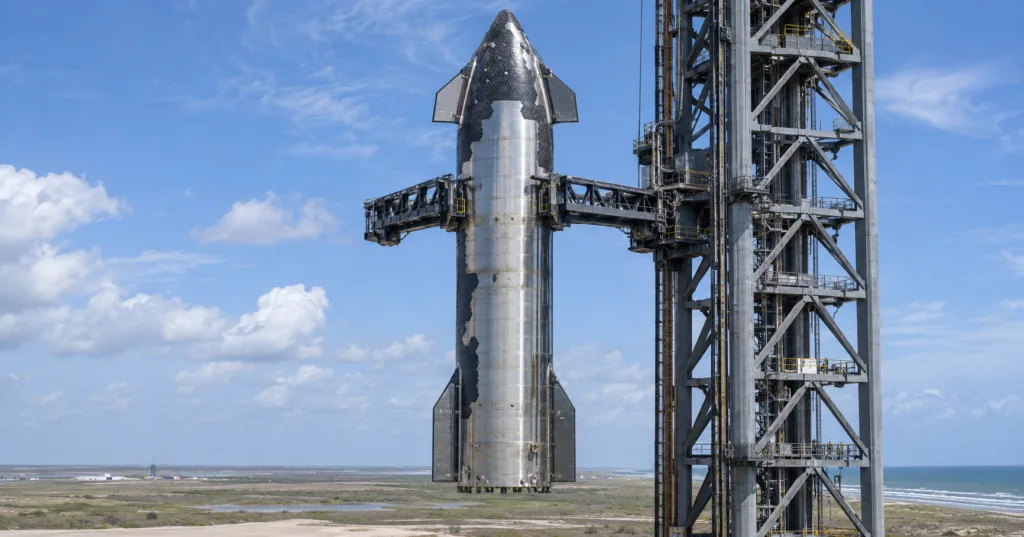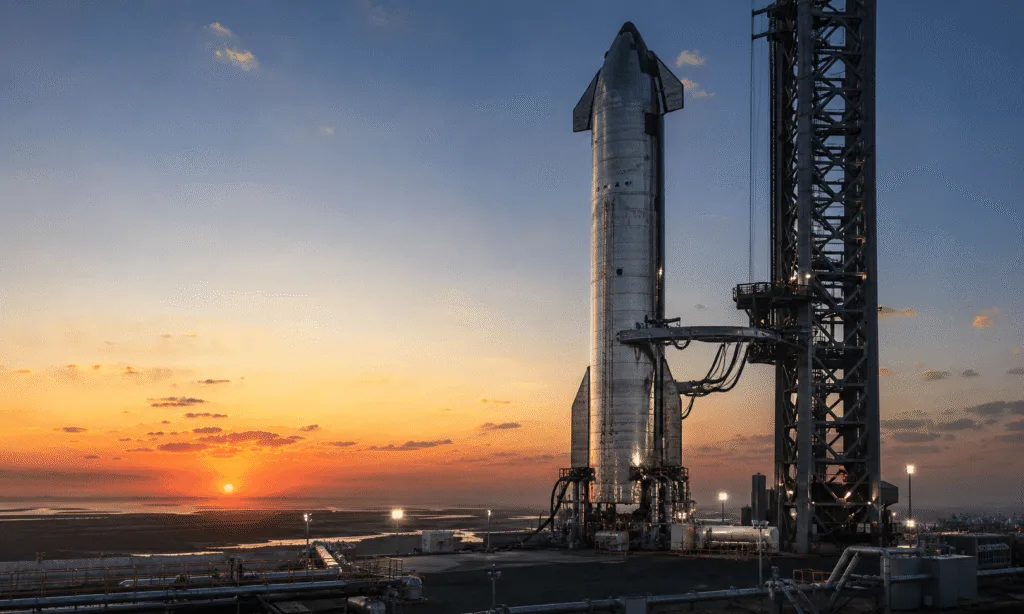
SpaceX called off Starship Flight Test 12 at Starbase, Texas, on May 21, 2026, after the countdown repeatedly stopped about 40 seconds before liftoff. The automated launch system held the count five times before the attempt was abandoned.
Elon Musk attributed the scrub to a hydraulic pin that failed to retract on the tower’s umbilical arm, which connects ground equipment to the rocket. He said another attempt could take place on May 22 if the problem was repaired. That conditional opportunity had a 90-minute window opening at 5:30 p.m. CDT, or 22:30 UTC.
New Starship hardware and launch infrastructure
Flight Test 12 was planned as the first flight of the taller, more powerful Starship V3 configuration and the first liftoff from a new pad at Starbase. SpaceX said the mission’s primary goal was to demonstrate redesigned elements of the vehicle in flight.
Starship is part of NASA’s lunar plans and SpaceX’s plans to deploy next-generation Starlink satellites and orbital data centers. SpaceX aims to reuse both stages rapidly, but only the Super Heavy booster had been reused at the time of the scrub. The company did not plan to recover either stage on Flight Test 12.
SpaceX filing discloses revenue growth and a loss
SpaceX filed an S-1 registration statement on May 20 ahead of a planned public offering. The filing reported revenue of $18.67 billion in 2025, compared with $14.02 billion in 2024, and a $4.94 billion net loss, following net income of $791 million in 2024.
The filing’s historical results retrospectively combine SpaceX, xAI and X because the transactions involved entities under common control. SpaceX acquired xAI on February 2, 2026. The figures therefore include AI operations for periods before that acquisition.
The filing reported a $6.36 billion operating loss for the AI segment in 2025. It attributed increased research and development expenses in that segment to higher GPU depreciation, infrastructure and cloud-computing costs, employee compensation and overhead.
Firefly expands its Central Texas campus
Firefly Aerospace announced on May 19 that it had moved into a new headquarters, expanded cleanroom space and added an innovation lab in Cedar Park, Texas. The company said two buildings next to its existing spacecraft facility brought the combined campus to 144,000 square feet, twice the size of its former Cedar Park facilities.
The campus is intended to support spacecraft assembly and testing, mission control, avionics and component production, engineering and business operations. Firefly said the expansion would support increased spacecraft production.
The company said the campus is less than 30 miles from its 200-acre Rocket Ranch in Briggs, Texas, which includes six test stands and 217,000 square feet of facilities for launch-vehicle engineering, manufacturing and integration.
TKMS and Isar announce a Canadian launch project
Maritime-defense company TKMS announced an industrial cooperation agreement with Isar Aerospace on May 19 to establish sovereign Canadian space-launch capability. TKMS described the project as part of its bid for the Canadian Patrol Submarine Project.
TKMS said Isar would establish a Canadian entity and work with Canadian small and medium-sized businesses on launch infrastructure, with jobs planned in Nova Scotia. The announcement did not set out a detailed construction or launch schedule.
Separately, Canada’s Department of National Defence said its Launch the North initiative planned C$105 million in investment over three fiscal years, targeting initial light-lift operational capability by 2028. NordSpace, Canada Rocket Company and Reaction Dynamics had each been conditionally approved for C$8.3 million in first-round funding.
Zenk Space raises funding ahead of a planned June debut
China’s Zenk Space secured 180 million yuan, about $26 million, ahead of the planned June 2026 debut of its kerosene-liquid oxygen Zhihang-1 rocket. The mission would be the company’s first orbital launch attempt.
Zhihang-1 is designed to measure 49.8 meters long and 3.35 meters in diameter. Zenk claims it will be able to carry 4,000 kilograms to a 500-kilometer Sun-synchronous orbit. The design uses YF-102 engines from the Academy of Aerospace Liquid Propulsion Technology and propellant tanks from R-Space.
Roscosmos begins rocket advertising campaigns
A Roscosmos representative said the agency had placed six advertisements on rockets since the start of 2026. Four were placements for PSB bank, the Coffeemania restaurant chain, Russian Media Group and the Russian Olympic Committee; two were public-service placements marking the 65th anniversary of the first human spaceflight.
Legislative changes permitting advertising on rockets and space infrastructure took effect on January 1, 2026. An explanatory note accompanying the legislation projected potential annual revenue of up to 200 million rubles from advertising on space hardware and up to 5 million rubles from space infrastructure. Those amounts were forecasts, not disclosed earnings.
Vulcan booster review and return-to-flight plans
In an April 15 statement, United Launch Alliance said Northrop Grumman had completed a successful static fire of a GEM 63XL solid rocket booster. ULA was investigating a nozzle problem during Vulcan’s February 12 USSF-87 mission for the U.S. Space Force.
One of the rocket’s four solid boosters suffered the nozzle problem before separation, and the vehicle rolled more than intended. The mission nevertheless delivered its payload to the intended geosynchronous orbit.
A ULA spokesperson said the static fire tested nozzle enhancements already in development and advanced propellant technology for future motors. ULA said the test data and investigation findings would support its return-to-flight work, with any necessary corrective actions to be implemented before the next Vulcan launch.
Gary Wentz, ULA’s vice president of government and commercial programs, said Amazon was the more likely customer for the return-to-flight mission. The timing was still being assessed. Amazon has contracted Vulcan launches for its broadband satellite constellation.
Worker dies after a fall at Starbase
Cameron County Justice of the Peace Mary Esther Sorola said Jose Luis Bautista died after falling from scaffolding at SpaceX’s Starbase complex in South Texas on May 15. Bautista was reported to have been working for a SpaceX contractor. Cameron County Sheriff Manuel Treviño said his office responded to the scene.
Brownsville Fire Chief Jarret Sheldon said fire and ambulance crews were dispatched but recalled before reaching the site. Starbase city administrator Cayetana Polanco confirmed the death in a May 19 statement and referred questions to SpaceX, the relevant contracting company and the authorities.