

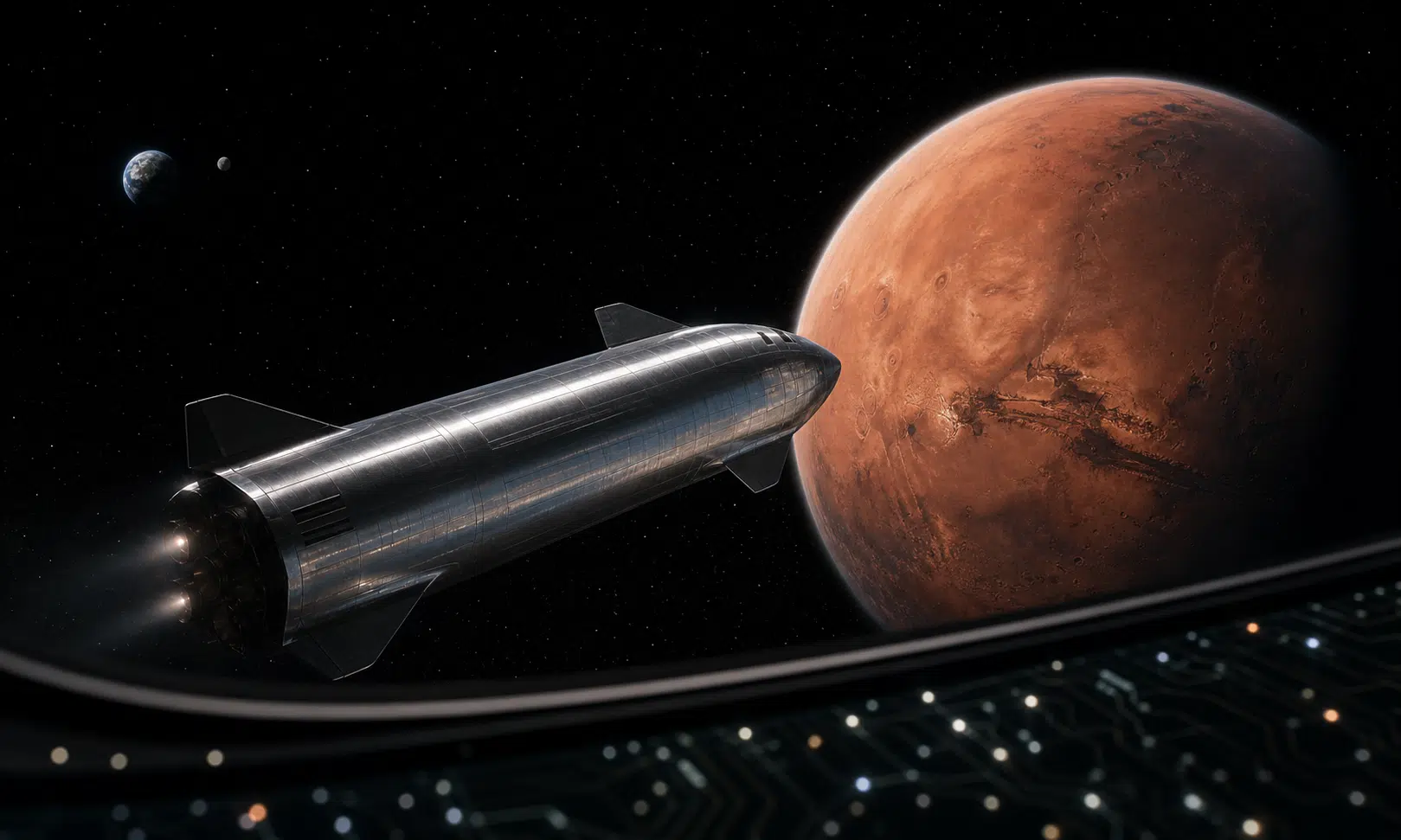

Chun Wang, the crypto investor best known as a co-founder of F2Pool, is set to command SpaceX’s planned first private human interplanetary mission, a Starship flight designed to travel beyond the Earth-Moon system, pass Mars and return to Earth.
The mission places one of bitcoin mining’s early figures at the center of a much larger test for SpaceX: whether Starship can eventually support long-duration crewed operations far outside low Earth orbit. The plan, as described by SpaceX and reported by industry outlets, is not a Mars landing. It is a flyby mission, and that distinction matters. A crewed flyby would still be a major step, but it would avoid the far harder challenge of landing people on Mars and launching them back home.
Wang has already flown with SpaceX. In 2025, he commanded Fram2, a privately funded Crew Dragon mission that became the first human spaceflight to orbit Earth over both polar regions. That flight helped establish Wang as more than a buyer of a private seat; he served as mission commander and selected the crew.
What SpaceX Says the Mission Is Meant to Test
The planned Mars flyby is being framed as a long-duration Starship demonstration rather than a conventional tourism flight. A two-year journey beyond the Earth-Moon system would test life support, radiation exposure, autonomous operations, vehicle reliability and deep-space navigation over a time span far beyond SpaceX’s existing human spaceflight experience.
Before that interplanetary mission, Wang is also expected to join Dennis and Akiko Tito on a separate Starship commercial flight around the Moon. That circumlunar mission is planned as a shorter deep-space test and would give SpaceX another opportunity to evaluate Starship systems before sending a crew toward Mars.
SpaceX has linked these private missions to its broader Mars ambitions, including the long-term goal of moving large amounts of cargo and eventually people to the Red Planet. Those ambitions remain dependent on Starship proving it can fly repeatedly, refuel in space and operate safely with crews.
To mitigate the risks of longer missions, SpaceX is expected to rely on the next generation of Starship hardware. However, specific claims around the vehicle’s final Starship V3 configuration and deep-space systems have not been independently verified, and the program remains in active development.
Why Wang’s Crypto Background Matters
Wang’s selection connects two industries that have often drawn the same kind of private capital: crypto and commercial spaceflight. F2Pool is one of the oldest bitcoin mining pools, and recent network data has placed it around 11% of global bitcoin hashrate. That figure refers to the mining pool’s share of network activity, not necessarily to Wang personally controlling that amount of computing power.
The broader point is still clear: Wang comes from the early bitcoin infrastructure world, where large pools helped professionalize mining and coordinate block production at scale. His move into private spaceflight shows how some crypto wealth has flowed into frontier technology projects outside digital assets.
That does not mean the Mars mission is a crypto mission. SpaceX’s objective is technical: prove whether Starship can carry people into deep space for extended periods. Wang’s role is notable because of his background, but the mission’s importance will be measured by spacecraft performance, crew safety and the data returned from the flight.
The Risks Are Larger Than the Headline
A Mars flyby would expose the crew and vehicle to a very different operating environment than a short orbital flight. Low Earth orbit missions can return quickly in an emergency. A deep-space trajectory offers far fewer options once the vehicle is committed.
Key challenges include:
- Keeping life-support systems stable for roughly two years.
- Managing radiation exposure outside Earth’s protective magnetic environment.
- Maintaining propulsion, power and thermal systems over long coasting periods.
- Executing navigation and return maneuvers with limited room for error.
- Supporting crew health and decision-making during prolonged isolation.
Fram2 offered a much shorter test of private astronaut operations, but it did include science and medical research relevant to future long-duration missions. A Mars flyby would move that work into a more demanding environment, where small system failures could become much harder to manage.
A Step Toward Mars, Not Mars Settlement
The planned mission should be read as an early proof point, not as evidence that routine Mars travel is close. Starship still has to demonstrate the reliability, reuse and in-space operations required for ambitious crewed missions. NASA’s lunar plans also depend on versions of Starship, which adds pressure for the vehicle to mature before private Mars timelines become realistic.
Still, the announcement is significant because it gives SpaceX’s Mars roadmap a named private commander with previous SpaceX flight experience. Wang is not being introduced as a first-time passenger. He has already commanded a private orbital mission and is now tied to the next, far riskier phase of SpaceX’s commercial human spaceflight strategy.
For the crypto industry, the story is partly symbolic: an early bitcoin mining entrepreneur is now attached to one of the most ambitious private spaceflight proposals yet. For SpaceX, the larger question is practical. If Starship can safely carry people around the Moon and later past Mars, the company will have taken a measurable step from testing rockets toward operating crewed spacecraft across deep space.