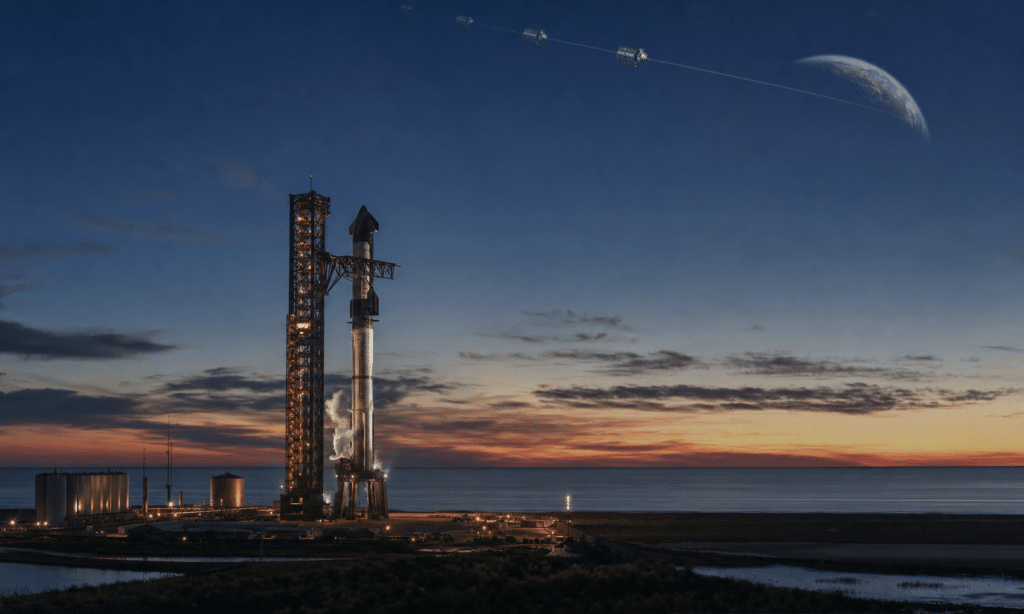
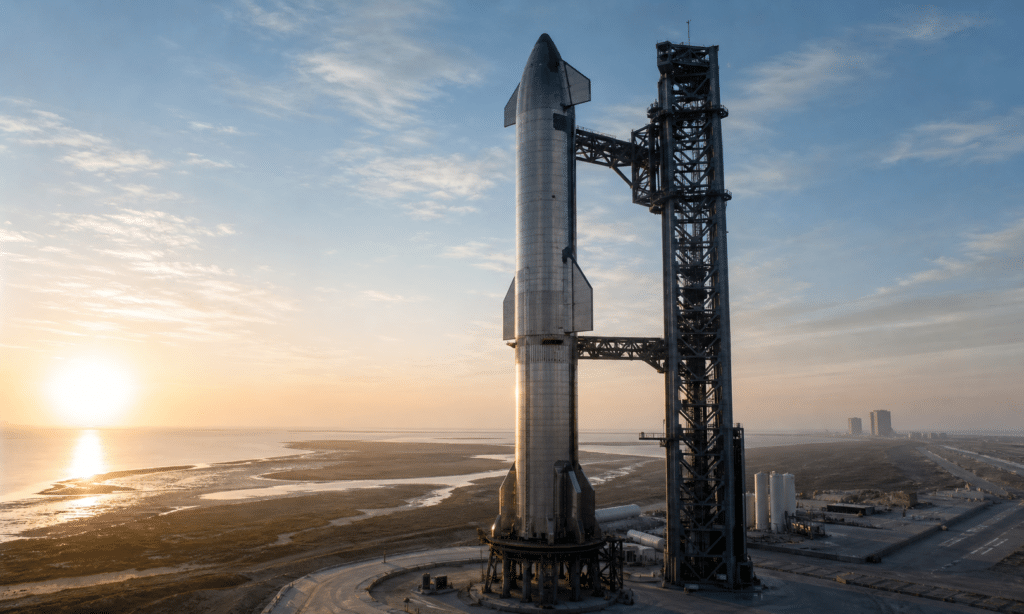
SpaceX launched Starship and its Super Heavy booster together for the first time on April 20, 2023, from Starbase in South Texas. The flight ended in the vehicle’s destruction about four minutes after liftoff, before the two stages separated, leaving later phases of the planned test unperformed.
SpaceX said multiple engines stopped working during the flight, the vehicle lost altitude and began tumbling, and the flight termination system was activated on both stages. The launch demonstrated that the combined vehicle could leave the pad, but it did not demonstrate a complete flight or recovery.
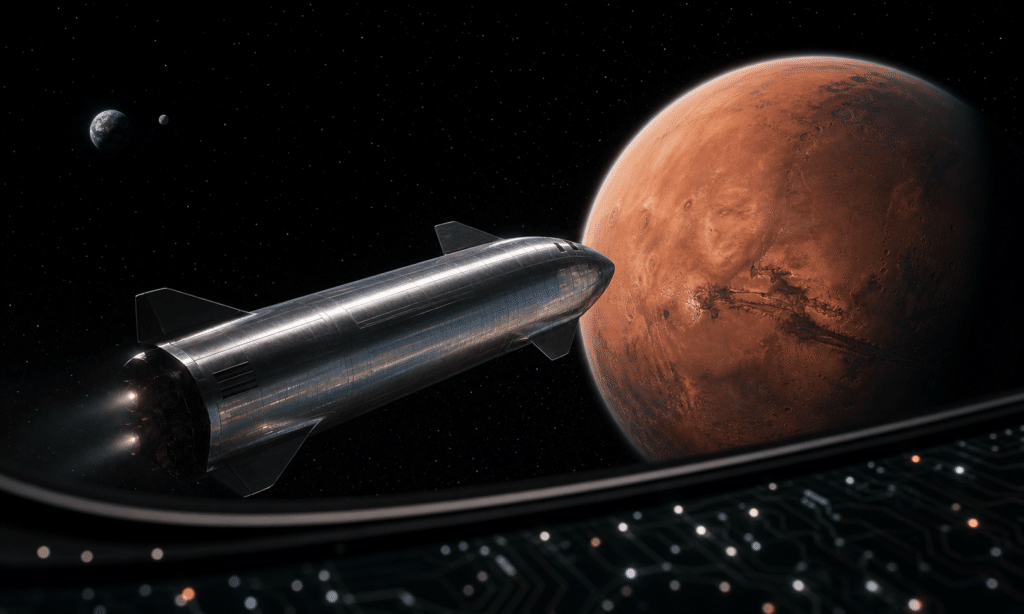
The test followed two decades of development spanning smaller orbital rockets, International Space Station cargo deliveries, booster reuse and astronaut transport. SpaceX described Starship as a system intended for full reusability and missions beyond Earth orbit, including Mars. Those ambitions remained development goals at the time of its first integrated flight.
From Falcon 1 to space station deliveries
Elon Musk founded SpaceX in 2002. Its early launch vehicle, Falcon 1, reached orbit in September 2008. That milestone preceded the company’s larger Falcon 9 rocket and Dragon spacecraft, which became the basis of its cargo transportation service for NASA.
NASA’s involvement began before Falcon 1 reached orbit. In August 2006, the agency awarded SpaceX funding to demonstrate cargo delivery and return capabilities for the space station. That work was part of NASA’s Commercial Orbital Transportation Services program. In December 2008, NASA awarded the company a separate $1.6 billion Commercial Resupply Services contract covering 12 cargo flights.
The distinction matters to the company’s development: NASA supported demonstrations of the transportation system and also contracted for subsequent deliveries. The 2008 agreement was part of a relationship already under way, rather than NASA’s first involvement after a successful orbital launch.
Falcon 9 first reached orbit in June 2010. In December that year, SpaceX launched Dragon into orbit and recovered it, demonstrating that the spacecraft could return to Earth. The two vehicles had different roles: Falcon 9 provided the launch, while Dragon carried cargo.
On May 25, 2012, Dragon became the first commercial spacecraft to attach to the International Space Station. Astronauts captured it with the station’s robotic arm and moved it into position for berthing. This was an arm-assisted attachment, distinct from the autonomous docking later used by Crew Dragon.
SpaceX’s first contracted cargo mission, CRS-1, launched in October 2012. Dragon’s role included returning research materials and equipment to Earth as well as delivering supplies. That return capability supported scientists who needed samples brought back from experiments conducted aboard the orbiting laboratory.
Falcon 9 moves from landing to reuse
On December 21, 2015, a Falcon 9 first stage returned to Landing Zone 1 at Cape Canaveral after a launch that delivered 11 communications satellites to orbit. The landing demonstrated recovery of a booster following its role in an orbital launch.
Flying recovered hardware again was a separate milestone. On March 30, 2017, SpaceX launched the SES-10 communications satellite using a previously flown Falcon 9 first stage. That booster had already supported the CRS-8 cargo mission in April 2016.
SpaceX’s stated rationale for reusability was to reduce the cost of space access by flying expensive rocket components more than once. The 2015 landing and 2017 reflight established the practical steps behind that approach: returning a stage and using recovered hardware on another mission.
Crew Dragon extends the NASA partnership
SpaceX’s work with NASA expanded from cargo transport to astronaut flights. On May 30, 2020, Falcon 9 launched Crew Dragon from Kennedy Space Center with NASA astronauts Robert Behnken and Douglas Hurley aboard the Demo-2 mission. The spacecraft docked with the station the following day.
The launch was the first to carry astronauts into orbit from the United States since the Space Shuttle Program ended in 2011. Demo-2 was also Crew Dragon’s first flight with astronauts, following an earlier uncrewed demonstration mission.
NASA used Demo-2 as an end-to-end test of the crew transportation system, covering launch, operations in orbit, docking and landing. The mission was part of the agency’s Commercial Crew Program and the process of certifying SpaceX’s system for regular astronaut transportation to and from the station.