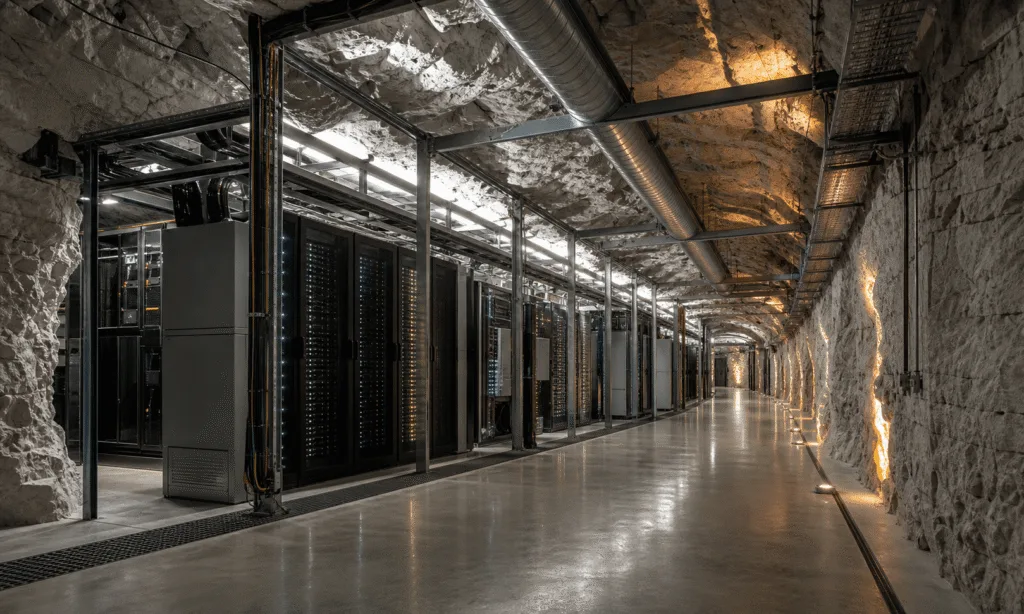
The main works for Intacture, a €50.2 million (about $58 million) data center inside an active mine in the Italian Alps, are complete, provincial vice president Achille Spinelli said in a statement issued April 3 by the Autonomous Province of Trento.
The Trentino DataMine project is an underground data center built into the Tuenetto di Predaia quarry in Val di Non, northern Italy, where dolomite extraction continues. Project materials describe more than 80% of its area as underground, reaching depths of 100 meters (328 feet).
The provincial administration said the center was operating at 800 kilowatts during its startup phase. Trentino DataMine executive Dennis Bonn said expansion was planned in stages to reach 6 megawatts. The project’s October 2024 presentation listed a maximum nominal capacity of 5 megawatts; the April statement does not explain how the two specifications relate.
Public and private backing
The University of Trento is the project’s implementing body and scientific leader. Its private partners are construction company Covi Costruzioni, IT services group Dedagroup, health technology company GPI and investment holding company ISA–Istituto Atesino di Sviluppo. The partnership was formally established in September 2023.
University project documents set out €18.4 million (about $21 million) in funding through Italy’s National Recovery and Resilience Plan, with approximately €31.8 million from private resources.
The partners intend the facility to provide data hosting services for public and private organizations and support research in artificial intelligence, health, cybersecurity and the energy transition.
Cooling and surface land use
The provincial administration describes the underground rooms as having a constant temperature of 12°C (53.6°F) and no humidity. It says fresh valley air and the surrounding dolomite rock help cool the facility, and describes the electricity supply as entirely renewable, predominantly from locally produced hydropower.
The October 2024 project presentation set a power usage effectiveness target below 1.25 and cited 1.6 as the European data center average. PUE is the ratio of a facility’s total energy consumption to the energy used by its IT equipment; a lower figure indicates less energy overhead from supporting systems such as cooling.
The same presentation estimated that a fully aboveground version of the project would occupy an area equivalent to 21 Olympic-size swimming pools, compared with a little more than one for the underground design’s surface footprint.
Construction inside a working mine
The provincial administration said construction involved extracting 63,000 cubic meters of rock (about 2.2 million cubic feet), excavating 15 kilometers (9.3 miles) of tunnels and building a vertical shaft, known locally as a “fornello,” more than 40 meters (131 feet) deep to connect the working galleries with the surface.
The mine also contains underground spaces used to store apples, sparkling wine and cheese, with those activities continuing alongside the data center project.
Other European underground data center projects include Cegeka’s announced development in Belgian Limburg, Mount10’s conversions of Swiss Alpine bunkers in the 1990s and Norway’s Lefdal Mine Datacenter, which opened in 2017.