

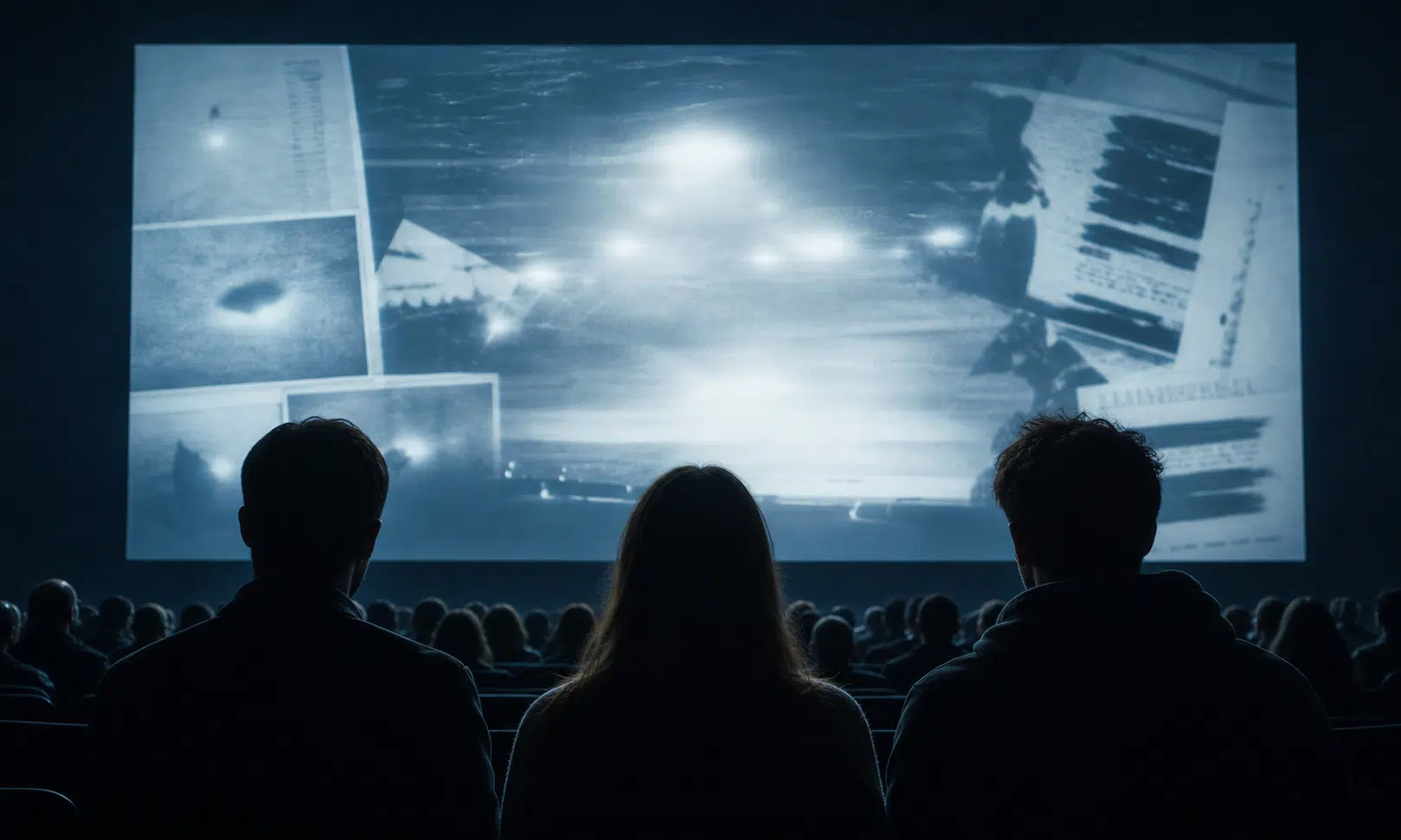

Steven Spielberg’s Disclosure Day is positioned as the kind of large-scale science-fiction movie that invites comparisons to the director’s earlier alien stories, though the film appears to be reaching for a different temperature: less innocent awe, more suspicion, urgency and moral pressure.
That distinction matters for anyone deciding whether to see it. This is not described as a gentle return to E.T. or a simple reworking of Close Encounters of the Third Kind. It is a PG-13, 145-minute sci-fi thriller about proof of nonhuman life, a hidden organization guarding that proof, and ordinary people pulled into a disclosure crisis they are not prepared to control.
The result, at least on the evidence of the film’s reported shape and critical response, is a Spielberg event movie built from familiar materials: a chase narrative, government secrecy, an alien mystery, carefully staged suspense and an emotional center that depends heavily on performance. The draw is not only the UFO premise. It is the chance to see Spielberg, David Koepp and John Williams working in a mode that connects spectacle to character instead of treating scale as the whole point.
Verdict: A Big Sci-Fi Thriller for Viewers Who Want Spielberg in Sincere Mode
Disclosure Day looks most likely to satisfy viewers who want a serious, emotionally driven summer sci-fi movie rather than a hard-edged alien horror film or a puzzle-box conspiracy thriller. Its reported strengths are clear: Emily Blunt and Josh O’Connor anchor the human story, Colin Firth gives the pursuit plot a colder authority, and Spielberg’s command of movement, suspense and sentiment remains central to the appeal.
The tradeoff is that the film’s biggest ideas may not be its most surprising ones. A cover-up involving alien evidence, a powerful organization trying to contain the truth, and fugitives trying to reveal it are familiar genre parts. The question is whether Spielberg’s control of tone, pacing and feeling makes those parts play freshly enough.
For many viewers, that will be enough. Disclosure Day is not being sold as a small, ambiguous art-house encounter with the unknown. It is a mainstream sci-fi thriller with a major cast, a theatrical scale and a premise that asks whether humanity can handle a truth larger than itself.
| Film | Disclosure Day |
|---|---|
| Director | Steven Spielberg |
| Screenplay | David Koepp, from a story by Spielberg |
| Cast | Emily Blunt, Josh O’Connor, Colin Firth, Eve Hewson, Colman Domingo, Wyatt Russell, Henry Lloyd-Hughes and Elizabeth Marvel |
| Rating | PG-13 |
| Runtime | 2 hours, 25 minutes |
| U.S. theatrical date | June 12, 2026 |
What Disclosure Day Is About
The film centers on an alien disclosure crisis, but it appears to approach that crisis through two separate human threads. One follows Daniel Kellner, played by Josh O’Connor, a technically gifted figure connected to Wardex, an organization tied to hidden evidence of nonhuman contact. Daniel becomes a fugitive after taking material that could expose what Wardex has kept from the public.
The other follows Margaret Fairchild, played by Emily Blunt, a Kansas City meteorologist whose life is disrupted by strange abilities and signals she cannot explain. Her connection to Daniel becomes the story’s central mystery, with the film gradually linking personal identity, memory and extraterrestrial contact.
Colin Firth plays Noah Scanlon, the authority figure trying to contain the leak. The role gives the film a human antagonist rather than a simple monster or alien threat. Scanlon’s danger appears to come from conviction as much as cruelty: he believes secrecy serves a national or institutional purpose, even as his methods become increasingly severe.
Colman Domingo’s Hugo Wakefield functions as an ally to Daniel and Margaret, guiding them through the implications of what they are carrying and what they may be. Eve Hewson’s Jane Blankenship is tied closely to Daniel’s flight and to the film’s moral and spiritual questions. Wyatt Russell appears in a more limited role connected to Margaret’s ordinary life before the extraordinary parts of the story take over.
The setup gives Disclosure Day a practical tension. It is not simply asking whether aliens exist inside the world of the film. It is asking who gets to know, who gets to decide, and what happens when information that could change human history is treated as property.
Spielberg’s Alien Movie, but Not a Nostalgia Exercise
Any Spielberg alien movie will be measured against Close Encounters of the Third Kind and E.T., fairly or not. Disclosure Day appears aware of that lineage without simply repeating it. The reported tone is more anxious and political, with a shadow agency, fugitives and surveillance pressure pushing the story closer to a paranoid thriller.
That shift is useful. Spielberg’s earlier alien films often framed contact through wonder, fear, childhood or faith. Disclosure Day seems more interested in what institutions do when wonder becomes evidence. If the older films asked what contact might feel like, this one asks what powerful people might do to control the meaning of that contact.
The comparison to Spielberg’s broader filmography is also unavoidable. Jaws, Raiders of the Lost Ark, Jurassic Park and Minority Report all show different versions of his gift for popular storytelling: suspense, pursuit, visual clarity and moral unease. Disclosure Day appears to draw from that larger toolkit. It has the alien imagery of one Spielberg tradition, the chase mechanics of another, and the ethical anxiety that shaped some of his darker genre work.
The risk is that this kind of self-echo can feel too neat if the movie leans on recognition alone. The opportunity is that Spielberg knows how to make a familiar frame feel alive through staging: where the camera sits, when the music rises, how a character looks at something impossible, and how quickly a moment of awe can turn into danger.
The Performances Are the Main Selling Point
Emily Blunt is positioned as the film’s emotional center. Margaret’s arc asks her to move from confusion and fear into a more purposeful understanding of what is happening to her. That kind of role depends on calibration. If the panic is too broad, the mystery collapses into melodrama. If the control arrives too quickly, the danger loses force. Blunt’s appeal here is that she can play intelligence, alarm and resolve in the same scene without making the transitions feel mechanical.
Josh O’Connor’s Daniel gives the film a different texture. He is described less as a conventional action hero than as someone thrust into field danger because he knows too much and has taken something too important. That distinction helps the chase plot. A character who is not built for violence can make pursuit scenes feel more vulnerable than heroic.
Together, Margaret and Daniel appear to give Disclosure Day its emotional charge. The film’s mystery is not only about what Wardex has hidden, but why these two people are connected and what their abilities or knowledge mean. That is the sort of character-first structure Spielberg tends to handle well when the script gives him room to breathe between set-pieces.
Firth, meanwhile, is the film’s pressure system. Playing Noah Scanlon against the easy warmth associated with some of his best-known roles, he reportedly brings severity and intelligence to the antagonist. That matters because Disclosure Day does not need a cartoon villain. It needs someone who can make secrecy sound reasonable, even as the consequences become threatening.
Domingo’s Hugo gives the story a steadier moral presence. His role as a guide and former insider lets the film explain its world without relying only on exposition dumps. Hewson’s Jane adds a faith and conscience dimension, while Russell’s character provides a glimpse of the life Margaret is forced to leave behind.
Action, Pacing and Spielberg’s Craft
The film’s thriller engine appears to start quickly, with Daniel already under pressure and Wardex trying to recover what he has taken. That opening structure matters because it avoids spending too long on setup. The audience is asked to catch up while the characters are already moving.
The reported standout action includes a high-speed pursuit involving a car and a moving train. On paper, that kind of sequence can sound like standard blockbuster escalation. In Spielberg’s hands, it usually comes down to geography and rhythm: the viewer understands where everyone is, what each movement costs and why the danger is rising.
That clarity is one reason Spielberg’s action scenes often remain legible even when they are busy. He tends to build suspense from physical cause and effect rather than from visual clutter. Disclosure Day seems to rely on that discipline, with editor Sarah Broshar’s pacing and John Williams’ score helping maintain pressure across a long runtime.
Williams’ involvement is especially meaningful for this kind of film. A story about alien contact, human fear and possible transcendence gives him a wide musical range: propulsion for the chase material, unease for the conspiracy elements and emotional lift for the more spiritual passages. The score has been singled out as one of the film’s major assets, and for many Spielberg viewers, that collaboration is part of the reason to buy a ticket.
Janusz Kaminski’s cinematography is another key part of the package. The film is described as visually controlled, with a muted palette shaped by pointed lighting rather than glossy over-decoration. That approach fits the premise. A disclosure story should feel like something hidden is pushing through a sealed world, not like every image is trying to announce spectacle.
Where the Film May Divide Viewers
Disclosure Day’s biggest potential weakness is also built into its concept. Alien disclosure stories carry a heavy load of expectation. Some viewers want mystery. Some want answers. Some want politics. Some want transcendence. A movie that tries to balance all of those can feel either rich or overextended, depending on how cleanly the final act lands.
The film also appears to use familiar genre devices: coded messages, secret archives, mind-based abilities, institutional pursuit and a public truth being suppressed. Those ideas are not automatically stale, but they need precise execution. If the emotional logic is strong, audiences may accept the familiarity. If it becomes too convenient, the machinery may show.
There are also signs that some details may play broadly, including the idea that alien presence can be connected to familiar animal forms. That may work for viewers open to Spielberg’s sentimental register. It may feel too soft or too symbolic for those hoping for a colder, more rigorous science-fiction thriller.
The global stakes, including unrest and nuclear anxiety, seem to sit in the background rather than dominate the story. That choice keeps the focus on Margaret, Daniel and the pursuit plot, but it may leave some viewers wanting a fuller sense of how the wider world is reacting to the possibility of disclosure.
For buyers deciding between a theatrical ticket and waiting, the key question is simple: are you going for plot novelty, or for Spielberg’s orchestration of feeling and suspense? If the former is your priority, Disclosure Day may sound familiar. If the latter is enough, the film’s scale and craft argue for seeing it on the biggest screen available.
Who Should See Disclosure Day in Theaters
Disclosure Day is best suited for viewers who still value the theatrical version of a Spielberg event movie: large images, swelling music, clean suspense and a sincere belief that spectacle should carry an emotional charge. It is also a natural choice for fans of Blunt, O’Connor, Firth and Domingo, since the cast appears to be doing much of the work that keeps the premise grounded.
It may be less ideal for viewers who want hard science fiction, minimalist ambiguity or a radically new take on alien contact. The film seems more interested in mythic and emotional resonance than in procedural realism. That is not a flaw by itself, but it is an important expectation to set.
- See it in theaters if you want a character-driven sci-fi thriller with Spielberg scale.
- Consider waiting if familiar UFO-conspiracy beats tend to frustrate you.
- Choose a premium screen if John Williams’ score and large-format spectacle are part of the appeal.
- Expect suspense, emotion and pursuit mechanics rather than a purely cerebral alien mystery.
The PG-13 rating and 145-minute runtime also matter for families and casual moviegoers. This is not a quick, lightweight alien adventure. It appears to be a full-length summer thriller with moments of intensity, government menace and emotional weight.
Final Take
Disclosure Day appears to find Spielberg returning to one of his defining subjects without pretending the world around that subject has stayed innocent. The wonder is still there, but it is filtered through secrecy, control, fear and the question of whether truth can survive the institutions built to contain it.
That makes the movie more compelling as a viewing decision. It is not simply another alien film, and it is not only a nostalgia play for people who grew up on Spielberg’s earlier classics. Its appeal rests on whether Spielberg can make a familiar disclosure premise feel intimate, urgent and emotionally earned.
Based on the reported elements, the strongest case for seeing Disclosure Day is the combination of cast, craft and theatrical scale. Blunt and O’Connor give the story its vulnerable center, Firth gives it menace, Domingo gives it conscience, and Spielberg gives it the kind of visual and musical shape that still matters most in a cinema.
For viewers who want a thoughtful but accessible sci-fi thriller, Disclosure Day looks like one of the year’s clearest big-screen choices.