

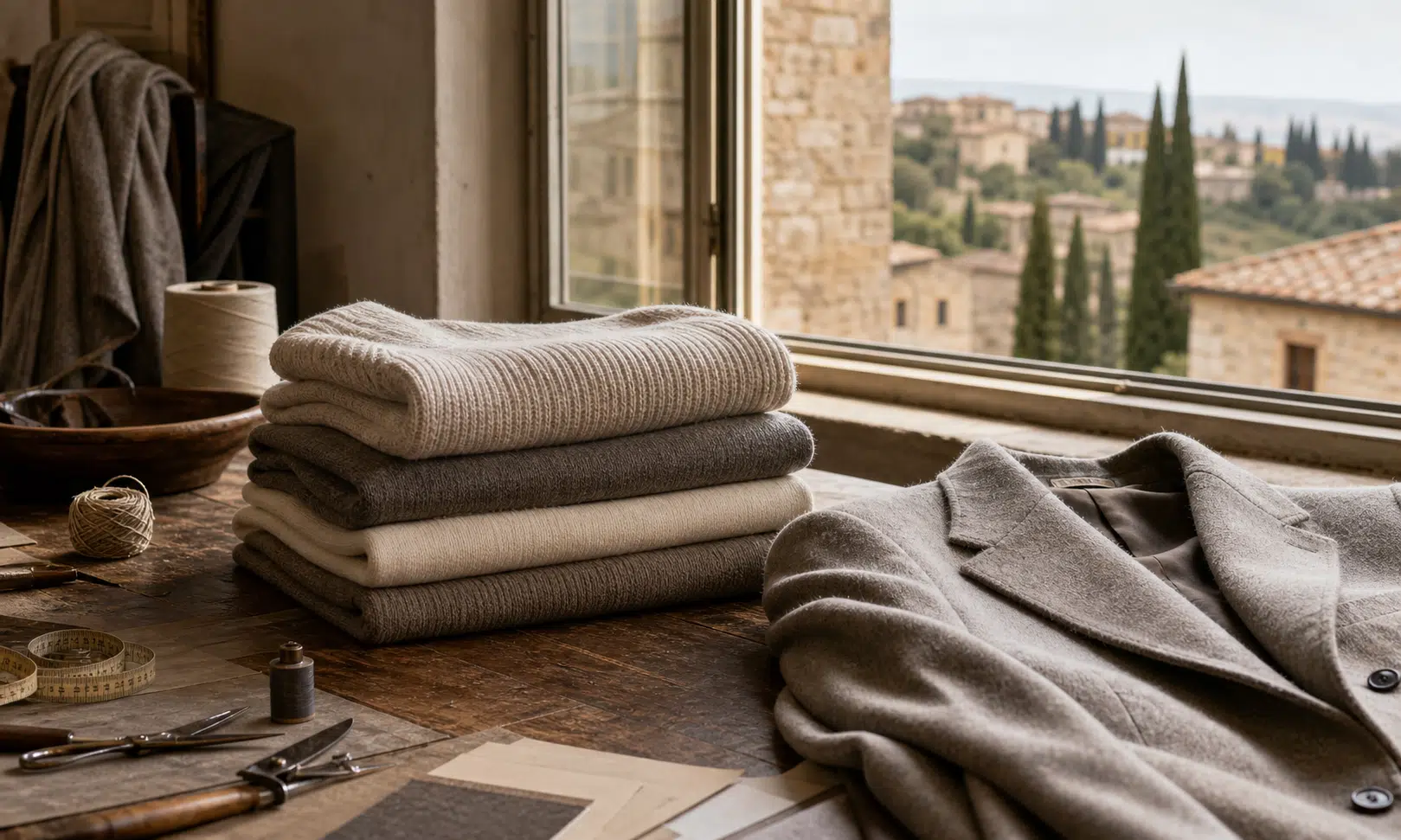

Brunello Cucinelli is best known as the Italian designer and entrepreneur behind one of luxury fashion’s most recognizable cashmere houses. The brand’s appeal has never rested only on soft knitwear or high prices. It is also tied to a carefully cultivated story about craft, restraint, work, dignity, and the small Umbrian village of Solomeo.
The source material presents Cucinelli as having been born in 1953 to a farming family in rural Italy and raised in modest conditions, including a home without electricity or running water. Because those early-life details were not independently verified in the provided material, they are best treated as part of the company founder narrative rather than as newly confirmed biographical facts.
What is clear from the brand story is the role that rural life, manual work, and Italian craft play in how Cucinelli explains his business. A quote attributed to him recalls the sensory memory of farming life: the scents, sounds, and lights of the place where he was born. Whether read as biography, brand language, or both, that memory helps explain why the company puts so much emphasis on material quality, place, and human labor.
From Cashmere Sweaters to a Luxury House
The source describes Cucinelli as entering fashion through colorful cashmere sweaters in 1978, when he was 25. It also says he borrowed 500,000 lire to start the company. Those details should be handled cautiously because they were not independently verified here, but they remain central to the way the Cucinelli story is usually told: a small, focused idea built around cashmere at a time when color gave the product a distinct identity.
The early business is also described as difficult. According to the source, Cucinelli had little fashion-industry experience and personally approached boutiques to persuade them to carry his sweaters. That account should not be presented as freshly verified reporting, but it does fit the broader portrait of a founder-led brand built through persistence, product conviction, and a narrow initial category.
A quote attributed to Cucinelli says he was convinced by the idea of making high-quality garments that reflected Italian craftsmanship and manual skill. That line captures the practical buying argument still attached to the label: customers are not only paying for a designer name, but for cashmere, construction, finishing, and a slower idea of luxury.
For buyers considering Brunello Cucinelli, that distinction matters. The brand is not positioned as trend-driven fashion first. Its value proposition is closer to quiet luxury: refined materials, soft tailoring, muted styling, and pieces intended to stay wearable beyond a single season.

Conair Battery-Operated Fabric Shaver
A fabric shaver can help remove light pilling from sweaters, knit jackets, and other soft wardrobe pieces. Use gentle pressure and test on a discreet area first, especially with delicate cashmere.
As an Amazon Associate I earn from qualifying purchases.
The Solomeo Identity
One of the most important parts of the Brunello Cucinelli story is Solomeo, the Umbrian village closely associated with the company. The source says Cucinelli bought a 14th-century castle there in 1985 and made it the company’s headquarters. Since that specific claim was not independently verified in the provided fact-check layer, it should be softened: Solomeo is presented in the brand narrative as more than an office location; it functions as a physical expression of the company’s values.
The source also describes restored buildings, a company theater, a library, and spaces connected to craft and culture. Those details should be treated as part of the brand’s stated world rather than as independently audited claims. Still, they are important because they show how Cucinelli has used place as a competitive advantage.
Most luxury brands lean heavily on fashion capitals, flagship stores, celebrity visibility, and runway momentum. Cucinelli’s identity is quieter. Solomeo gives the label a sense of rootedness: an image of stone buildings, workshops, artisanship, and long-term stewardship. For customers, that can make the clothes feel less like seasonal merchandise and more like objects connected to a specific culture of making.
Humanistic Capitalism as Brand Strategy
Cucinelli is closely associated with the phrase “humanistic capitalism.” A quote attributed to him describes it as pursuing fair profit while trying to cause as little harm as possible to creation and humanity. The exact wording should be treated as attributed rather than independently verified here, but the concept is central to the company’s public identity.
In practice, the source links this philosophy to employee treatment, work-life balance, community investment, and the restoration of Solomeo. It says the company pays workers 20% above market rate, donates 20% of profits to charity, and ends the workday at 5:30 p.m. Because those specific operational claims were not independently verified in the provided material, they should not be stated as confirmed facts. A safer reading is that the Cucinelli brand publicly emphasizes higher human standards at work and uses those standards as part of its luxury positioning.
That positioning is commercially powerful. Luxury buyers often look for more than fabric and fit. They want confidence that a product has a coherent reason to cost what it costs. Brunello Cucinelli answers that question through a mix of cashmere, Italian craftsmanship, restrained design, and a founder philosophy centered on dignity.
What Buyers Should Notice
For someone deciding whether Brunello Cucinelli is worth the price, the useful question is not whether every piece is “better” in an abstract sense. It is whether the brand’s strengths match the buyer’s priorities.
- Material quality: The brand is especially associated with cashmere and soft luxury fabrics.
- Design language: Pieces tend to favor understated color, relaxed tailoring, and low-key refinement.
- Brand values: The company’s image is closely tied to craft, dignity, culture, and Solomeo.
- Longevity: The strongest purchases are likely to be pieces that can be worn often and maintained well.
- Price discipline: Buyers should separate genuine wardrobe value from the emotional appeal of the brand story.
The best Cucinelli purchase is usually not an impulse buy. It is a considered piece: a cashmere sweater, knit jacket, tailored trouser, outerwear piece, or accessory that fits an existing wardrobe and will be cared for properly. The brand makes the most sense for buyers who prefer subtlety over logos and texture over obvious novelty.
Business Lessons Without the Mythmaking
The source frames Cucinelli’s career through several lessons: build around a philosophy, resist industry norms, use physical spaces to express values, draw from older ideas, and turn a hometown into an advantage. Those are useful observations, but they should not be inflated into proof that every stated policy or anecdote is fully verified.
The stronger takeaway is simpler: Brunello Cucinelli built a luxury business with an unusually consistent story. Product, place, founder language, workplace ideals, and retail image all point in the same direction. That consistency is hard to copy because it depends on more than a marketing campaign.
For business readers, the case is not just about ethics or aesthetics. It is about alignment. A brand becomes more durable when its materials, pricing, operations, public language, and customer experience all support the same promise. In Cucinelli’s case, that promise is a refined version of Italian luxury built around cashmere, craft, civility, and place.
A Brand Built on More Than Cashmere
The source calls Cucinelli the “King of Cashmere,” a title that reflects his public reputation but should be read as a nickname rather than a measurable claim. The more useful description is that he has turned cashmere into the center of a broader business philosophy.
That is why Brunello Cucinelli remains interesting to both buyers and business observers. The clothes matter, but so does the world built around them. For customers, the decision comes down to whether the quality, restraint, and philosophy justify the premium. For entrepreneurs, the lesson is that a brand can become stronger when its commercial success is tied to a clear, lived point of view rather than only to product features.