

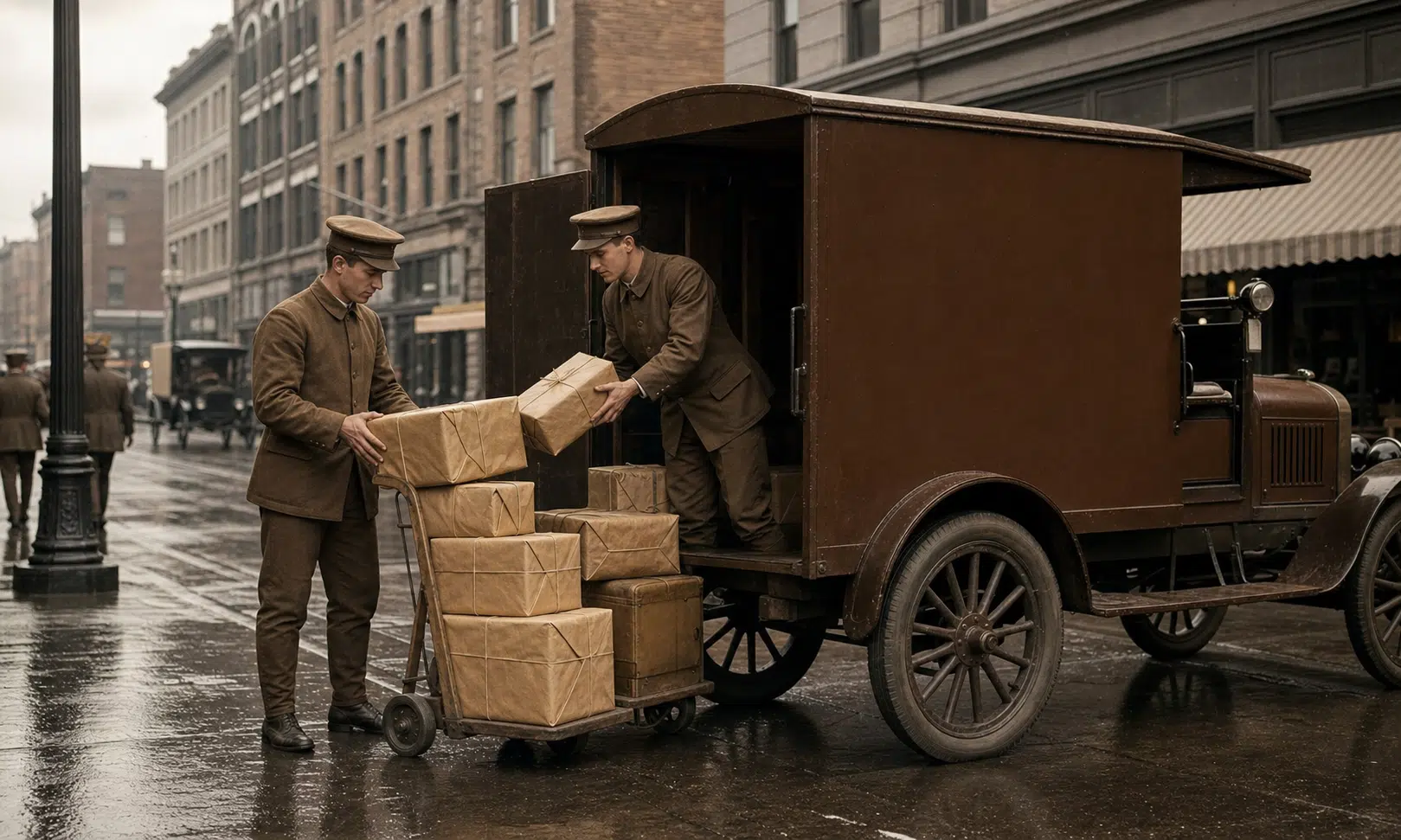

The UPS history is usually told as a story of steady adaptation rather than sudden invention. The familiar version begins in Seattle in 1907, when Jim Casey and Claude Ryan are said to have started the American Messenger Company with a small loan and a focus on errands, messages, and local delivery work.
That founding story is often repeated because it captures something useful about the company: UPS did not begin as a global logistics system. It began with a practical service in a specific city, serving customers who needed messages and small items moved reliably.
Some of the most colorful details in that early account, including later quoted recollections attributed to Casey, are difficult to treat as verified without stronger sourcing. What can be said more carefully is that the company built its identity around discipline, service consistency, and a willingness to change when the market changed.
From Messages to Parcels
The early American Messenger Company operated in a delivery market that was crowded, local, and physically demanding. Seattle’s hills, competing messenger firms, and thin margins all made the work difficult. The business survived by focusing on the kind of dependable service customers would use again.
A major turning point in the company story came as retail delivery became more important. Stores needed a practical way to get purchases to customers, and the business moved beyond message delivery toward parcels. That shift mattered because it put the company closer to a larger, more durable need: moving goods, not just information.
By the late 1910s, the company is commonly described as having expanded beyond Seattle and adopted the United Parcel Service name. UPS, as a brand, grew out of that broader parcel-delivery role rather than the messenger work alone.
Growth Built on Operating Discipline
The source material frames UPS as a company shaped by details: uniforms, service standards, appearance, routing, and local decision-making. Some specific claims about founder policies and internal management practices should be treated cautiously, but the larger editorial point is reasonable: delivery businesses win or lose on execution.
For a parcel company, reliability is not an abstract value. It shows up in whether a driver arrives when expected, whether a package is handled consistently, and whether customers trust the service enough to use it again. UPS’s reputation was built around those operational habits as much as around expansion.
The company’s brown vehicles are also part of that identity. The source suggests the color choice began as a practical decision and became a recognizable brand asset. Whether every detail of that origin story is fully verified or not, the broader lesson is clear: a useful operating choice can become part of a company’s public image when it is repeated consistently for decades.
Setbacks and Adaptation
The source points to several periods of pressure: wartime constraints, changing retail patterns, labor tension, e-commerce, globalization, and environmental concerns. Some details, including quoted language and precise descriptions of internal lessons, should not be repeated as confirmed fact without stronger evidence.
Still, the pattern is useful. UPS is presented as a company that had to keep adjusting its model as customers, labor markets, and commerce changed. The move from local errands to parcel delivery was one adaptation. Later, the rise of home delivery, business shipping, and online retail pushed the company further into large-scale logistics.
The 1997 Teamsters strike is also part of the company’s modern history in the source account. Rather than dramatizing it, it is enough to say that labor relations became a visible test of the company and its operating model. For a delivery network, a labor disruption is not a side issue. It affects customers, schedules, costs, and trust.
What the UPS Story Shows
The most useful reading of the UPS story is not that a small idea automatically becomes a giant company. It is that a simple service can grow when the business keeps matching its operations to changing demand.
Several practical themes stand out:
- Start with a real customer need, even if it looks ordinary.
- Build trust through consistent execution, not slogans.
- Change the service model when the market changes.
- Treat brand identity as something reinforced by daily operations.
- Do not separate labor, logistics, and customer experience; in delivery, they are connected.
The source closes with a famous line attributed to Jim Casey: “Determined people, working together, can do anything.” That quotation should be handled cautiously unless independently verified. But the sentiment fits the company story as it is usually told. UPS became notable not because its beginning was glamorous, but because the business kept turning practical delivery work into a larger system.