


SpaceX’s move into the public markets has inevitably been framed around Elon Musk. That is how most SpaceX stories are framed: Musk supplies the ambition, the timeline pressure, the public drama, and the gravitational pull for investors.
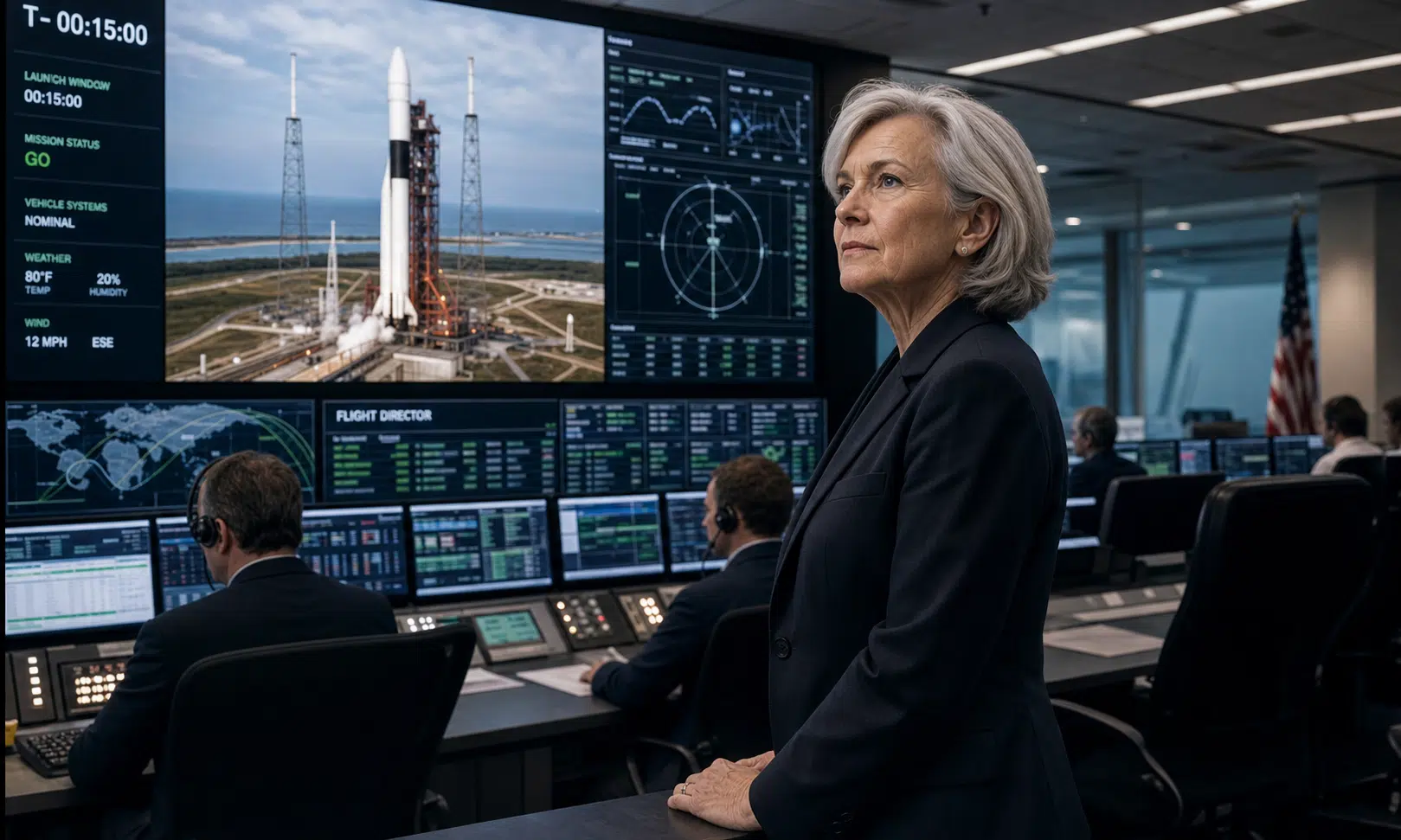
But the company’s public debut also puts a different figure closer to the center of the story: Gwynne Shotwell, SpaceX’s president and chief operating officer. For more than two decades, Shotwell has been the executive most closely associated with turning SpaceX’s technical bets into a working launch business, a government contractor, and the operator behind Starlink.
That distinction matters more for a public company than it did for a private one. Investors can be drawn in by reusable rockets, Mars plans, and satellite broadband. They will stay, or leave, based on launch cadence, contract execution, customer trust, margins, governance, and whether the company can keep converting engineering breakthroughs into predictable revenue.
The operator behind the spectacle
Shotwell joined SpaceX in 2002, the year Musk founded the company, and later became its president and COO. Her role has long centered on day-to-day operations, customer relationships, and the commercial structure around SpaceX’s engineering programs.
That is not the part of SpaceX that tends to dominate public attention. The more visible story is the rocket landing, the Starship test, the Mars speech, or the next large claim about the future of space. Shotwell’s work sits underneath that: negotiating with customers, keeping government relationships intact, building launch manifests, and helping make SpaceX a company that agencies and commercial satellite operators could rely on.
Her background fits that operating role. Shotwell trained as an engineer, earning degrees from Northwestern University, and worked at The Aerospace Corporation before joining Microcosm and then SpaceX. She brought technical fluency to a job that was never just sales, even when business development was central to it. Selling a rocket launch requires convincing customers that the vehicle will exist, work, fly on schedule, and be backed by a company that can survive long enough to deliver.
At SpaceX, that combination became unusually important. The company was not selling incremental improvements to an established product. It was asking customers, including NASA and the U.S. government, to trust a new entrant in a market defined by high cost, low tolerance for failure, and deep institutional caution.
Why the NASA contracts still matter
The most important early example came after Falcon 1 reached orbit in 2008 on its fourth attempt. SpaceX had endured three failed launches and was under severe financial pressure. Later that year, NASA awarded SpaceX a Commercial Resupply Services contract valued at about $1.6 billion for cargo missions to the International Space Station.
That contract did more than bring in money. It helped validate SpaceX as a serious provider for NASA and gave the company a path toward Falcon 9, Dragon, and eventually crewed flights. SpaceX later became the first private company to send NASA astronauts to orbit, with Crew Dragon carrying astronauts to the International Space Station in 2020.
Shotwell’s importance is clearest in that bridge between technical success and institutional trust. A rocket reaching orbit is the proof that the hardware can work. A NASA contract is proof that a customer with high standards is willing to build a program around it. SpaceX needed both.
The pattern has continued across the company’s major businesses. Falcon 9 became a dominant launch vehicle for commercial satellites, national security missions, NASA payloads, and Starlink deployments. Starlink gave SpaceX a second business line with a much larger consumer and enterprise footprint than launch alone. NASA has also selected SpaceX to develop the U.S. Deorbit Vehicle for the International Space Station, a contract with a potential value of up to $843 million.
None of that makes Shotwell the sole author of SpaceX’s rise. Musk’s technical direction, appetite for risk, capital-raising ability, and insistence on reusability are central to the company’s identity. But SpaceX’s story has never been only about vision. It has also depended on the less glamorous work of making ambitious systems repeatable, sellable, and credible to customers that cannot afford surprises.
Public markets change the test
Going public changes the audience. A private SpaceX could answer mainly to Musk, its board, major investors, employees, and customers. A public SpaceX has to answer to a broader market that prices growth but also punishes missed expectations, governance concerns, and inconsistent execution.
That makes Shotwell’s role more visible. Public investors may buy into the company because of Musk’s vision, Starlink’s scale, reusable launch economics, and the possibility of future markets around Starship. But the public-company version of SpaceX will be judged quarter by quarter on whether those businesses can perform in a way the market understands.
That is a difficult fit for a company built around long technical cycles and extreme goals. Rocket development does not move neatly on earnings-call schedules. Starship testing, Mars ambitions, satellite-network expansion, defense contracts, and launch operations all involve regulatory, engineering, and customer constraints that do not disappear because the stock is trading.
Shotwell’s task is not simply to make SpaceX look calmer. It is to help translate a company defined by long-range bets into an organization that can withstand public scrutiny without losing the speed and tolerance for risk that made it valuable in the first place.
The credit question is not simple
There is a temptation, especially when a powerful operator sits beside a famous founder, to flip the story too neatly: Musk as the showman, Shotwell as the person who actually made it work. That is too simple. SpaceX’s success came from an unusual combination of engineering pressure, private capital, government demand, commercial timing, and a management structure that let the company move faster than traditional aerospace competitors.
The better read is that SpaceX has depended on a division of labor. Musk has set the outer edge of what the company tries to do. Shotwell has been one of the key executives responsible for making those ambitions function as a business.
That distinction is especially important now. Public investors are not just buying a story about rockets. They are buying a company with launch customers, Starlink subscribers, government contracts, manufacturing constraints, regulatory exposure, and enormous capital demands. The more SpaceX is valued like a technology platform, the more it has to operate like one without forgetting that its core products still have to survive the physics of launch.
What to watch next
The first phase of a public listing is about demand and valuation. The harder phase comes after that, when the market starts looking for evidence that the business can support the expectations built into the share price.
For SpaceX, that means watching launch reliability, Starlink growth, Starship progress, contract execution, and how management handles the pressure of public reporting. It also means watching how much investors treat Shotwell as part of the company’s core stability rather than a background figure in a Musk-led narrative.
SpaceX became one of the most important companies in space by making extraordinary technical goals feel increasingly operational. Its public-market chapter will test whether that operating discipline can hold at a much larger scale. Shotwell’s role is not a side note to that test. It is one of the main reasons the test exists at all.