

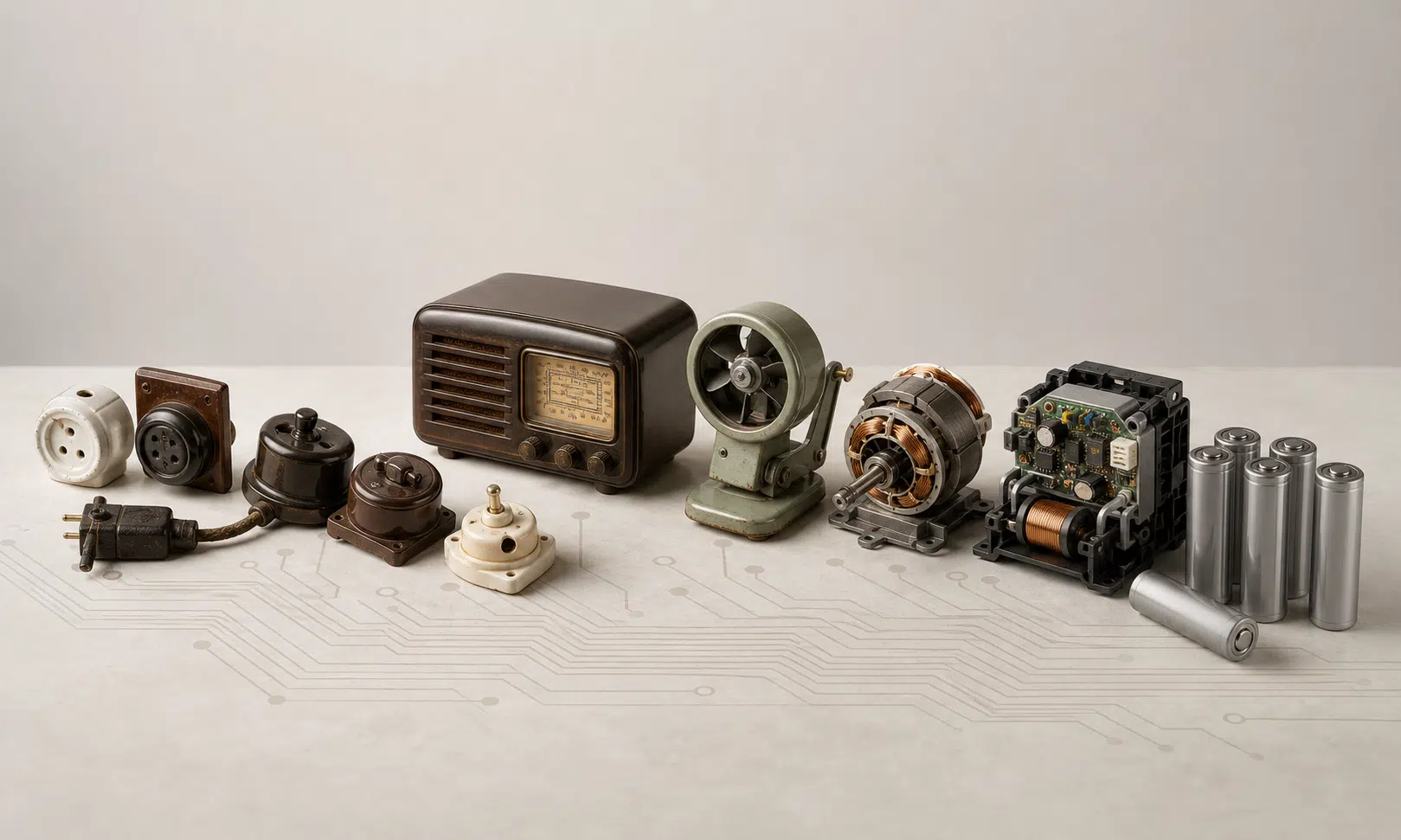

Panasonic history starts with a useful but unglamorous idea: better electrical fittings for a world that was rapidly wiring itself into modern life. Long before the name Panasonic became attached to TVs, cameras, batteries, appliances and factory systems, the company was a small Japanese operation built around components and a belief that mass-produced technology could make daily life cheaper and easier.
That mission shaped the company’s first century. Panasonic grew from plugs and sockets into home appliances, radios, televisions, industrial systems and automotive batteries, while repeatedly changing its structure to follow the market. It also had to survive the shocks that define any long-running manufacturing company: depression-era pressure, wartime production, postwar rebuilding, oil-crisis disruption and the digital shift away from analog electronics.
The result is not a clean founder myth or a straight line of product wins. It is a story about a company that kept changing what it made while trying to hold onto a simple manufacturing idea: useful technology should become common, affordable and dependable.
From Electrical Parts to a Manufacturing Company
The company traces its roots to Konosuke Matsushita, who started building electrical components in Japan in the early 20th century. Its earliest products were not finished consumer electronics in the modern sense, but practical parts for homes and businesses adopting electric power.
Those early products included lighting components, an attachment plug and a two-way socket. The business expanded quickly enough to move beyond a home-based operation and into a more formal manufacturing setup under the Matsushita name. That origin matters because it explains much of Panasonic’s later direction: the company was built around practical utility before it became a consumer brand.
By the 1920s, the business was already broadening its product line and developing a culture around production discipline, employee training and long-term planning. Matsushita’s management ideas were closely tied to manufacturing scale. He pushed the idea that producers should make useful goods plentiful and inexpensive, a philosophy that later fit neatly with Japan’s postwar appliance boom.
The company’s early growth also showed how much of Panasonic’s future would depend on adaptation. It did not stay locked to sockets and plugs. It moved into irons, radios and electric motors, the kinds of products that could anchor a wider home-electronics business as electricity became more central to everyday life.
Appliances Became the Growth Engine
In the 1930s, Matsushita Electric Industrial Co. emerged as a larger organization with thousands of employees and hundreds of products. The company was no longer just a parts maker. It was becoming a diversified manufacturer with a portfolio that reached into appliances, motors and household technology.
Electric motors were especially important because they opened the door to more categories of appliances. Once a company can design and manufacture motors at scale, it can participate in a much wider set of products, from fans and washing machines to other powered home devices. That capability helped Panasonic become part of the broader transformation of the home into a technology market.
The company also invested in employee training and benefits during this period, including training facilities and health-related support for workers. Those details are more than corporate trivia. Large electronics companies do not grow only by inventing products; they grow by building repeatable systems for production, sales and workforce development.
War, Recovery and the Postwar Consumer Boom
World War II disrupted Panasonic’s business and pushed it into manufacturing work far outside its original expertise. The company produced military-related equipment during the war, then faced major losses in factories, offices and overseas operations afterward.
The immediate postwar period forced a reset. Like many Japanese manufacturers, Panasonic had to rebuild under difficult economic and political conditions. It experimented with basic goods while working its way back toward the electronics and appliance categories that would define its expansion.
The postwar consumer boom changed the company’s trajectory. Between the mid-1940s and the end of the 1950s, Panasonic moved into products that became staples of modern domestic life, including washing machines, monochrome televisions, refrigerators, radios, rice cookers, tape recorders and home air conditioners.
That product list shows why Panasonic became such a recognizable global name. It was not attached to one breakthrough device. It became part of the home through a stream of practical machines that matched the needs of a growing middle class.
Global Expansion and Management Changes
Panasonic began expanding more aggressively outside Japan in the 1950s, turning a domestic manufacturing business into a global electronics company. Its consumer products gave it a path into international markets, while its industrial capabilities helped it serve businesses as well as households.
Konosuke Matsushita eventually stepped back from day-to-day leadership, and Masaharu Matsushita became president in the 1960s. During that decade, the company introduced changes such as a five-day work week and a wage structure based more on position than seniority.
The 1970s brought another test in the form of economic pressure tied to the oil crisis. Panasonic kept expanding its personal-electronics lineup through the following decades, competing in categories that were becoming increasingly crowded and global. By the 1980s, the company was part of a Japanese electronics wave that shaped how people bought TVs, audio gear, video equipment and household appliances.
The Digital Shift Forced Another Reinvention
The digital era changed the electronics industry in ways that were especially hard on companies built around analog hardware. Panasonic eventually stopped making analog TVs and reworked its identity around a simpler global brand.
In 2008, Matsushita Electric Industrial Co. changed its corporate name to Panasonic Corporation, formalizing the brand that had already become familiar to consumers in many markets. The move reflected a broader shift: Panasonic was no longer just a collection of product lines under an older corporate name. It needed a unified identity for a market where hardware, software, services and industrial systems were increasingly intertwined.
By 2013, Panasonic reorganized around major business areas including appliances, eco solutions, AVC networks, and automotive and industrial systems. That structure pointed toward a company trying to balance its legacy in consumer electronics with growth areas beyond the living room.
Batteries, Smart Cities and the Next Industrial Bet
One of Panasonic’s most visible modern pivots has been its battery work with Tesla. In 2014, Panasonic announced plans to invest more than a quarter-billion dollars in Tesla Motors’ planned Gigafactory battery plant. The company has supplied batteries for Tesla vehicles including the Model S, Model X and Model 3.
That relationship fit Panasonic’s larger move toward automotive and industrial systems. As cars became more electrical, connected and software-defined, battery manufacturing became a strategic bridge between Panasonic’s materials expertise and the future of transportation.
Panasonic also worked with Denver on smart-city technology tied to energy efficiency, connectivity and transportation. That project reflected another direction for the company: not just selling devices, but participating in infrastructure systems where hardware, sensors, networks and energy management are bundled together.
The same pattern runs across Panasonic’s first century. The products changed repeatedly, but the underlying playbook stayed familiar: identify a practical technology that is moving from specialized use into everyday life, then build manufacturing and distribution around it.
Why the Panasonic Story Still Matters
Panasonic’s history is useful because it cuts against the idea that technology companies succeed by staying fixed to one category. The company began with electrical components, became a household-appliance power, grew into a global consumer-electronics brand and then pushed deeper into batteries, mobility and connected infrastructure.
That does not make every pivot equally successful. It does show why long-lived tech manufacturers tend to be less glamorous and more complicated than the products people remember them for. A company that lasts through multiple technology cycles has to know when a product category is peaking, when a manufacturing capability can be reused and when a brand name needs to be rebuilt around a different market.
Panasonic’s first century is ultimately a manufacturing story. It is about taking useful technology out of niche markets and making it ordinary enough to disappear into daily life. That may be less flashy than a single hit product, but it is the kind of work that turns a small electrical-parts business into a global technology company.