

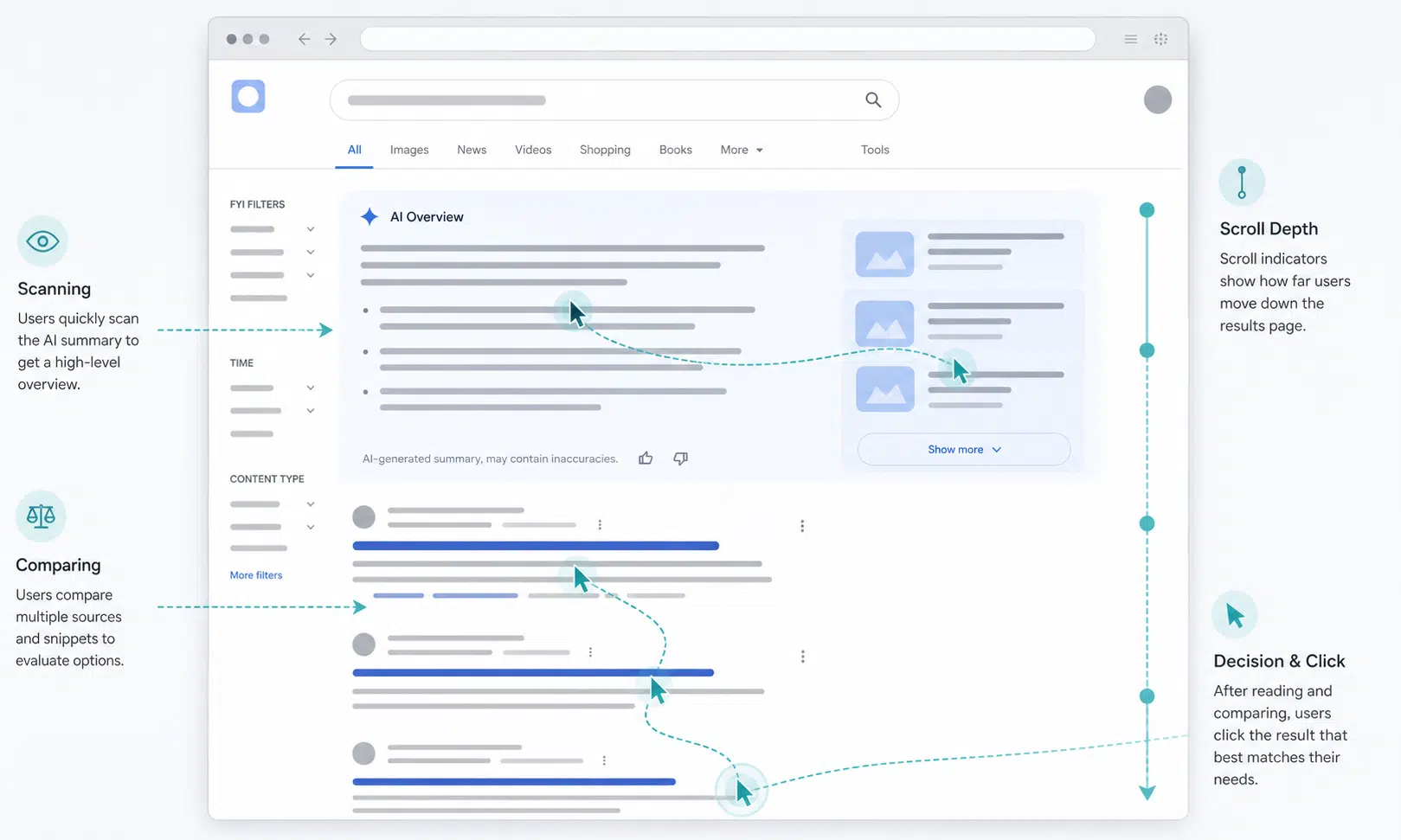

AI Overviews May Be Turning Google Results Into A Longer Decision Page
When someone types your brand name into Google or Chrome, it is easy to assume they are trying to reach your site as quickly as possible. For years, that was a reasonable working assumption. Google was the pass-through layer between the searcher and the destination.
AI Overviews complicate that path.
A recent analysis of anonymized U.S. Google Search sessions from February and March 2026 looked at what happens on the search results page before the click. The study examined cursor movement, scrolling behavior, and time spent on the page across a large set of sessions. Because the underlying clickstream data and analysis have not been independently verified here, the exact figures should be treated as reported findings rather than settled industry benchmarks.
Even with that caveat, the pattern is useful for marketers, SEO teams, and brand owners: when an AI Overview appears, users appear to spend more time evaluating the search results page itself.
That matters because the search snippet is no longer just a doorway. It may be part of the decision.
For commercial teams, the practical question is not simply whether AI Overviews reduce clicks. It is whether they change how people compare brands before choosing where to click. The reported behavior suggests a slower, more deliberate SERP experience, especially for searches that used to be fast and predictable.
What The Study Looked At
The analysis reviewed approximately 846,000 Google Search sessions from anonymized clickstream data. The sessions were U.S.-based and came from February and March 2026.
Rather than focusing only on rankings or click-through rates, the study looked at user behavior on the search results page. That included where the cursor moved, how long users remained active, how much of the visible page they appeared to cover, and whether they scrolled back up after moving down the page.
Cursor data is not the same as eye tracking. A cursor can sit still while someone reads, move while someone thinks, or remain idle while someone is distracted. But during active search and comparison tasks, cursor position can be a useful signal of attention. In this dataset, cursor positions were reportedly sampled once per second for up to 60 seconds per session.
The study used different datasets for different comparisons:
- A balanced dataset for comparing search intent types and AI Overview presence more evenly.
- A representative dataset intended to reflect the natural mix of real Google searches.
- A filtered representative dataset that excluded very short and very long SERP sessions.
Those distinctions matter. Informational searches dominate real-world query volume, so a representative dataset will naturally lean toward informational behavior. A balanced dataset is more useful when comparing intent types side by side.
The Core Finding: AI Overviews Appear To Slow The Search Journey
The broad takeaway is that AI Overviews may keep people on Google longer before they click, refine, abandon, or continue searching.
The study reported that users encountering an AI Overview remained active on the results page longer across several search intent types, including informational, local, navigational, transactional, and video searches. Without an AI Overview, behavior varied much more sharply by intent.
That finding should be read carefully. It does not prove that every website loses traffic when an AI Overview appears. It also does not prove that every user reads the AI Overview in depth. But it does suggest that the SERP becomes more of a comparison surface when AI-generated summary content is present.
For brands, that changes the job of the organic listing. A title tag and meta description still need to earn the click, but they may now need to hold up under closer inspection. A vague promise that once survived a quick scan may look weak when a user pauses, scrolls, and compares several options on the same page.
Reported Behavior By Search Intent
The most interesting part of the analysis is the way AI Overviews appear to flatten differences between search intents.
Normally, different search types behave differently. Someone searching for a restaurant nearby may spend time comparing ratings, maps, business hours, and locations. Someone searching for a brand name may click quickly because the destination is already known. Someone watching for a video result may scan thumbnails and titles differently again.
According to the study, that variation became less pronounced when an AI Overview appeared. At the three-second mark, the analysis reported that all five intent types were clustered between 91.9% and 93.1% still active on the SERP. Because this exact figure has not been independently verified, it should be treated as a reported study result, not a universal benchmark.
At 21 seconds, the study reported that the same intent groups were still relatively close together, between 41.9% and 48.5% active. Again, that range should be treated as the study’s reported outcome rather than a confirmed industry-wide rule.
A simplified view of the reported pattern looks like this:
| Search condition | Reported behavior pattern | Practical implication |
|---|---|---|
| No AI Overview | User behavior varied more by search intent. | Brand, local, informational, and transactional searches followed more distinct paths. |
| AI Overview present | Intent groups reportedly stayed active on the SERP for more similar lengths of time. | The AI Overview may make different search journeys feel more like comparison sessions. |
| Navigational searches | The study reported a particularly large change in time spent on the SERP. | Even brand-name searches may no longer behave like automatic clicks. |
For SEO teams, the implication is direct: intent still matters, but the presence of an AI Overview may matter just as much when interpreting search behavior.
Why Navigational Searches Matter Most
Navigational searches are the most commercially sensitive part of this discussion.
A navigational query is the kind of search where someone types a brand, company, product, website, or known destination into Google. These searches have historically been some of the most reliable organic visits because the user already knows where they want to go.
That is why the reported shift is important. The study said navigational searchers were gone the fastest when no AI Overview appeared, with only 12% still active after 21 seconds. That exact figure has not been independently verified, so it should be treated as a reported finding from the analysis rather than a confirmed benchmark.
When an AI Overview appeared, the study reported that the share of navigational users still active at 21 seconds rose substantially. The claimed pattern is plausible in a practical sense: if Google places a generated summary, related entities, third-party mentions, reviews, competitors, or supporting information near a brand result, the searcher has more to inspect before clicking.
For a brand, this means the searcher may still want you, but Google may now introduce a pause.
That pause can expose the user to competing interpretations of your brand. It can show alternative sources, comparison pages, review snippets, support pages, news coverage, and other SERP elements that sit around your official listing. In some cases, that extra context may help you. In others, it may create friction before a visit that used to feel nearly guaranteed.
What Brand Teams Should Check
For buyer-aware SEO, navigational search should not be treated as a maintenance task. It should be audited like a conversion page.
- Search your brand name and key product names in the markets that matter most.
- Document whether an AI Overview appears for those queries.
- Compare the language in your title tags and meta descriptions against review sites, competitors, and marketplace listings.
- Check whether your official result clearly explains the next best action.
- Look for outdated support pages, weak sitelinks, or confusing page titles that may dilute the brand result.
The goal is not to manipulate every SERP element. The goal is to make your owned result clear enough to win when the user is comparing rather than rushing.
Cursor Behavior Suggests More Reading And Comparing
The study also looked at cursor movement across the visible search results page.
One reported finding was that users with an AI Overview kept their cursor still more often, while also covering more of the visible page with cursor movement. That combination is more interesting than either metric alone.
A still cursor can mean someone is inactive. But paired with broader page coverage, it can also suggest a pattern of reading, pausing, moving to another section, and reading again. That is different from the classic quick-scan model of search behavior, where the user looks at the top results, picks one, and leaves.
The study reported that users on AI Overview pages had more cursor stillness and wider page coverage than users on pages without AI Overviews. Since these exact percentages are not independently verified here, they are best used as directional evidence rather than precise planning inputs.
For SEO work, the directional lesson is still useful: the snippet has to make sense when compared side by side with other information on the page.
That raises the standard for several elements:
- The title tag needs to say what the page actually helps the user do.
- The meta description should reduce uncertainty, not repeat generic marketing language.
- Brand pages should make official ownership obvious.
- Product and service pages should use specific descriptors that match buyer intent.
- Pages targeting comparison searches should make the comparison angle clear before the click.
This is especially important for commercial investigation queries. A searcher comparing options may read the AI Overview, scan organic snippets, look at third-party reviews, and then return to an earlier result before choosing. In that setting, a bland title can lose even when the ranking position is strong.
Back-Scrolling Is A Sign Of Reconsideration
Another useful finding involved scroll direction.
Search behavior is often described as a downward journey: the user starts at the top, scrolls through the page, and clicks when something looks useful. The reported scroll data suggests a more active pattern when AI Overviews appear.
The study found that users often reversed direction during a search session. It also reported that back-scrolling became more prominent when an AI Overview was present. Among users who did reverse direction, the analysis said the median user on an AI Overview page spent nearly half of total scrolling going back up the page. That precise claim should be treated as an unverified reported finding, but the behavior it describes is important.
Back-scrolling usually means the user saw something worth revisiting. They may have read a summary, moved down to organic results, compared a few snippets, and then returned upward to check the AI Overview or an earlier result again.
For brands, that creates both risk and opportunity. A user may give your listing more than one look. But the second look is often more demanding than the first.
A generic description may pass when the user is only scanning. It may fail when the user returns to compare your result against a competitor, a review site, or a more specific page title.
How To Write For A More Deliberate SERP
The practical response is not to stuff titles with keywords. It is to write SERP previews that answer the user’s comparison problem quickly.
- For branded homepages, make the official brand destination unmistakable.
- For product pages, include the product category and the primary decision factor.
- For service pages, name the audience, use case, or location when relevant.
- For comparison pages, state the comparison clearly instead of using a vague editorial headline.
- For support or documentation pages, signal whether the page solves, explains, configures, or troubleshoots the issue.
In other words, title tags and descriptions need to act less like labels and more like short decision aids.
What This Means For SEO Tools And Reporting
AI Overviews make rank tracking harder to interpret by itself.
A page can hold its ranking position while user behavior around that ranking changes. A brand can still appear first and still see a longer path to click. A product page can rank below an AI Overview and still win qualified traffic if its snippet answers a clearer buyer need than competing results.
That means SEO reporting should include more than position and clicks where possible.
Useful decision criteria include:
- Whether an AI Overview appears for the query.
- Whether the query is branded, navigational, informational, transactional, or local.
- Which owned pages appear above and below major SERP features.
- How title tags compare against competing snippets.
- Whether branded queries are producing unexpected drops in click-through rate.
- Whether users who do click are more engaged once they reach the site.
For teams evaluating SEO platforms, the priority is shifting. Basic rank tracking still has value, but AI SERP monitoring, branded query tracking, and snippet testing are becoming more important for decision-making.
A Practical Comparison Framework For Brands
If AI Overviews are present in your market, the best response is a structured SERP review. The goal is to understand which queries are most exposed to delayed clicks and comparison behavior.
| Query type | Why it matters | What to review |
|---|---|---|
| Brand name | These searches used to be closest to guaranteed visits. | Official result clarity, sitelinks, AI Overview language, review snippets, competitor mentions. |
| Product name | Users may compare your product against alternatives before clicking. | Title specificity, pricing language if visible, third-party reviews, comparison content. |
| Category query | The user may still be choosing between vendors. | Snippet differentiation, buyer intent match, page type, visible proof points. |
| Local query | Maps, reviews, and business listings already spread attention across the SERP. | Business profile quality, review freshness, local landing page relevance. |
| Support query | AI summaries may answer part of the issue before the click. | Documentation titles, troubleshooting clarity, freshness of help content. |
This framework keeps the work grounded. Instead of reacting broadly to AI Overviews, you can identify the query groups where the SERP has become more competitive, more informational, or more likely to delay the click.
The Bottom Line
The reported analysis suggests that AI Overviews may change Google Search behavior in a specific way: they appear to make the results page a place where users pause, compare, revisit, and reconsider before clicking.
The exact numbers should be handled with care because they have not been independently verified here. But the pattern is consistent with what many SEO teams are already seeing in practice. The SERP is becoming less like a simple list of links and more like a compressed decision environment.
For brands, the immediate takeaway is practical. Audit the searches that matter most, especially navigational and product-led queries. Look at what users see before they reach your site. Then rewrite weak titles and descriptions so they can survive a slower, more comparative search experience.
Rank still matters. But when AI Overviews appear, the preview may matter more than it used to.