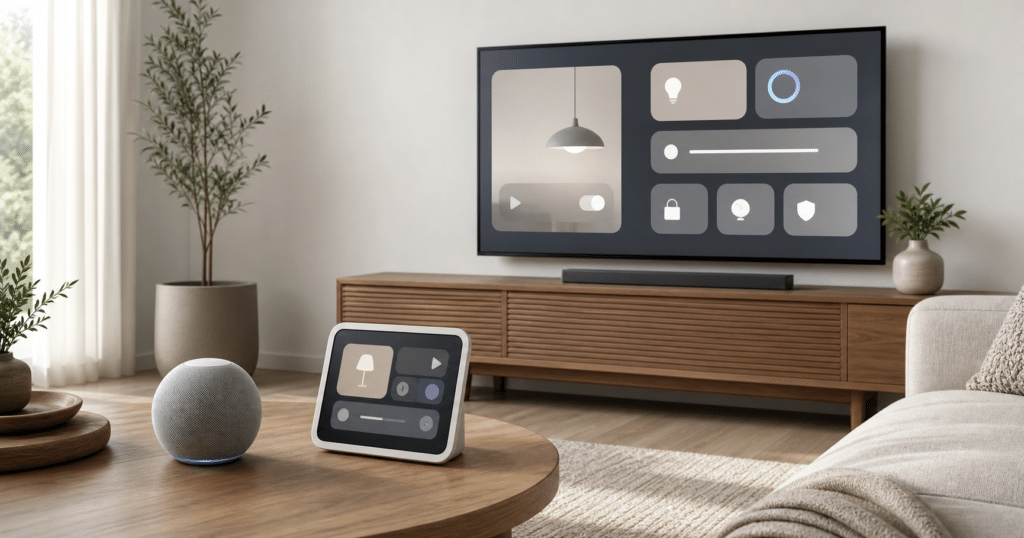
Apple’s long-anticipated smart home expansion may be approaching its first major release window. Three Apple smart home products are reportedly nearing launch: a faster Apple TV, an updated HomePod mini and an entirely new home hub built around a seven-inch display.
The Apple TV and HomePod mini updates are expected to retain the familiar designs of their predecessors while gaining faster processors intended to support more capable, AI-driven Siri features. The home hub is the more ambitious device, combining smart home controls, communication features and personalized information in a dedicated display.
None of these products has been formally announced, so pricing, configurations and final release dates remain unsettled. That makes this less of a conventional upgrade cycle and more of a reason for prospective buyers to consider whether they need an Apple home device immediately or can wait for the lineup to become clearer.
Three products, with different levels of ambition
| Product | Reported changes | Possible launch window |
|---|---|---|
| Apple TV | Faster processor and support for new Siri AI capabilities; familiar exterior design | As soon as fall 2026 |
| HomePod mini | Updated chip for new Siri AI capabilities; design expected to resemble the existing model | As soon as fall 2026 |
| Apple smart home hub | Seven-inch square display, new tvOS-based software, FaceTime, home controls and personalized information | Between October 2026 and early 2027 |
The first two devices sound like conventional hardware refreshes. Their main purpose appears to be providing enough processing power for Apple’s planned Siri upgrades rather than introducing substantially different product designs.
The hub represents a new category for Apple. Two versions are reportedly in development: one places the display on a half-dome-shaped base, while another attaches to a wall with a magnetic mounting system. It is not yet clear whether Apple intends to sell both designs, launch them at the same time or choose one configuration for the initial release.
Apple TV and HomePod mini could get overdue chip upgrades
The existing Apple TV 4K is powered by the A15 Bionic, while the existing HomePod mini uses the S5 processor originally found in the Apple Watch Series 5. The rumored replacements would move both products to faster silicon capable of handling Apple’s next generation of Siri features.
The external designs are expected to remain close to what Apple already sells. Buyers hoping for a redesigned streaming box or a dramatically different compact speaker may therefore find these updates relatively conservative. The meaningful changes are more likely to involve responsiveness, software support and how well each device fits into Apple’s broader smart home system.
That distinction matters when deciding whether to wait. Someone who only wants straightforward media streaming or a compact speaker may not need the unannounced models. Buyers interested in Apple’s AI-powered Siri experience, however, have a stronger reason to hold off until Apple explains which features the new processors enable and whether older hardware will receive comparable support.
There are still important gaps. The specific processors, prices and storage configurations have not been established, and the phrase “faster chip” does not reveal how substantial either upgrade will be. Until those details are official, the safest assumption is that these are iterative replacements rather than complete reinventions.
Apple TV 4K
The current Apple TV 4K is a practical option for immediate access to Apple’s streaming platform and existing smart-home features. Consider waiting if support for Apple’s anticipated AI-powered Siri experience is a priority.
As an Amazon Associate I earn from qualifying purchases.
The seven-inch home hub is the centerpiece
Apple’s display-based home hub is expected to use a seven-inch square screen and an entirely new operating system built on tvOS. Its interface reportedly combines elements of tvOS and watchOS, using apps, icons and widgets to present information at a glance.
The planned feature set includes FaceTime, home security monitoring, customizable clock faces and integration with Apple’s smart home platform. That combination would give Apple a centralized screen for communication and household controls rather than asking users to manage everything through an iPhone, iPad or Apple TV.
HomeKit integration could make the hub especially relevant to households that already use compatible lights, locks, cameras and other accessories. Its value will depend on how quickly it can surface controls, whether it supports multiple household members cleanly and how much it can do without requiring another Apple device nearby. Those operational details remain unanswered.
The headline feature is expected to be facial recognition. The hub could identify the person viewing it, estimate how far that person is from the screen and adjust the interface in real time. Information could become larger or change format when viewed from across a room, while personal content such as calendars and notes could appear for the recognized user.
That degree of personalization could separate Apple’s hub from a basic smart display, but it also creates questions Apple will need to address. Buyers will want to know where recognition is processed, how household profiles are managed, what happens when a guest approaches and how personal information is kept from appearing for the wrong person. No final implementation details have been confirmed.
Should you buy an Apple home device or wait?
Waiting makes the most sense for buyers who consider the new Siri experience essential or specifically want a dedicated Apple smart home display. The Apple TV and HomePod mini updates are tipped for the earliest release window, while the hub may not arrive until later.
Buying existing hardware can still be reasonable when the need is immediate and limited to features already available. The reported similarity in design suggests that the next Apple TV and HomePod mini will focus on internal performance rather than making the existing models physically obsolete overnight. The unanswered question is how much of Apple’s planned AI functionality will depend on the newer chips.
The home hub is harder to evaluate because Apple does not sell a direct predecessor. Its appeal rests on a feature mix that has not yet been demonstrated, and there is no confirmed price against which to judge its value. Anyone considering the hub should wait for details about household profiles, accessory compatibility, privacy controls and the differences between the desktop and wall-mounted designs.
Apple is also believed to be developing two more distant smart home products: a higher-end robotic hub with a nine-inch display and a more advanced indoor security camera. Those devices appear to sit later on the roadmap and should not influence an immediate purchase without firmer launch plans.
For now, the practical takeaway is straightforward. Buyers satisfied with basic streaming, audio or existing home controls do not have a confirmed reason to postpone a necessary purchase. Those building an Apple-centered smart home—or expecting Siri’s new AI capabilities to be the centerpiece—have more to gain by waiting for Apple to reveal the hardware, pricing and precise software requirements.