

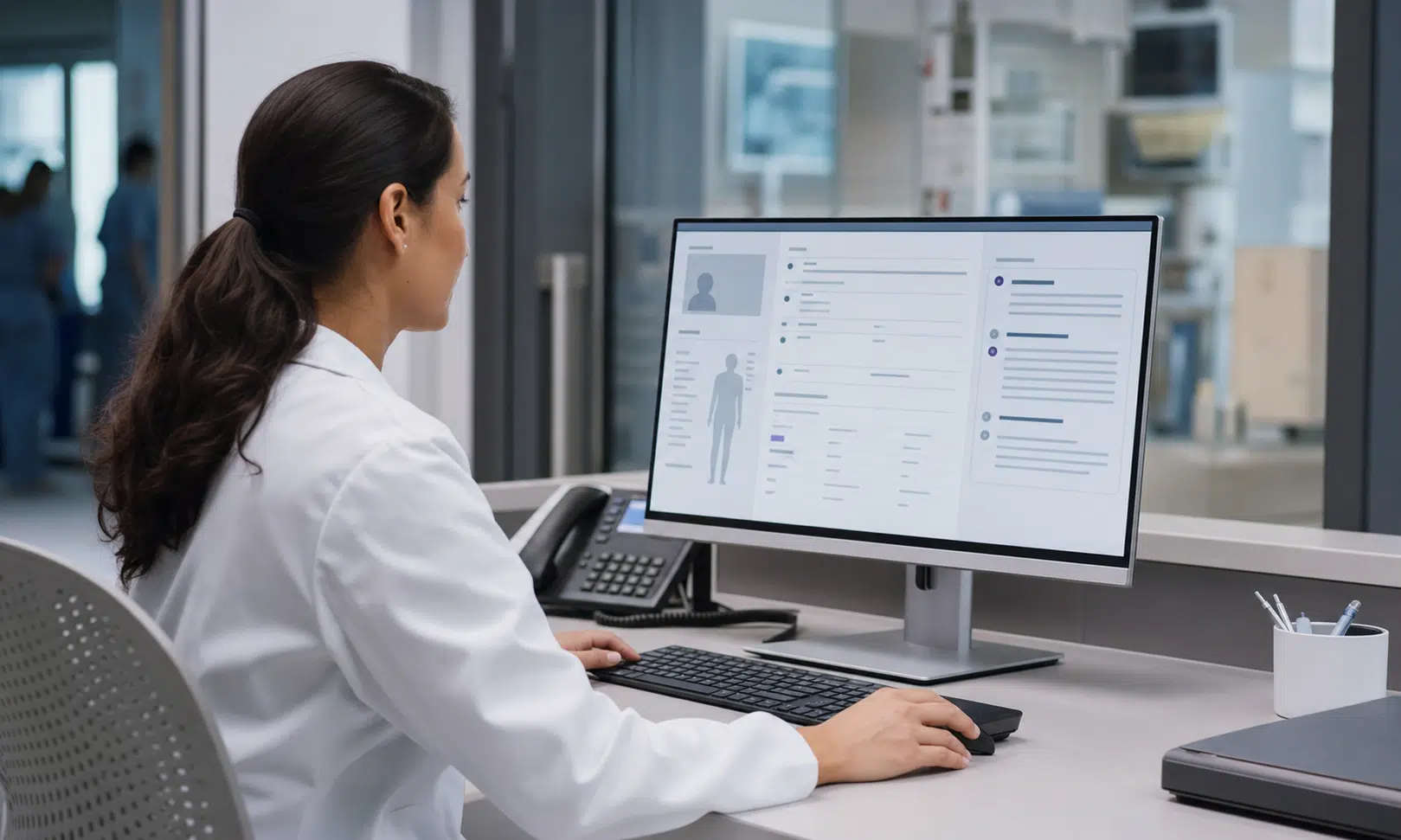

In difficult medical cases, the missed diagnosis is not always missed because a doctor ignores the answer. Sometimes the right possibility never makes it onto the list.
That is the specific gap new AI systems may be able to help with. Recent research suggests that large language models, especially newer reasoning-focused models, can perform strongly when asked to generate possible diagnoses from complex patient information. In some tests, an AI system was more likely than physician comparison groups to include the correct diagnosis among its possibilities.
That does not mean AI is ready to diagnose patients on its own. The more useful takeaway is narrower and more practical: AI may become valuable as a second-opinion tool that helps clinicians think more broadly, especially when a case is unusual, fast-moving, or easy to mistake for something routine.
For hospitals, health systems, and clinical software buyers, that distinction matters. A diagnostic AI tool should not be evaluated like a search box with a medical vocabulary. It should be judged by how well it supports real clinical work, how it handles uncertainty, how it documents its reasoning, and how safely it fits into a human-led care process.
What the New Research Suggests
A recent study tested a large language model on several kinds of medical reasoning tasks. The cases included classic clinical training scenarios and real-world emergency department data from patients at a Boston hospital.
Across those tests, the model performed especially well at generating diagnostic possibilities. In practical terms, that means the AI was often good at putting the right diagnosis, or a close alternative, somewhere in its list of possible explanations.
That skill is clinically important. Doctors are trained to build a differential diagnosis: a ranked list of possible causes that can be narrowed with more history, examination, imaging, lab work, and response to treatment. If the correct condition is never considered, later steps may move in the wrong direction.
AI may be useful because it can rapidly compare a messy clinical picture against a large store of medical patterns. It does not get tired, rushed, anchored to the first plausible explanation, or influenced by a busy department in the same way a human can. Those advantages are real, but they are also limited. A language model does not examine the patient, understand context as a clinician does, or carry responsibility for a treatment decision.
The study’s strongest implication is not that AI is “better than doctors” in a broad sense. It is that AI may be particularly strong at one part of the diagnostic process: suggesting possibilities that deserve consideration.
Why Missed Diagnoses Happen
Missed diagnoses are rarely simple. A patient may arrive with vague symptoms. Early lab results may be normal. A rare disease may look like a common one. A dangerous condition may begin with symptoms that resemble a mild infection, medication side effect, anxiety, dehydration, or routine respiratory illness.
Clinicians also work under pressure. Emergency departments, primary care offices, and inpatient teams often make decisions with incomplete information. A physician has to decide what is likely, what is dangerous, what can wait, and what must be ruled out immediately.
That is where diagnostic support tools can help, at least in theory. A well-designed system can prompt clinicians to ask: What else could this be? What diagnosis would be dangerous to miss? What feature of this case does not fit the leading explanation?
The best use case is not replacing medical judgment. It is interrupting premature certainty.
For example, if a patient’s symptoms appear ordinary but the patient has a transplant history, immune suppression, recent surgery, unusual exposures, or a rapidly changing clinical course, a second-opinion system might surface diagnoses that are uncommon but urgent. That can be useful even when the AI’s top answer is not correct, because the value may come from expanding the differential.

Improving Diagnosis in Health Care
This reference is useful for readers who want a deeper framework for understanding diagnostic error, teamwork, health IT, and safety culture before evaluating AI diagnosis tools.
The Important Limits
Another recent study reached a more cautious conclusion. Researchers tested multiple AI models across different steps of clinical reasoning and found that performance was uneven. The models tended to do better on final diagnosis and management-style questions than on the earlier work of building a careful differential diagnosis and navigating uncertainty.
That distinction is critical. Choosing from a set of possibilities is different from deciding which possibilities should exist in the first place. Medicine often turns on ambiguity: two diagnoses may both be plausible, a test may be falsely reassuring, or a symptom may matter only because of a patient’s history.
Large language models can also sound more confident than they should. They may generate a polished explanation that appears clinically coherent while skipping uncertainty, over-weighting one clue, or failing to account for missing information. In a medical setting, that style of error is not just a technical flaw. It can influence human decisions.
This is why unsupervised patient-facing diagnosis remains a risky use case. A consumer chatbot that tells a patient what they “probably” have is very different from a clinician-facing tool that lists possibilities, flags uncertainty, and reminds the care team what to consider next.
What Buyers Should Look For in AI Diagnostic Tools
For health systems evaluating AI medical diagnosis software, the headline performance number is not enough. A tool that performs well on benchmark cases may still fail in daily clinical use if it does not fit workflow, document uncertainty, integrate with records, or earn clinician trust.
The first question should be scope. Is the tool meant to generate a differential diagnosis, summarize chart data, suggest next tests, flag risk, or support triage? Each job has a different risk profile. A vendor should be clear about what the product is designed to do and what it is not designed to do.
The second question is evidence. Buyers should look for validation on realistic cases, not only exam-style questions. Stronger evidence includes blinded clinician review, testing on real clinical data, prospective trials, and performance reporting across patient groups and care settings.
The third question is oversight. The safest systems keep clinicians in control. They show their output as suggestions, not orders. They make uncertainty visible. They preserve an audit trail. They allow clinicians to reject, edit, or ignore recommendations without fighting the interface.
The fourth question is integration. A diagnostic assistant that forces doctors to copy and paste large chunks of chart text will not be used consistently. A tool that pulls relevant data from the electronic health record, separates signal from noise, and returns concise suggestions at the right moment has a better chance of helping.
Security and privacy also matter. Medical AI systems may process sensitive health information, so buyers need to understand data handling, retention, model training policies, access controls, logging, and compliance posture before any deployment.
Clinical Decision Support: The Road Ahead
This book fits readers evaluating how diagnostic support should be designed, integrated, and governed inside clinical workflows.
AI as a Second Opinion, Not a Standalone Doctor
The most realistic near-term role for AI is as a second opinion inside clinician-led care. In that role, the AI does not decide what disease a patient has. It helps the doctor think through what could be missed.
That can still be valuable. A second-opinion tool can be useful when a case is complex, when symptoms do not fit neatly, when the patient is not improving as expected, or when a clinician wants to check for uncommon but serious alternatives.
The product design should reflect that role. A good diagnostic assistant should avoid presenting one answer as final. It should show several plausible diagnoses, explain what features support or weaken each possibility, and identify what information would help narrow the list. It should also make clear when the available information is too thin to support a strong conclusion.
This is where many AI tools will either earn trust or lose it. Clinicians do not need another system that adds noise. They need support that is specific, restrained, and easy to challenge.
What Still Needs to Be Proven
The next major test is not whether AI can perform well on retrospective cases. It is whether AI improves care when used prospectively with real patients.
That means clinical trials and real-world evaluations. Researchers and health systems need to measure whether AI support reduces missed diagnoses, changes testing behavior, speeds treatment, affects costs, introduces alert fatigue, or creates new kinds of error.
They also need to study how doctors interact with AI recommendations. A tool can be accurate and still harmful if users over-trust it. It can be imperfect and still helpful if it reliably prompts better thinking. The human-AI interaction is part of the safety profile.
Equity is another concern. If AI systems are trained or tested on data that underrepresents certain populations, performance may vary across patients. Buyers should ask vendors for subgroup analysis and post-deployment monitoring, especially for tools used in emergency care, primary care, or triage.
The Bottom Line
AI may help doctors avoid some missed diagnoses by broadening the list of possibilities in difficult cases. That is a meaningful capability, especially when the correct diagnosis is rare, time-sensitive, or easy to overlook.
But diagnostic reasoning is more than naming a disease. It includes uncertainty, patient context, evolving symptoms, test selection, communication, and judgment under pressure. Current AI systems can assist with parts of that process, but they should not be treated as independent clinicians.
For now, the strongest case for AI in diagnosis is supervised use: a careful second opinion, embedded in clinical workflow, evaluated with real patient outcomes, and governed by clear safety rules.
The technology is moving quickly. The standard for adoption should move just as carefully.
AI in Health: A Leader’s Guide
This resource is most relevant for health-system leaders thinking about AI adoption strategy, operational fit, and governance beyond benchmark performance.