


E Ink and MediaTek are trying to move color e-readers beyond their familiar limits: muted color, slower refreshes, and a feature set built mainly around reading. Their expanded partnership centers on MediaTek ePaper system-on-chips designed for E Ink’s color ePaper platforms, including Gallery and Kaleido displays.
The pitch is straightforward. E Ink says the new silicon can help improve color reproduction, refresh behavior, handwriting responsiveness, and on-device AI features. MediaTek is positioning the chips as a way to turn color e-readers into smarter note-taking and study devices, not just quiet screens for books.
For buyers, the more useful question is not whether this sounds advanced. It is whether the upgrades solve the problems that make color e-readers hard to recommend over monochrome e-readers or full tablets. Color e-paper can be excellent for comics, textbooks, diagrams, magazines, and annotated documents, but it still has to justify its price, speed, and complexity.
What E Ink and MediaTek are promising
The companies describe the work as a deeper integration between E Ink’s color ePaper displays and MediaTek’s next ePaper SoCs. E Ink says the system will support both Gallery and Kaleido technologies, two display approaches already associated with color e-readers and e-paper tablets.
The source material points to several promised improvements:
- Support for up to 7-bit color depth on compatible Gallery-based systems.
- Display support up to 13.3 inches with 300 PPI resolution, according to the companies’ technical claims.
- Faster refresh performance and smoother screen transitions.
- Lower ghosting through display algorithms.
- Better web browsing, animation playback, and multitasking behavior than older color e-paper devices typically provide.
- On-device AI features such as speech recognition, transcription, summarization, and translation.
Those claims should be read as product-direction claims, not proof that every future device using the hardware will feel dramatically better. E-reader performance depends on the display panel, processor, software tuning, battery size, operating system, and the manufacturer’s priorities. A chip can remove bottlenecks, but it does not guarantee a great finished product.
The buyer case for better color e-paper
Color is the part of this announcement that matters most for many shoppers. Traditional black-and-white e-readers remain hard to beat for novels and long-form reading because they are simple, light, and efficient. Color e-readers make more sense when the reading material actually benefits from color.
That includes comic books, manga editions with color pages, magazines, cookbooks, children’s books, academic PDFs, charts, maps, and textbooks. In those cases, color is not decoration. It can make diagrams easier to understand, preserve the design of printed pages, and reduce the need to reach for a tablet.
The tradeoff is that color e-paper has historically asked buyers to accept compromises. Color can look softer than on an LCD or OLED tablet. Refreshes can feel slower. Page transitions, browsing, and writing can expose ghosting or lag. If E Ink and MediaTek can make color displays feel cleaner and more responsive, the category becomes easier to recommend to students, comic readers, and anyone who marks up documents.
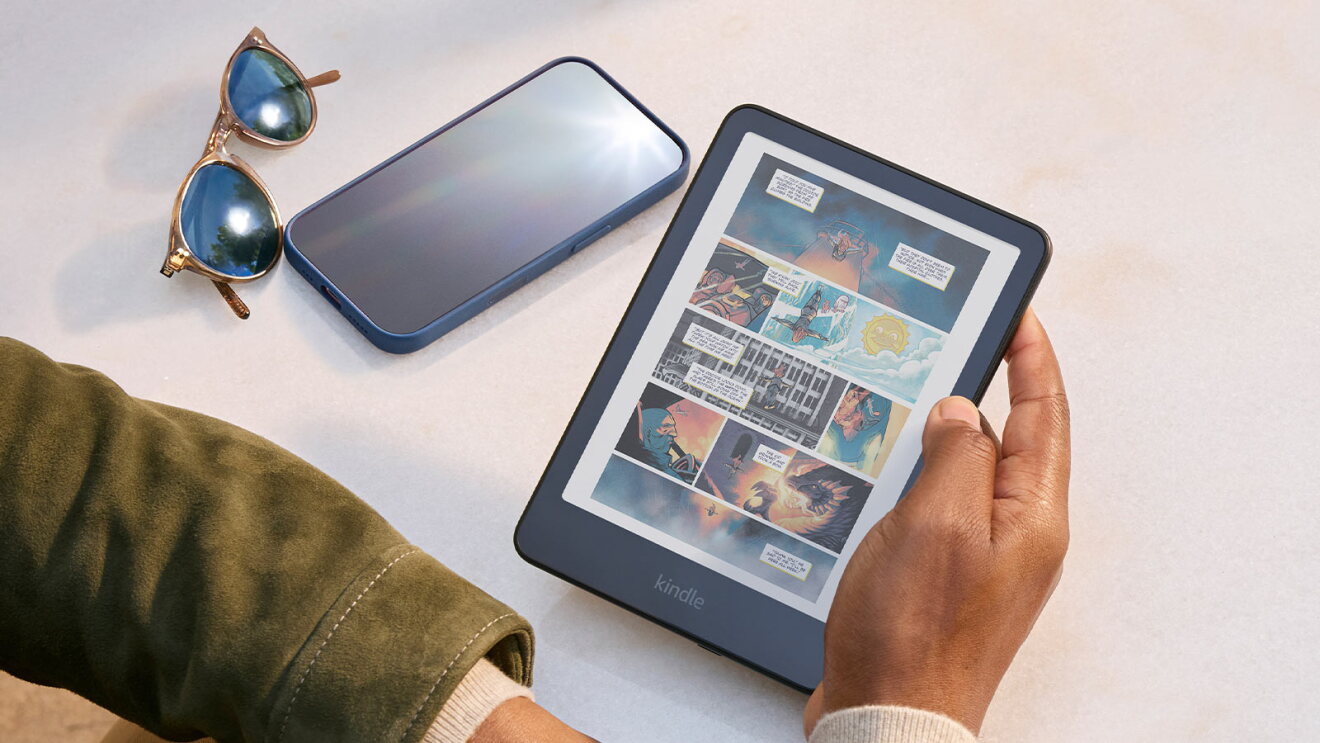
Kindle Colorsoft
Kindle Colorsoft is a relevant current option for readers who want color covers, comics, graphic novels, and color highlights in an e-reader format. It is best considered against the article’s cautions about color softness, refresh behavior, and whether color matters for your reading library.
As an Amazon Associate I earn from qualifying purchases.
Where the AI features may help
MediaTek’s newer AI-focused e-reader chips, including the MT8115 and MT8126 named in the source, are described as supporting 7.4 TOPS of AI compute. The companies say the chips can handle features such as multi-speaker speech recognition, transcription, summarization, and real-time translation in 20 languages. They are also described as supporting both Linux and Android systems.
The most practical detail is that the AI processing is described as happening on the device. If implemented well, that could let users use some features without relying on a cloud connection. For students, workers, and travelers, local processing can be more convenient than features that only work online.
Still, AI belongs in an e-reader only when it serves the reading or note-taking job. Transcribing a lecture, summarizing personal notes, translating passages, or searching handwritten notes could be useful on a large e-paper notebook. AI that gets in the way of reading, pushes up the price, or drains the battery is harder to defend.
What could go wrong
The strongest objection is feature bloat. Many people buy e-readers because they do less than tablets. A focused e-reader is valuable precisely because it is not constantly pulling the user into notifications, feeds, apps, and algorithmic distractions.
Adding AI, web features, animation improvements, and more tablet-like behavior could make color e-readers more useful. It could also make them more expensive, more complicated, and less appealing to readers who want a quiet device.
There are also practical concerns the announcement does not settle. The source does not provide battery-life results for finished products, final pricing, release timing for consumer devices, or side-by-side testing against existing e-readers. Without that, buyers should treat the claims as a roadmap rather than a buying recommendation.
| Potential upgrade | Why it matters | Buyer question |
|---|---|---|
| Richer color | Could make comics, textbooks, charts, and magazines easier to read. | Does the finished device make color clear enough to justify the price? |
| Faster refresh | Could improve page turns, browsing, menus, and document handling. | Is it noticeably smoother in daily use, or only better on a spec sheet? |
| Lower ghosting | Could reduce visual leftovers from previous pages or interface elements. | Does ghosting stay controlled while writing, scrolling, and viewing images? |
| On-device AI | Could support transcription, summarization, and translation without cloud dependence. | Are the features useful enough to offset cost, storage, and battery concerns? |
Who should pay attention
This technology is most relevant to people who already know why monochrome e-readers are not enough for them. Students who work with charts and textbooks, comic readers who want less shelf clutter, professionals who annotate PDFs, and note-takers who prefer e-paper over glass tablets are the clearest audience.
For ordinary novel reading, the case is weaker. A lighter monochrome e-reader may still be the better buy if long battery life, low weight, and simplicity matter more than color, transcription, or translation.
The education market also makes sense as a target. Color e-paper can show diagrams, photographs, and visual reference material while preserving some of the eye-comfort appeal that makes e-readers attractive. If the handwriting and refresh improvements are real in shipping devices, schools and students may have a stronger reason to consider color e-paper notebooks instead of standard tablets.
Verdict: promising, but wait for real devices
E Ink and MediaTek are pointing color e-readers in a more capable direction. Better color, faster refreshes, cleaner transitions, and local AI could address several weaknesses that have kept color e-paper from feeling like an easy mainstream recommendation.
The cautious view is still the right one. The announcement supports the idea that future color e-readers may become better study, comic, and note-taking devices. It does not prove that the next wave will be worth replacing a Kindle, Kobo, reMarkable-style notebook, iPad, or Android tablet.
Buyers should watch for finished devices that show clear gains in color quality, handwriting latency, page refresh, battery life, and price. If those pieces line up, this partnership could make color e-readers much more practical. If the AI features arrive before the basics are improved, the result may feel like another expensive device trying to do too much.