
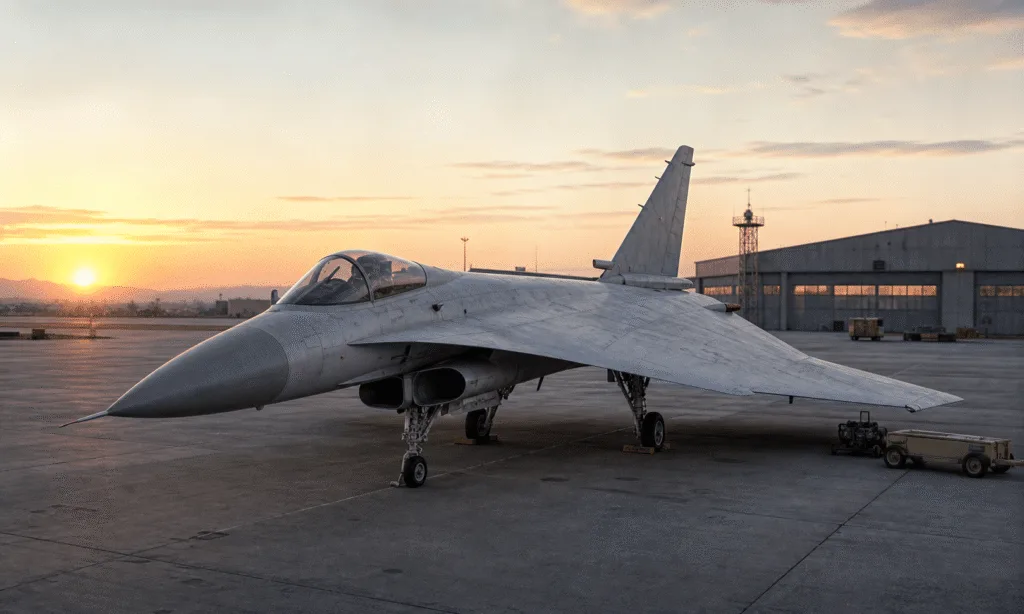
The General Dynamics F-16XL remains one of the more intriguing branches of the F-16 family tree: a cranked-arrow delta-wing prototype that promised more range, more weapons carriage, and better high-speed performance than the standard Fighting Falcon.
Its most debated claim is not simply that it was fast. It is that, according to accounts tied to later F-16XL histories, the aircraft demonstrated a form of supercruise: sustained supersonic flight without afterburner. Those same accounts say the U.S. Air Force asked General Dynamics to keep that capability quiet because of possible sensitivity around the Advanced Tactical Fighter program. That request has not been independently verified here, so it is best treated as a reported detail from the aircraft’s historical literature rather than a confirmed official record.
The larger story is less about one secretive performance note and more about why the F-16XL failed to move into production. The aircraft was evaluated for the Air Force’s dual-role fighter requirement, but the service ultimately went with the F-15E Strike Eagle. That choice says a great deal about what the Air Force wanted at the time: not just a faster or more efficient F-16 derivative, but a larger strike aircraft with the growth, payload, and range margins senior leaders were prepared to fund.
What Made the F-16XL Different
The F-16XL was derived from the F-16 Fighting Falcon, but it was not a minor wing change. The defining feature was its cranked-arrow delta wing, a planform intended to improve lift, fuel capacity, weapon carriage, and high-speed handling compared with a conventional F-16 layout.
Historical accounts of the program describe its early roots under the Supersonic Cruise and Maneuver Prototype name, often shortened to SCAMP. The basic idea was to show that an aircraft closely related to the F-16 could offer better supersonic cruise and improved air-to-ground usefulness without starting from a completely clean-sheet fighter design.
That mattered because the standard F-16 had been designed primarily as a lightweight air combat fighter, while the Air Force increasingly used it for ground attack and multirole missions. Air-to-ground stores, targeting equipment, and external tanks could add drag and weight, reducing the speed and range advantages that made the original F-16 attractive in the first place.
The F-16XL aimed to solve that problem by carrying more fuel and weapons more cleanly. In theory, that made it a more capable strike platform while preserving much of the F-16’s single-engine fighter character.
The F-16XL vs. F-15E Decision
The F-16XL eventually found itself measured against what became the F-15E Strike Eagle. General Dynamics reportedly argued that a production F-16XL could complement the standard F-16 rather than compete directly with the larger F-15. The funding environment did not favor that argument. The Air Force’s Dual-Role Fighter decision came down to one aircraft, and the F-15E won.
The comparison was not a simple question of which aircraft was more elegant or technically interesting. The F-15E came from a larger twin-engine airframe with more inherent room for fuel, sensors, crew workload sharing, and heavy strike stores. The F-16XL offered a different answer: a more efficient, F-16-based path to a deeper strike role.
| Decision point | F-16XL | F-15E Strike Eagle |
|---|---|---|
| Basic lineage | F-16 derivative with a cranked-arrow delta wing | Strike version of the F-15 Eagle |
| Program appeal | Promised F-16 commonality with improved strike range and carriage | Offered a larger twin-engine platform for long-range strike |
| Mission emphasis | Supersonic cruise, maneuver, and air-to-ground improvements | Dual-role strike with heavy payload and growth margin |
| Outcome | Remained a prototype and later research aircraft | Selected for production as the Air Force’s dual-role fighter |
For readers comparing the two, the key tradeoff is clear. The F-16XL represented a smarter, leaner evolution of an existing lightweight fighter. The F-15E represented a heavier, more expansive strike solution. The Air Force chose the platform with broader growth room.
The Reported Supercruise Claim
The supercruise detail is the part of the F-16XL story that still attracts attention. According to later accounts of the aircraft, one modification replaced the standard inlet with a Large Normal Shock Inlet. The source material says this increased engine air intake by 8 percent, but that specific figure has not been independently verified here and should be treated as a reported program detail.
Those accounts also link the inlet change with the F110-GE-129 engine and say the combination allowed the F-16XL to sustain supersonic flight without afterburner. In modern fighter discussions, that is a highly meaningful capability because afterburner dramatically increases fuel consumption. A fighter that can remain supersonic without it can cover distance faster while preserving more fuel for the mission.
The caution is important: the claim is not presented here as a verified Air Force declaration. The safer reading is that F-16XL histories report a supercruise demonstration, and that the Air Force may have preferred not to publicize it while the Advanced Tactical Fighter competition was still relevant. That competition involved the YF-22 and YF-23, aircraft built around the next generation of stealth, speed, and sensor requirements.
If accurate, the reported request to keep quiet would make political and programmatic sense. A modified F-16 derivative showing a headline capability associated with future fighters could have complicated the messaging around the Advanced Tactical Fighter effort. But without independent confirmation, it remains a notable reported anecdote rather than a settled fact.
Other Proposed F-16XL Variants
The F-16XL’s unrealized variants show how far General Dynamics and associated planners were willing to imagine the design beyond a single strike-fighter role.
One proposed Wild Weasel version was reportedly aimed at suppression of enemy air defenses. The concept included space for radar detection and jamming avionics and support for AGM-88 HARM anti-radiation missile employment. That would have pushed the F-16XL toward a specialized mission later associated with dedicated F-16 suppression variants.
An interceptor concept was even more ambitious. Accounts describe a long-range air-to-air version with infrared search and track sensors and possible radio-frequency sensors worked into the leading edge of the wing. It was also associated with a large long-range missile concept resembling the AIM-54 Phoenix in broad form, though details remain speculative in the available source material.
A reconnaissance version was also described. That two-seat aircraft would have emphasized battlefield intelligence gathering, with specialized camera systems and a data link arrangement. The concept reportedly removed the gun port, which would have marked a full shift away from the fighter’s original close-in combat role and toward sensor-driven reconnaissance.
These variants are useful because they show the F-16XL as more than a one-off performance demonstrator. It was a platform idea: strike fighter, suppression aircraft, interceptor, and reconnaissance aircraft all built around the same unusual wing and larger internal volume.
Why the F-16XL Still Matters
The F-16XL did not enter production, but its story remains useful for understanding how fighter decisions are made. Aircraft are not chosen only because they are clever, efficient, or technically impressive. They are chosen because they fit a service’s budget, doctrine, politics, risk tolerance, and long-term upgrade expectations.
The F-16XL appears to have offered real advantages on paper: better carriage, more fuel, a striking aerodynamic layout, and reportedly a path to supercruise under certain test conditions. The F-15E offered something the Air Force valued more: a proven large airframe with two engines, two crew members, and substantial room to grow into the deep-strike mission.
That does not make the F-16XL a failure in the ordinary sense. It became an important research aircraft after its production prospects faded, including work associated with NASA flight research. Both prototypes are described in the source material as having survived into museum custody at Edwards Air Force Base, with one displayed and the other stored.
The lasting appeal of the aircraft comes from the question it leaves behind. The F-16XL was not selected, but it showed how much performance could be drawn from the F-16 concept when designers were allowed to rethink the wing, fuel volume, and weapons layout. For aviation readers, that makes it less a rejected fighter than a reminder that some of the most interesting aircraft are the ones that almost changed the plan.
