

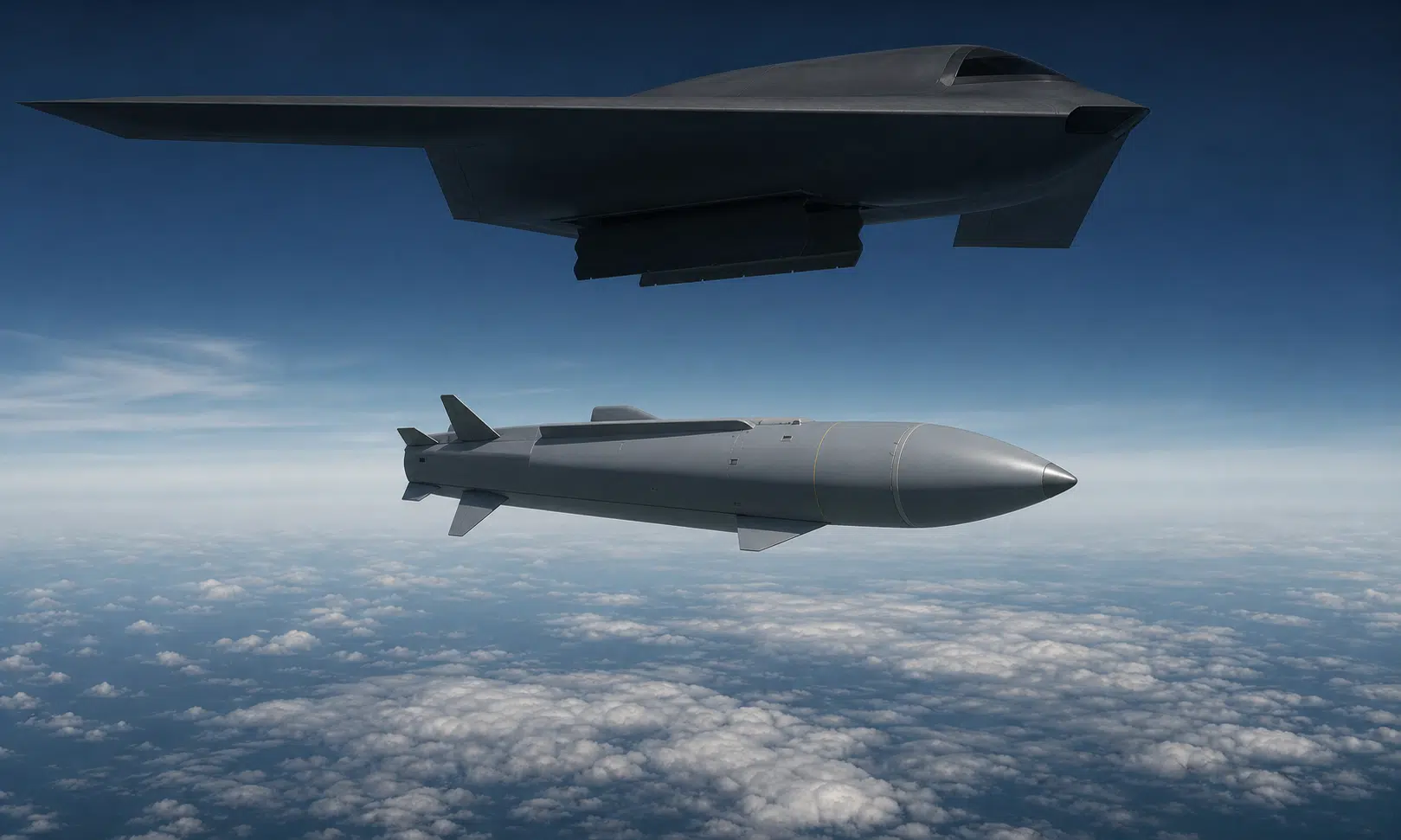

The Air Force appears to be laying the groundwork for a new long-range air-launched missile family, one that would stretch well beyond today’s fighter-carried air-to-air weapons and sit closer to the service’s higher-end standoff ambitions.
The concept is called the Air Force Long Range Weapon, or AFLRW. The available description points to at least two variants: one for air-to-air targets and one for air-to-surface targets. The minimum range attached to the effort is 1,000 nautical miles, or roughly 1,150 statute miles. That range figure is the headline, but the more interesting signal is the mission mix. A weapon family spanning both aerial and surface targets would give the Air Force a flexible standoff option at distances normally associated with bomber-carried strike weapons, not conventional fighter missiles.
The details remain limited, and the program should not be treated as a fielded weapon or even a finalized acquisition plan. The Air Force has not publicly identified a carrying aircraft, disclosed the target set in detail, or laid out a production timeline. What is visible is the shape of the requirement: long reach, modular integration, and enough adaptability to support more than one role.
What the Air Force is asking industry to consider
The Air Force Life Cycle Management Center has described a classified two-day industry event scheduled for August 25-26 at Eglin Air Force Base in Florida, focused on the AFLRW effort. The event is tied to the guided weapons evaluation community at Eglin, a natural venue for a weapon concept that would need to work across sensors, aircraft, mission systems, and munitions architecture.
The service’s preferred contractor role appears to start with a complete round: a fully assembled, tested missile that can be delivered ready for use. That would put responsibility on the vendor not only for the outer weapon body, but also for subsystem design and manufacturing. The requirements also point toward Weapons Open System Architecture and Government Reference Architecture compatibility, meaning the Air Force wants a design that can plug into broader government-defined interfaces rather than becoming a tightly closed, vendor-specific system.
A secondary path would have a vendor act as a master integrator, bringing subsystems together inside the missile body. That distinction matters. A company able to deliver a complete tested round would likely have more control over the full weapon design. A master integrator role could open the door to a more distributed supply chain, where propulsion, guidance, seekers, datalinks, warheads, and other subsystems come from multiple suppliers.
The range puts AFLRW in a different class
A 1,000-nautical-mile minimum range would put AFLRW far outside the envelope of the Air Force’s best-known fighter air-to-air weapons. F-22 and F-35 fighters carry the AIM-120D Advanced Medium-Range Air-to-Air Missile, a weapon generally associated with ranges above 100 miles. Exact effective range depends on launch conditions, target behavior, altitude, speed, and other factors, but the comparison shows the scale of what AFLRW is meant to explore.
On the air-to-surface side, the proposed range is closer to the Air Force’s long-range bomber strike portfolio. The AGM-181A Long Range Standoff weapon is intended for bombers such as the B-52 Stratofortress and B-21 Raider and has been associated with a strike range of up to about 1,500 miles. AFLRW’s stated minimum range would not necessarily make it a direct replacement for that weapon. It does, however, suggest the Air Force is interested in a standoff capability that can reach deep into contested areas while keeping launch platforms farther away from dense air defenses.
| Weapon or effort | Primary role | Range detail available | Likely platform context |
|---|---|---|---|
| AFLRW | Air-to-air and air-to-surface variants | Minimum 1,000 nautical miles described | Carrier aircraft not specified |
| AIM-120D AMRAAM | Air-to-air missile | More than 100 miles commonly associated | F-22 and F-35 among compatible fighters |
| AGM-181A LRSO | Air-to-surface standoff weapon | Up to roughly 1,500 miles expected | B-52 and B-21 bomber context |
The carrier aircraft question is unresolved
The biggest missing piece is the aircraft. A missile with this kind of range could be relevant to bombers, fighters, or other launch platforms, but each option creates different tradeoffs.
A bomber-launched weapon can usually be larger and heavier, with more room for fuel, propulsion, sensors, and payload. A fighter-compatible weapon faces much tighter size, weight, carriage, and integration constraints, especially if internal carriage is required for stealth aircraft. External carriage could simplify size constraints but may affect aircraft signature and performance.
That makes the air-to-air variant particularly intriguing. A very long-range air-to-air missile could be useful for targeting high-value airborne assets from standoff distances, but it would need more than raw range. It would likely require resilient targeting, guidance updates, and endgame performance against moving aerial targets. Those details have not been publicly defined for AFLRW, so the practical role of the air-to-air version remains open.
Why open architecture matters
The mention of open architecture is not procurement boilerplate. For a long-range weapon family, modularity can determine how quickly the Air Force can adapt the missile over time.
A weapon built around government-defined interfaces may allow future upgrades without redesigning the entire round. That could matter for seekers, communications links, mission software, navigation components, and electronic protection. It could also help the Air Force avoid being locked into one supplier for every subsystem.
For industry, the open-architecture language changes the competitive picture. It favors companies that can either deliver a complete weapon while still meeting government interface requirements or coordinate a supplier ecosystem without turning integration into the program’s main risk.
Not obviously part of the low-cost missile push
AFLRW does not appear to be framed primarily as an affordability program. That separates it from the Air Force’s Family of Affordable Mass Missiles effort, which is aimed at lower-cost cruise missile capacity and multiple variants.
Recent defense messaging has put significant emphasis on buying cheaper missiles in larger numbers. Defense officials have discussed low-cost cruise missile deals around the $500,000-per-missile mark, contrasted with higher-end cruise missiles that can cost several times more. Air Force budget testimony has also pointed to a large role for FAMM in planned munitions purchases over the next five years.
AFLRW reads differently. The combination of 1,000-nautical-mile range, dual mission variants, classified industry engagement, and open-system integration suggests a more specialized weapon family. That does not automatically mean it would be unaffordable or produced only in small numbers. It does mean the program’s public framing is not centered on cheap mass production.
What defense contractors should watch
For potential vendors, the practical question is not simply who can build a missile that flies far. The Air Force appears to be looking for a contractor that can handle the full weapon as a system: manufacturing, subsystem integration, architecture compliance, and readiness for operational use.
That creates several decision points for industry teams:
- Whether to compete as a full-round prime contractor or as a subsystem supplier inside another team’s bid.
- How to prove open-architecture compliance without exposing sensitive design details.
- How to balance air-to-air and air-to-surface requirements inside a common weapon family.
- How to manage range, size, propulsion, guidance, and platform-integration tradeoffs before the carrier aircraft is publicly identified.
The classified nature of the industry event also suggests that some of the most important requirements will stay out of public view. That is normal for advanced weapons work, but it limits how much can be concluded from the public description alone.
The bottom line
AFLRW is best understood as an early signal of where the Air Force wants more options: long-range, air-launched weapons that can stay relevant in heavily defended environments and support more than one mission set. The proposed 1,000-nautical-mile minimum range is enough to make the effort stand out, especially with both air-to-air and air-to-surface variants in view.
The open questions are just as important as the stated range. The Air Force has not publicly identified the launch aircraft, the target scenarios, the acquisition timeline, or the expected production scale. It also has not made affordability the visible centerpiece of the effort, which sets AFLRW apart from the service’s lower-cost missile initiatives.
For now, AFLRW looks less like a near-term product and more like a serious probe of what the next generation of standoff weapons should become: longer-legged, more modular, and potentially more flexible across mission types than the missiles the Air Force relies on today.