

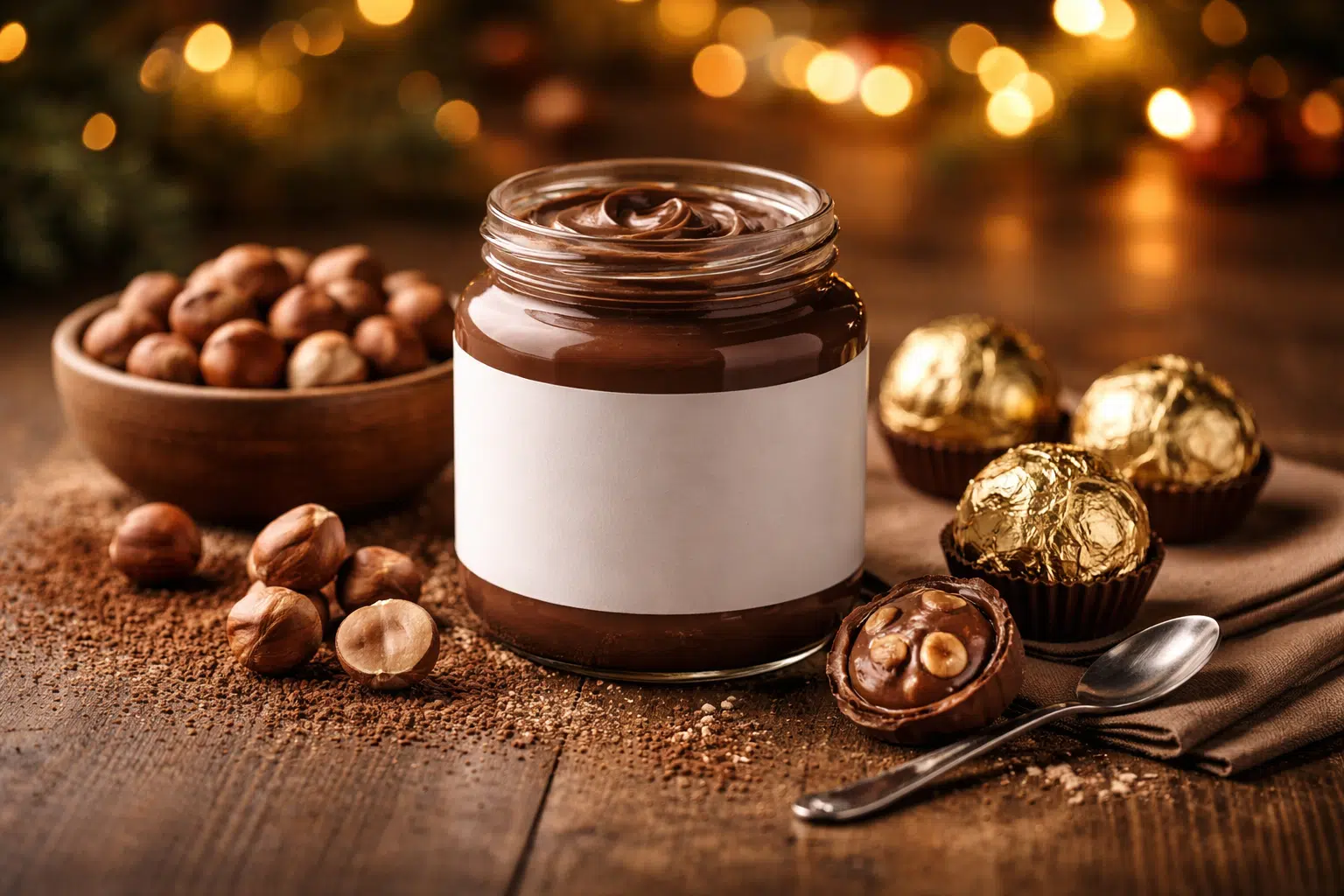

Ferrero isn’t just the company behind Nutella. It’s one of the largest confectionery businesses on Earth—quiet, private, and engineered for obsessive consistency. That’s also why Giovanni Ferrero, the family heir and longtime leader, sits near the very top of Italy’s wealth ladder: his fortune is tied to a privately held machine that prints cash from chocolate, hazelnuts, and holiday-season rituals.
Ferrero’s reach is bigger than many people realize. The group reported €18.4 billion in revenue for its FY 2023/2024 financial year, employs tens of thousands globally, and operates dozens of production sites around the world. Nutella is the headline act, but the catalog is deep: Kinder products, Tic Tac, Ferrero Rocher, and an expanding portfolio of acquired U.S. and U.K. brands.
And while Halloween may move the most candy volume, Ferrero’s sweet spot has always been the premium, giftable side of the business—especially around the winter holidays, when packaging and presentation become part of the product.
But the Ferrero story didn’t begin with a spread in a jar. It began with a workaround.
The origin: hazelnuts as a chocolate substitute
A common myth says Nutella was invented during the Napoleonic wars. The truth is more interesting—and more specific.
During the Napoleonic era, cocoa became scarce in parts of Europe, particularly in and around Piedmont. Local confectioners started stretching chocolate with ground hazelnuts. That tradition produced gianduja/gianduia, the chocolate-hazelnut confection that would eventually become Ferrero’s signature flavor base.
Nutella itself, though, is much more modern: the branded spread launched in 1964, after decades of product iteration inside the Ferrero family business.
Pietro Ferrero’s postwar breakthrough
After World War II, shortages returned. In 1946, Pietro Ferrero—a pastry maker from Alba, in the Piedmont region—created a chocolate-hazelnut product meant for everyday people who needed affordable calories. It initially sold as a solid loaf/block, wrapped in foil and sliced onto bread.
Ferrero refined the idea into a spreadable version, and by 1951, the product was known as Supercrema. The timing was perfect: it was familiar enough to feel “traditional,” but different enough to stand out in a rebuilding Europe.
Michele Ferrero turns a local hit into a global brand
Pietro died young, and the business eventually moved into the hands of his son, Michele Ferrero, who became the company’s defining figure.
In 1964, Supercrema was rebranded as Nutella, and the product was reformulated for wider appeal and broader distribution. The “why” behind the name change is often told as a story about advertising rules and “superlatives,” but accounts vary; what matters is the outcome: Nutella became the portable, scalable version of a regional tradition—and it conquered supermarkets.
Michele wasn’t a one-product entrepreneur, either. Under his leadership, Ferrero built a lineup of hits that turned the company from a Nutella-maker into an innovation factory:
- Mon Chéri (1956): cherry and liqueur wrapped in chocolate
- Tic Tac (1969): compact mints designed for repeat buying and habit
- Kinder Surprise (1974): confectionery plus a toy—an idea that created a massive second business inside the first
- Ferrero Rocher (1982): the product that made Ferrero synonymous with gift chocolate
Ferrero Rocher, in particular, is a masterclass in “theater.” It’s not just candy—it’s candy presented like a present. That matters because Ferrero is built for the calendar. The company is famous for heavy seasonal sales, especially during the final quarter of the year when gifting peaks.
The next generation—and a shock to the system
Michele eventually handed the company to his sons, Pietro Ferrero Jr. and Giovanni Ferrero, who became co-CEOs in 1997. For a time, the succession looked clean.
Then tragedy hit. In 2011, Pietro Jr. died of a heart attack while cycling in South Africa. In 2015, Michele Ferrero died at age 89.
Giovanni took full control—at a moment when many wondered whether Ferrero could remain private and independent in a world that rewards consolidation.
Giovanni Ferrero’s acquisition era
For decades, Ferrero was famously conservative: low debt, minimal M&A, and an almost stubborn preference for internal product creation. After 2015, that changed. Giovanni made it clear Ferrero wasn’t for sale—and then began buying scale.
The goal was simple: expand Ferrero’s footprint, especially in the U.S. and U.K., and build a broader snack platform.
Key moves included:
- Thorntons (2015) for £112 million
- Fannie May (2017) (price widely reported but not always consistently disclosed)
- Ferrara Candy (2017) (terms not consistently disclosed publicly)
- Nestlé’s U.S. confectionery business (2018) for $2.8 billion, bringing brands like Butterfinger, Baby Ruth, and CRUNCH
- Kellogg’s cookies/fruit snacks (2019) for $1.3 billion, adding brands such as Keebler and Famous Amos
- Burton’s Biscuit Company (2021) (price officially undisclosed; widely reported as a ~£300M-level deal)
This acquisition push has been divisive among purists. Some argue U.S. legacy brands sit “below” Ferrero’s premium identity. Others point out that scale in snacks often demands breadth, not purity.
Either way, the strategy is clear: Ferrero wants to be the consolidator, not the target.
The challenges Ferrero can’t wrap in gold foil
Ferrero’s future isn’t just about growth. It’s about inputs, labor, and trust—especially in its most famous ingredient: hazelnuts.
Ferrero is commonly described as the world’s largest hazelnut buyer, using roughly a quarter of global supply in some estimates. Much of that supply comes from Turkey, which produces a large majority of the world’s hazelnuts. The sector has faced repeated scrutiny over labor practices, including child-labor risks. Ferrero says it has strict policies, supplier programs, and traceability goals—but supply chains at this scale are hard to fully control.
Ferrero has also faced criticism over health marketing. Nutella’s positioning as part of a “balanced breakfast” became a legal headache in the U.S.; in 2013, Ferrero agreed to a $3.05 million settlement related to advertising claims and adjusted messaging.
The quiet empire behind the headline products
Ferrero’s story is often told through Nutella because it’s the most recognizable symbol. But the company’s real advantage is structural:
- A signature flavor base (hazelnut + cocoa) that repeats across products
- A calendar-driven business that dominates gifting seasons
- A private-company mindset that lets it play long-term
- And now, a consolidation strategy that aims to grow Ferrero beyond “confectionery” into a broader snack empire
Ferrero started as a workaround for scarcity. It became a global machine built on ritual, branding, and relentless product engineering. And as the company modernizes under Giovanni’s expansion playbook, the biggest question isn’t whether Ferrero can get bigger.
It’s whether it can get bigger without losing the premium magic that made it Ferrero in the first place.