

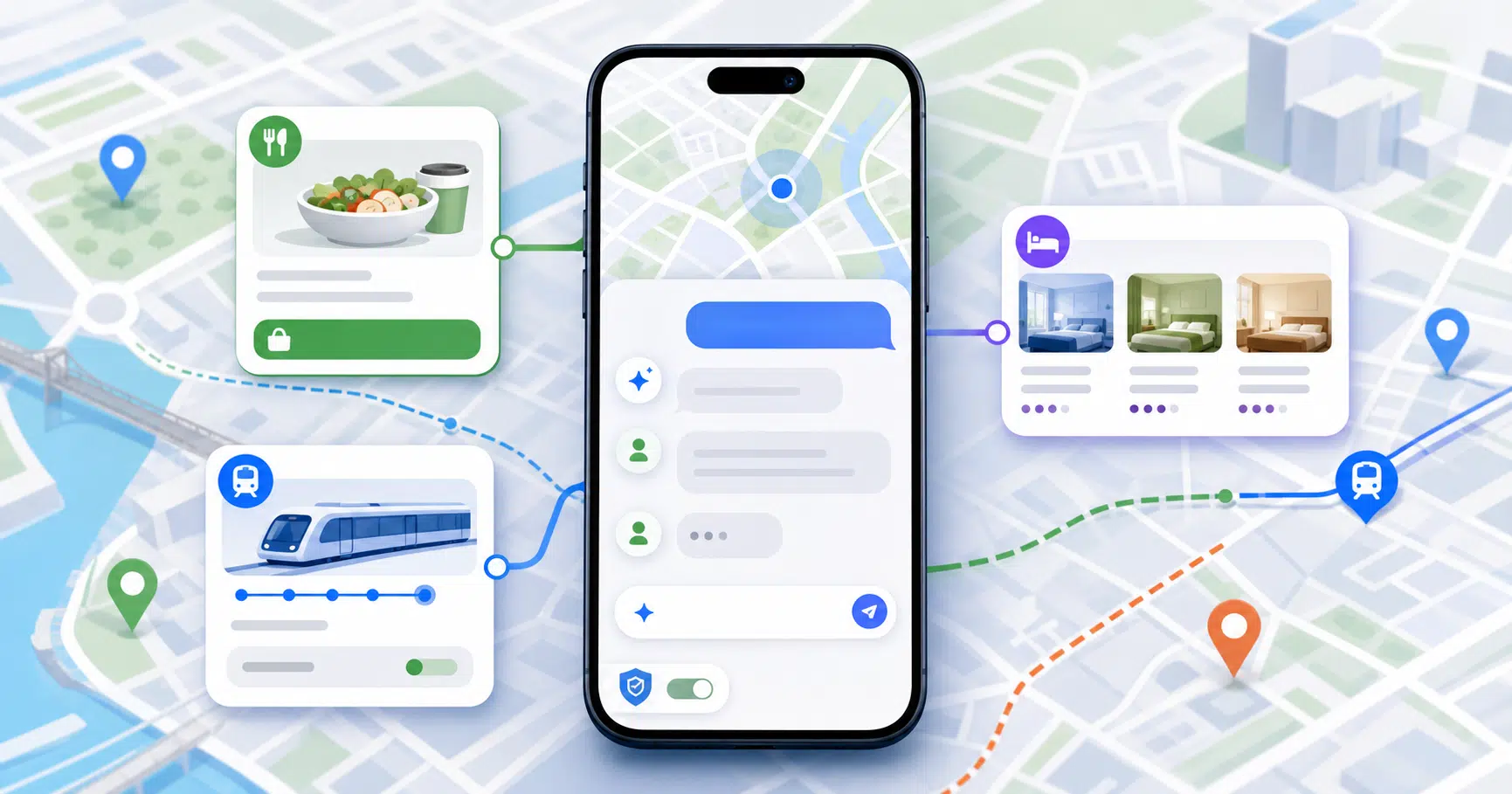

Google is positioning its Google Maps chatbot as more than a tool for finding places. The planned Ask Maps upgrades would let users describe what they need, narrow the options and move toward ordering food or booking a hotel without starting with a conventional search. It is an ambitious expansion, although its practical value will depend on partner coverage, regional availability and how well the assistant handles real-world constraints.
Ordering and booking move into the conversation
Google describes a conversational process in which Ask Maps interprets a request, recommends suitable businesses and helps the user take the next step. Instead of searching separately for a restaurant, delivery service or hotel, the assistant is intended to keep more of that planning inside one exchange.
- Food: Ask Maps is expected to recommend restaurants and initiate an order based on a conversational request. Google has named Toast and Square as initial partners, with Uber Eats intended to follow later.
- Hotels: Travelers could specify a budget, preferred room size and nearby attractions. Google says the assistant is designed to compare prices and availability before sending the user to a partner website to complete the reservation.
- Live events: The same discovery system is intended to surface nearby concerts and comedy shows based on a user’s request.
The hotel handoff is an important limitation. Ask Maps may reduce the work involved in creating a shortlist, but travelers would still need to review the final price, room terms and availability on the booking partner’s website. For food orders, usefulness will similarly depend on whether a preferred restaurant uses one of Google’s supported ordering partners.
Personalization adds convenience and a privacy decision
Google also plans to connect Ask Maps with Personal Intelligence, the personalization system associated with Gemini. With permission, the chatbot could inspect Gmail for useful context, such as the location of a booked hotel, and then recommend restaurants nearby. Gmail is the first planned connection, while support for services including Calendar is expected later.
The integration is described as optional and off by default. Google says users must choose to connect Gmail. Enabling Maps history is also intended to let Ask Maps retain previous conversations so they can be continued later. That may be convenient for multi-stage trip planning, but it gives users another reason to review their Google Maps privacy settings before switching everything on.
Transit updates and map corrections
Ask Maps is also being developed to display live transit widgets inside conversations. A commuter asking about a route involving Vancouver’s SeaBus, for example, could see operational details such as delays and waiting times without leaving the chat. A firm timetable for this experience has not been specified.
Google is planning a conversational contribution tool for Local Guides as well. A user who notices incorrect business hours could upload a photo of the storefront information, review the change proposed by Ask Maps and submit it. Google says these contributions would pass through the same review process used for manually submitted edits.
Availability remains the biggest catch
Google’s rollout plan puts food ordering, hotel and event discovery, and conversational map contributions in the US first. The company also lists Ask Maps conversational access for Australia, Brazil, Canada, Indonesia, Japan and Mexico, alongside roughly 150 other countries and territories where the chatbot can operate in English.
Personal Intelligence and live transit widgets are intended to reach markets where Ask Maps is offered. However, Google has not provided a firm timetable for every feature, partner or country, so the experience may vary substantially by location.
Early verdict: promising, but partner coverage will decide its value
Ask Maps looks most useful for people who already rely on Google Maps to plan meals, trips and daily travel. Combining discovery, comparison and live information could eliminate several repetitive searches, while optional Gmail access may make recommendations more relevant to an existing itinerary.
The bigger test is execution. Hotel comparisons must remain accurate through checkout, food ordering needs broad restaurant support, and transit information has to be timely. Until those pieces are widely available, the transactional features are best viewed as a promising roadmap rather than a replacement for dedicated booking and delivery services.