


Welcome to this week’s Rocket Report, where the near-term story is not only which rocket flies next, but which vehicles are mature enough to shape the next phase of human spaceflight.
NASA hardware for the third Space Launch System vehicle is coming together in Florida, while SpaceX is preparing the first upgraded Starship Version 3 vehicle for flight from South Texas. Blue Origin’s New Glenn rocket and Blue Moon lander are also part of the same strategic picture. A firm timeline for how all of these systems will shape Artemis III has not been publicly confirmed, but their readiness will influence what NASA can realistically attempt in low-Earth orbit before returning astronauts to the Moon.
This edition also tracks India’s private launch sector, Russia’s latest Sarmat missile claim, European interest in air launch and spaceplanes, Chinese commercial rocket progress, and a new Silicon Valley-backed plan to build data centers in orbit.
Small and Medium Launch Updates
Indian startup Skyroot nears its first orbital launch
India’s private launch industry is moving toward a milestone. Skyroot Aerospace, based in Hyderabad, says its Vikram-1 launch vehicle could fly within the next couple of months. The company recently raised $60 million in a round that valued it at $1.1 billion, giving it more room to pursue commercial launch work.
Skyroot was founded in 2018 by Pawan Kumar Chandana, a former engineer at India’s space agency. The company emerged after India began opening a formal path for private firms to build and launch rockets. Chandana has argued that India has several ingredients that can support a launch industry: engineering talent, an existing supplier base, government spaceports, and a geography that can be useful for launches near the equator.
Skyroot named its initial launch vehicles after Vikram Sarabhai, widely regarded as a founding figure of India’s space program. The company’s Vikram-S suborbital vehicle flew in 2022 as a technology testbed. The larger Vikram-1 is described by the company as a three-stage, solid-fueled orbital rocket intended to carry small payloads to low-Earth orbit. Skyroot has said the vehicle is designed for payloads up to roughly half a metric ton to low-Earth orbit, though that performance will need to be demonstrated in flight.
The first Vikram-1 launch will matter beyond a single startup. India has a large national space program, but a purely commercial launch sector is still young. A successful orbital debut would give the country another route into the global market for small satellite launches, where customers often care as much about cadence and schedule certainty as headline payload capacity.
Italy tests an air-launch demonstration
An Italian consortium has completed a suborbital demonstration of an air-launched rocket system. The project used a Dornier Alpha Jet aircraft and a HAX25 sounding rocket developed by T4i, an Italian company. GMV, another contractor, supplied avionics. The Italian-backed program is known as Aviolanco.
A ground-launched sounding rocket completed the program’s first test flight in 2022. The newer demonstration moved to an air-launch profile, using an Alpha Jet over the Gulf of Mexico on April 22. The test targeted an altitude in the 80-to-100-kilometer range, although public statements about the demonstration did not clearly state whether that target was reached.
The appeal of air launch is flexibility. A carrier aircraft can move the launch point, avoid some weather constraints, and potentially support missions that need a faster response than a fixed launch range can provide. Northrop Grumman’s Pegasus and Virgin Orbit’s LauncherOne showed that air-launched orbital rockets can work technically, but the business case has been difficult. Pegasus became expensive and rarely used, while Virgin Orbit collapsed after failing to build a sustainable launch cadence.
That history does not make air launch irrelevant. It does mean the value proposition has to be specific. For countries looking at responsive launch, military flexibility, or national access to space without building multiple full launch pads, air launch may still have strategic appeal even if it is not the cheapest commercial path.
European companies revisit the spaceplane idea
Dassault Aviation and German satellite developer OHB are joining forces around Dassault’s Vortex-S spaceplane concept. The companies want the vehicle to become a European Space Agency program, with Dassault acting as prime architect and integrator and OHB developing a service module.
The proposed vehicle family begins with a subscale suborbital demonstrator, Vortex-D, which Dassault says could fly as soon as 2028. That would be followed by Vortex-S, an orbital free-flyer, and eventually Vortex-C, a cargo transport vehicle with a mass of roughly 8 to 9 metric tons. Dassault has also discussed long-term human-rated ambitions.
Europe has been here before. ESA’s Hermes spaceplane was canceled in 1992. Space Rider, a smaller low-Earth orbit vehicle, has moved slowly. Meanwhile, ESA is already working with The Exploration Company and Thales Alenia Space on capsule-based cargo vehicles for the International Space Station.
The Vortex proposal is technically interesting, but Europe may have too many overlapping low-Earth orbit transport concepts competing for attention. A spaceplane can offer cross-range, runway-style recovery, and reusability options that capsules do not. It also brings complexity. ESA will have to decide whether those benefits justify another major program in a crowded field.
Military and National Security Space
Russia says Sarmat test succeeded, but independent confirmation is limited
Russia says it has completed a successful test of the RS-28 Sarmat intercontinental ballistic missile, a long-delayed system intended to replace the Soviet-era R-36M2. President Vladimir Putin has said the weapon could be operationally deployed later this year.
The Russian government said the launch took place from the Plesetsk Cosmodrome in the Arkhangelsk region and that the missile reached a target at the Kura test range on the Kamchatka Peninsula about half an hour later. That claim has not been independently verified.
The Sarmat, known by NATO as SS-29 Satan II, is a silo-launched, liquid-fueled, nuclear-armed ICBM. Russia has presented it as a heavy missile designed to carry multiple warheads and defeat missile defenses. The program, however, has had a troubled test record.
Russia reported a successful Sarmat test in 2022. That was followed by a failed test in February 2023. Another test in September 2024 also appears to have failed, with damage reported at the Plesetsk test site. Against that background, Moscow’s latest announcement is more significant than a routine missile test would be, but it should still be treated as a Russian claim unless more evidence becomes available.
SpaceX launches another NRO batch for a new sensing role
SpaceX launched another batch of satellites for the National Reconnaissance Office’s proliferated architecture from Vandenberg Space Force Base in California. The satellites are part of a constellation developed through a partnership involving SpaceX and Northrop Grumman.
The NRO says the architecture now includes more than 200 satellites and is supporting the Defense Department’s Ground Moving Target Indication mission. GMTI has traditionally been handled by aircraft, including the E-8C Joint STARS fleet, which retired in 2023. The shift to space-based GMTI reflects a larger move toward distributed satellite networks that can monitor activity from orbit.
The military logic is clear: aircraft can be vulnerable, range-limited, and constrained by access to bases and airspace. Satellites are not a complete replacement for aircraft, but large constellations can provide persistence and coverage that airborne systems struggle to match. The Space Force is also developing a separate constellation for Air Moving Target Indication.
China’s Launch Sector Keeps Moving
Zhuque-2E returns after a failure
LandSpace’s Zhuque-2E rocket returned to flight with a successful orbital mission from a commercial spaceport in the Gobi Desert. The launch carried a mock payload and marked the rocket’s first flight since a second-stage failure last August.
Zhuque-2E is an evolved version of Zhuque-2, the methane-fueled rocket that became the first methane launcher to reach orbit in 2023. The newer version is taller and more powerful, standing about 55.9 meters high and producing roughly 745,000 pounds of thrust at liftoff. LandSpace lists its low-Earth orbit payload capacity at more than 6 metric tons.
LandSpace is also preparing for another flight of Zhuque-3, a larger reusable rocket. Zhuque-3 made its first flight in December and became the first Chinese orbital-class rocket to attempt booster recovery. The launch phase succeeded, but the booster crashed during the downrange landing attempt. The next flight is expected to include another recovery try.
China’s commercial rocket industry is now developing in several directions at once: methane propulsion, reusable boosters, and larger payload classes. Not every test will work, but the pace is meaningful. The return of Zhuque-2E suggests LandSpace is still moving after last year’s failure.
Tianzhou 10 resupplies China’s space station
China also launched Tianzhou 10, a robotic cargo ship carrying supplies to the Tiangong space station. The freighter lifted off on a Long March 7 from the Wenchang Space Launch Site on Hainan Island and docked with Tiangong about five hours later.
Tianzhou 10 carried about 6.3 metric tons of supplies, including scientific experiments, propellant, crew provisions, and a new spacesuit for spacewalks. The current Tiangong crew has been in orbit since October, and a new crew rotation is expected in the coming weeks.
Tiangong is now a mature operating station rather than a construction project. China completed the three-module outpost in low-Earth orbit in late 2022, and the steady rhythm of cargo flights and crew rotations is becoming the main story. That matters for scientific work, astronaut training, and China’s long-term human spaceflight ambitions.
Big Money Chases Orbital Infrastructure
Cowboy Space pitches rockets and data centers in orbit
A startup founded by Baiju Bhatt, the billionaire co-founder of Robinhood Markets, has raised $275 million, changed its name, and outlined an ambitious plan to put data centers in orbit. The company, founded in 2024, is now called Cowboy Space Corp. after previously operating as Aetherflux.
Aetherflux initially focused on satellites that could beam solar energy to Earth. Under the Cowboy Space name, the company says it will develop its own rocket and use that system to place data centers in orbit. Index Ventures led the new funding round, which valued the company at $2 billion.
The core pitch is part launch company, part orbital infrastructure company. Cowboy says its rocket’s upper stage would become the satellite itself, rather than simply deploying a separate spacecraft. The company says it is targeting a rocket debut in 2028.
The idea has company. SpaceX and Blue Origin have both discussed using their own rockets to support orbital data center concepts. The logic is that space offers abundant solar power, a vacuum environment useful for thermal engineering, and proximity to emerging space-based computing or sensing networks.
The obstacles are large. Orbital data centers would need reliable launch access, power systems, thermal control, radiation-hardened hardware, communications links, maintenance strategies, and a business case that beats terrestrial alternatives. Even companies led by Elon Musk and Jeff Bezos are expected to seek outside funding for large orbital infrastructure efforts.
Cowboy’s fundraising makes it worth watching, but the distance between a funded concept and a working orbital data center network is enormous. The company is entering a field where capital helps, but launch execution and system engineering matter more.

Space Mission Engineering: The New SMAD
This engineering reference is useful for readers who want a deeper grounding in spacecraft mission design, architecture trades, and practical space-system planning.
As an Amazon Associate I earn from qualifying purchases.
Heavy-Lift Rockets and Artemis Planning
SpaceX prepares Starship Version 3 for a May 19 test
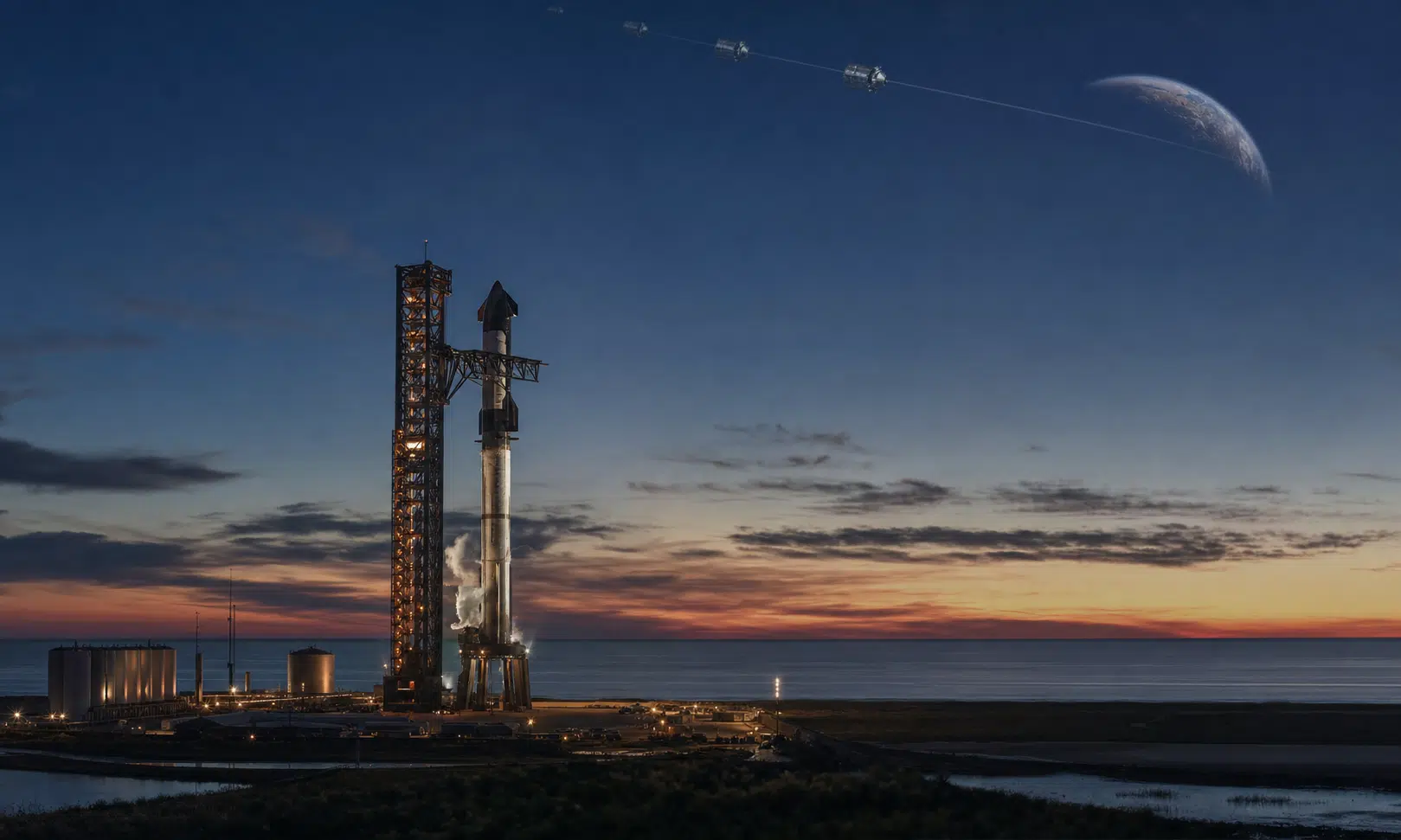
SpaceX has stacked the first Starship Version 3 vehicle on the launch pad at Starbase in South Texas. The new-generation Starship is taller and more powerful than earlier versions and is central to SpaceX’s plan to begin in-orbit refueling demonstrations.
That refueling work is not a side project. It is essential to SpaceX’s role in NASA’s Artemis program. Starship needs orbital propellant transfer before it can serve as a lunar lander for crewed missions. A Starship lunar lander has to launch, receive propellant in Earth orbit, travel to lunar orbit, receive astronauts from Orion, land on the Moon, and return the crew to lunar orbit.
SpaceX conducted a countdown rehearsal Monday, loading the vehicle with more than 11 million pounds of methane and liquid oxygen. After the rehearsal, the rocket was removed from the pad so teams could install flight termination system hardware. The test flight is scheduled for Tuesday, May 19, and would be the 12th launch of a full-scale Starship and Super Heavy booster.
It would also be the first Starship launch since last October. That gap raises the stakes for Version 3. SpaceX does not need every objective to be completed on the first flight of a new vehicle variant, but it does need to demonstrate that the upgraded design is ready for a faster campaign. The Artemis schedule depends on more than launch spectacle. It depends on repeatable flights, reliable staging, controlled reentry behavior, and eventually propellant transfer.
NASA reshapes Artemis III as a low-Earth orbit mission
NASA has now said Artemis III will fly in low-Earth orbit rather than attempt a lunar landing. The agency still targets 2027 for the mission, but the plan is now framed as a stepping-stone flight that can help prepare for a later human landing on the Moon.
The agency chose low-Earth orbit partly to preserve the final remaining Interim Cryogenic Propulsion Stage for Artemis IV, which is now expected to carry the landing mission later in the decade. For Artemis III, NASA plans to use a spacer that simulates the mass and dimensions of an upper stage without providing propulsion.
The revised Artemis III plan calls for four astronauts to launch aboard Orion on the Space Launch System. In Earth orbit, they would rendezvous with one or both of the lunar lander systems under development: SpaceX’s Starship and Blue Origin’s Blue Moon Mark 2.
NASA has not finalized what the astronauts would do after rendezvous. One possibility is that crew members could enter at least one lander test article, depending on the maturity of life support systems and other readiness criteria. NASA is expected to continue assessing Starship and Blue Moon through the rest of 2026 and possibly into early 2027 before settling the final flight plan.
The change reflects a practical constraint. Artemis III was once discussed as the mission that would return astronauts to the lunar surface. The hardware and operations needed for that landing are not yet ready. A low-Earth orbit mission gives NASA a way to keep Orion and SLS flying, exercise rendezvous procedures, and test pieces of the lunar architecture without forcing a landing attempt before the landers are mature.
Launch Calendar
The next few launches on the schedule include a mix of cargo, broadband, and Chinese constellation work. Times and dates can shift quickly in launch operations, but the near-term manifest currently includes:
| Date | Rocket | Mission | Launch site | Target time |
|---|---|---|---|---|
| May 15 | Falcon 9 | CRS-34 | Cape Canaveral Space Force Station, Florida | 22:05 UTC |
| May 16 | Falcon 9 | Starlink 17-37 | Vandenberg Space Force Base, California | 14:00 UTC |
| May 17 | Long March 8 | Qianfan Polar Group | Wenchang Space Launch Site, China | 14:40 UTC |
The Week’s Through Line
The week’s stories point in the same direction: space systems are becoming more distributed, more commercial, and more dependent on launch cadence.
India wants private rockets to complement its national program. Italy is testing whether air launch can support responsive access to space. Europe is weighing another spaceplane concept while also funding capsule alternatives. China is pushing methane rockets, reusable boosters, and steady space station logistics. The NRO is moving sensing missions into large satellite constellations. Cowboy Space is trying to turn orbital infrastructure into a venture-backed business.
Then there is Artemis. NASA’s revised Artemis III plan shows the gap between aspiration and readiness. Starship, Blue Moon, SLS, Orion, New Glenn, and future propellant transfer systems are all part of the same architecture, but they are not moving at the same speed. Low-Earth orbit may become the proving ground where NASA finds out which pieces are ready to become part of the lunar return plan and which ones still need time.

Fundamentals of Astrodynamics and Applications
Vallado’s astrodynamics text is a strong fit for readers interested in the orbital mechanics behind launch windows, rendezvous, station operations, and lunar-transfer planning.
As an Amazon Associate I earn from qualifying purchases.

Designing Data-Intensive Applications
Kleppmann’s book is useful background for the data-center side of the story, especially reliability, distributed storage, replication, and system tradeoffs at scale.
As an Amazon Associate I earn from qualifying purchases.