


NASA’s next Mars helicopters will need to do more than prove flight is possible. Ingenuity already handled that job. The harder question now is whether a small aircraft can become a working field tool on Mars, carrying useful instruments across meaningful distances in an atmosphere that barely gives rotor blades anything to push against.
A recent rotor test at NASA’s Jet Propulsion Laboratory in Southern California moved that idea closer to engineering reality. In a chamber built to simulate Martian conditions, engineers pushed next-generation Mars helicopter rotor tips beyond the speed of sound and did not see the blades come apart. The result matters because Mars aircraft have a narrow performance window: to lift more mass in extremely thin air, they either need bigger rotors, faster rotors, or both.
That is not just a technical curiosity. It affects what future Mars helicopters could carry, how far they might fly, and whether aerial scouting can become a regular part of robotic exploration instead of a one-off demonstration.
Why Supersonic Rotor Testing Matters On Mars
Mars makes flight difficult in a very specific way. Its atmosphere is only a small fraction of Earth’s density, so a rotorcraft cannot rely on the same aerodynamic margin that a helicopter has at sea level. There are fewer air molecules for the blades to accelerate downward, yet the aircraft still has to fight Martian gravity.
Ingenuity solved that problem with an extremely light design and very fast counter-rotating blades. Its mission was deliberately modest at first: prove that powered, controlled flight could happen on another planet. NASA’s original demonstration plan called for a short campaign, and Ingenuity went far beyond that, completing 72 flights before its mission ended in January 2024.
The next step is different. Future Mars aircraft are being designed around payloads that could matter to scientists and mission planners, such as cameras, sensors, and possibly instruments for scouting terrain or looking for subsurface ice. Those payloads add mass. Larger batteries for longer flights add mass too. More mass requires more lift, and on Mars that puts rotor design under pressure.
One way to generate more lift is to spin the blades faster. But faster blade tips approach the sound barrier, and that is where engineers become cautious. Around Mach 1, airflow behavior changes, loads can shift, vibration can increase, and small design weaknesses can become large problems.
For Ingenuity, NASA kept rotor tip speeds comfortably below that threshold. That was a practical decision for a first-of-its-kind aircraft operating far from repair, recovery, or hands-on inspection. With future vehicles, JPL needed better data rather than conservative assumptions.
Inside JPL’s Supersonic Rotor Test
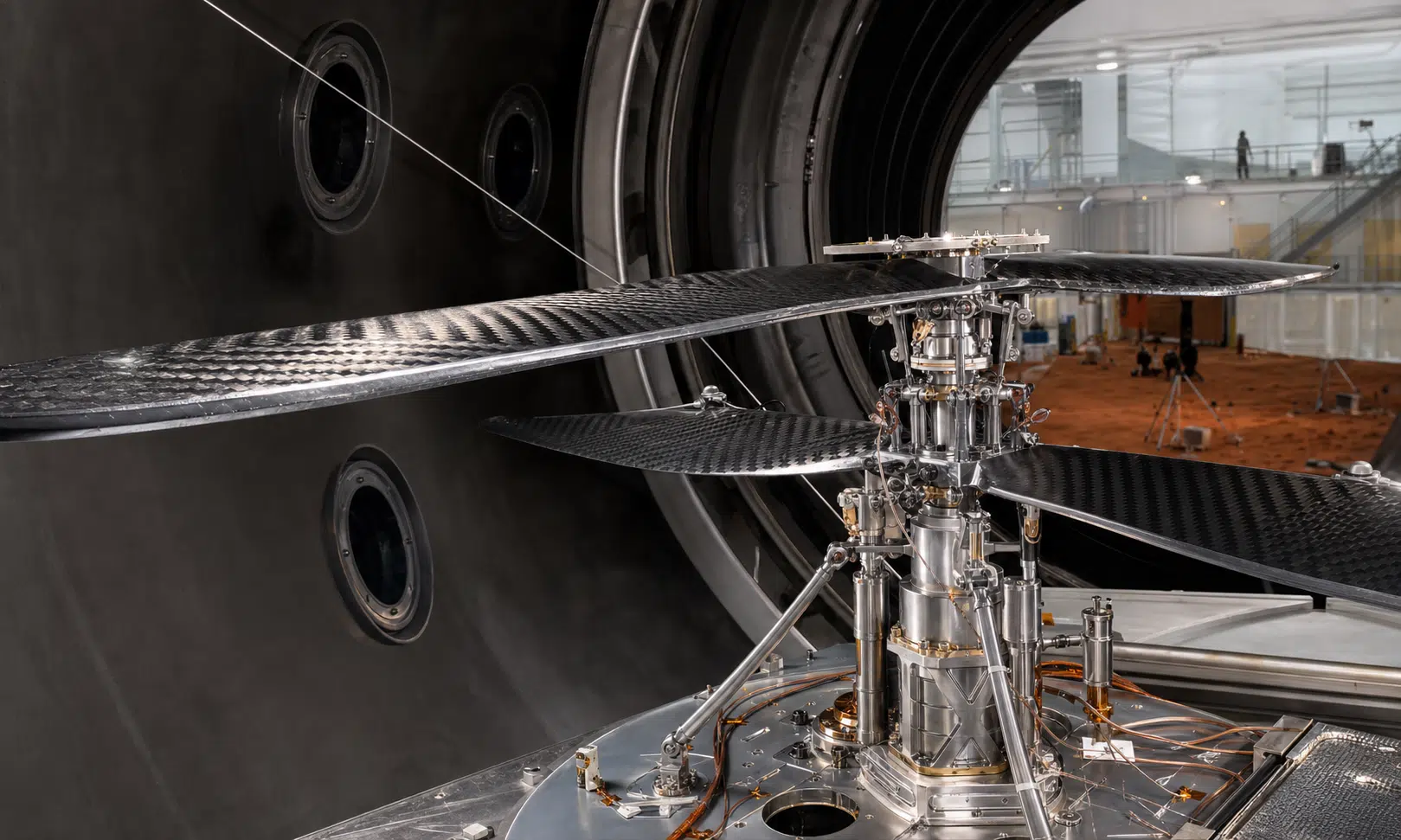
The recent campaign used JPL’s 25-Foot Space Simulator, a large test chamber that can reproduce important parts of the Martian environment. Engineers removed Earth air from the chamber and replaced it with enough carbon dioxide to approximate Mars-like atmospheric conditions. Then they spun rotor hardware at high speed while adding wind across the blades.
The test team started with a three-bladed rotor design that could inform future Mars helicopter concepts. The rotor was developed with AeroVironment, the company that also worked with JPL on Ingenuity. Engineers took the possibility of failure seriously: part of the chamber was lined with sheet metal in case the blades broke apart during high-speed runs.
During the test sequence, the rotor reached 3,750 rpm. At that point, the blade tips were traveling just under Mach 1 before the team added headwind. With the additional airflow, the effective tip speed crossed the sonic threshold. NASA’s test data indicate the tips reached Mach 1.08 without structural failure.
That number is important, but the more useful takeaway is the margin it begins to create. Test data indicate that pushing the blades into that speed range could support a lift improvement of roughly 30 percent for the vehicle design being evaluated. That figure should be read as an engineering result from the test campaign, not as a guarantee that every future Mars helicopter will automatically carry 30 percent more useful payload.
The team also evaluated a two-bladed SkyFall rotor design. Because that rotor is slightly longer than the three-bladed version, it can reach similar tip-speed conditions at a lower rpm. NASA has described SkyFall as a project intended to carry three next-generation Mars helicopters to the Red Planet, with a target design timeline tied to December 2028. As with any space mission in development, schedules and final architecture can change before launch.
From Ingenuity To Working Mars Aircraft
Ingenuity’s importance is hard to overstate, but it was still a technology demonstrator. It carried cameras, not a full science payload. It also operated with help from the Perseverance rover, which acted as a communications relay between the aircraft and mission controllers.
A future helicopter mission would not necessarily have that convenience. If helicopters operate away from a rover, they would need to communicate through orbiters or other mission infrastructure. They would also need enough autonomy to make safe flight decisions in a place where real-time piloting from Earth is impossible.
The engineering demands stack up quickly:
- More useful science instruments increase vehicle mass.
- Longer flights require larger batteries or more efficient power management.
- Independent operations require more capable communications and autonomy.
- Higher lift margins require stronger, faster, and carefully tested rotor systems.
That is why the rotor test is more than a speed record. It addresses one of the practical bottlenecks in turning Mars helicopters from impressive demonstrators into tools that can scout routes, inspect terrain, and reach places a rover may never safely drive.
The business side of space technology also matters here, even if there is no consumer product to buy. For aerospace suppliers, research institutions, and mission planners, this kind of test helps define which hardware paths are becoming credible. Rotor materials, motor control, battery systems, lightweight structures, and autonomous flight software all become more valuable when agencies can show that heavier Mars aircraft are physically plausible.
What Heavier Mars Helicopters Could Actually Do
The most immediate benefit of more lift is payload capacity. Ingenuity’s cameras were enough to support navigation and provide useful scouting imagery, but future aircraft could carry more specialized instruments. Scientists are especially interested in aerial views of areas that are difficult, risky, or too time-consuming for rovers to reach.
A helicopter can cross broken terrain, crater rims, steep slopes, sand traps, and rock fields without dealing with wheel traction or route planning in the same way a rover must. It can also survey a wider area quickly, helping mission teams choose where to send slower ground vehicles.
For human exploration planning, the potential value is even broader. Aerial scouts could help map landing zones, identify hazards, inspect equipment, or search for resources near a planned base area. None of that becomes simple just because a rotor test succeeded, but lift capacity is one of the gates that has to open first.
There is also a power tradeoff. Flying faster or carrying more mass consumes energy. Mars helicopters must manage batteries carefully, and the thin atmosphere gives them little aerodynamic generosity. Larger batteries help, but they add weight, which then requires more lift. That loop is exactly why rotor efficiency and high-speed blade behavior matter.
How This Compares With Dragonfly
NASA is also developing Dragonfly, a much larger rotorcraft mission for Saturn’s moon Titan. On paper, Dragonfly sounds more difficult because it is far larger than Ingenuity or the proposed Mars helicopters. The flight environment, however, is very different.
Titan has a thick atmosphere and low gravity, which makes powered flight more forgiving than flight on Mars in some important respects. Mars has enough gravity to make lift demanding, but not enough atmosphere to make lift easy. That combination is what forces Mars helicopter rotors toward extreme speeds.
The comparison is useful because it shows that “flying on another world” is not one engineering problem. Each destination sets its own rules. A rotorcraft built for Titan is not simply a scaled-up Mars helicopter, and a Mars helicopter cannot borrow Earth helicopter assumptions without major redesign.
The Bottom Line For Future Mars Missions
JPL’s supersonic rotor test does not mean Mars helicopters are suddenly easy to build. It does mean one major concern has been tested under relevant conditions: next-generation blades can cross the sonic threshold in a Mars-like chamber without immediately failing.
That gives engineers more room to design aircraft that are heavier, more capable, and more useful than Ingenuity. The next challenge is turning that test performance into flight hardware that can survive launch, cruise, entry, landing, deployment, cold Martian nights, dust, wind, and repeated autonomous flights.
Ingenuity proved that Mars flight was possible. The new rotor work is aimed at a more practical question: whether Mars flight can become useful enough to carry real mission work. For buyers, suppliers, and research teams watching the planetary exploration market, that is the more important signal. NASA is no longer testing Mars helicopters only as a novelty. It is testing the parts that would make them operational tools.