

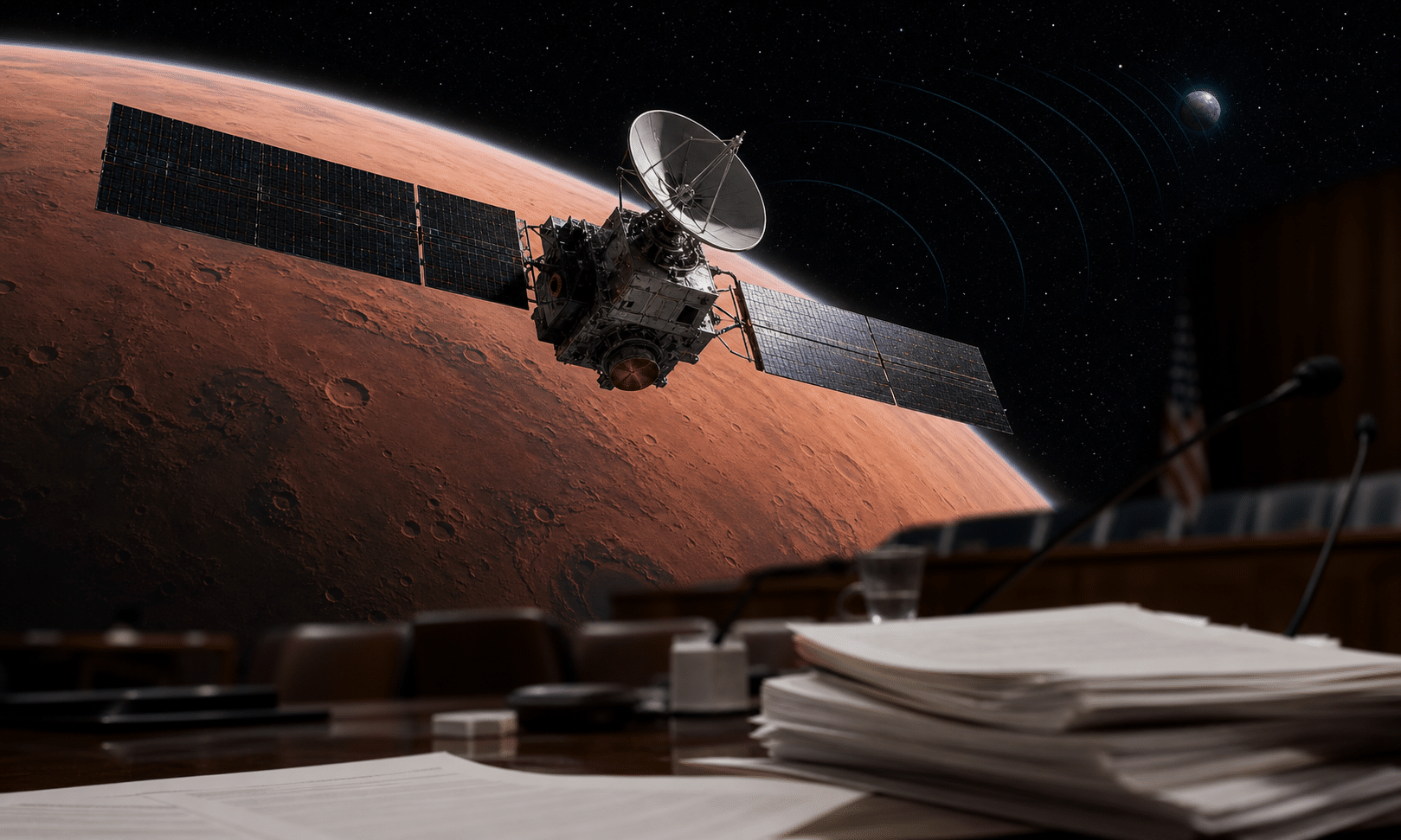

NASA’s next Mars communications spacecraft should be a straightforward purchase by space-agency standards: build a relay orbiter, launch it to Mars, and keep future landers, rovers, orbiters, and possibly sample-return hardware talking to Earth.
Instead, the Mars Telecommunications Network is already becoming a test of procurement design, political influence, and commercial credibility. The project has $700 million behind it, aging infrastructure as its practical justification, and enough carefully written eligibility language to make competitors and observers ask whether the race is as open as NASA says it is.
The buyer question is not whether NASA needs more Mars relay capacity. It does. The harder question is what NASA is really buying with this contract: a communications spacecraft, a path back toward Mars Sample Return, or a strategic advantage for whichever company can say it already designed the right architecture.
The Practical Need: Mars Needs a New Relay
NASA’s best-known Mars communications workhorse is the Mars Reconnaissance Orbiter, which has been operating at Mars for roughly two decades. It remains an important asset, but no long-term Mars strategy can depend indefinitely on legacy spacecraft that were not built to carry every future mission.
A dedicated telecommunications orbiter would reduce that risk. It would provide a modern relay layer for science missions, future robotic landers, and any renewed effort to return Martian samples to Earth. That is the part of the procurement that is not especially controversial.
The Mars Telecommunications Network, or MTN, is the name now attached to the effort. Earlier references described a Mars Telecommunications Orbiter, but the newer program name points to a broader communications service rather than only a single piece of hardware. In practical terms, NASA is seeking an industry-built capability that can support operations around Mars for years.
For mission planners, this is not a nice-to-have upgrade. Mars missions depend on reliable relay passes to send science data home, receive commands, and support surface operations. The more ambitious the mission, the more important the relay architecture becomes.
That is why the MTN contract matters beyond its headline cost. The spacecraft could become one of the enabling pieces for the next decade of Mars exploration.
The Procurement: Fast Timeline, Narrow Gate
The contract is being framed as a competitive procurement, but eligibility appears to be the central issue. NASA’s solicitation language says the acquisition will be conducted as a full and open competition, while also requiring bidders to show that they previously proposed a separately launched Mars telecommunications orbiter in support of an end-to-end Mars Sample Return architecture.
That requirement is the hinge of the story.
A normal Mars relay procurement might ask whether a bidder can build, launch, and operate the spacecraft. This one also looks backward at what companies proposed during earlier commercial Mars Sample Return design work. That does not automatically make the process improper, but it does narrow the field in a very specific way.
Public procurement summaries list a mid-June 2026 proposal deadline and an award target around the start of fiscal year 2027, though the final schedule should be treated as procurement-sensitive until NASA confirms each milestone through formal channels. The broader policy direction is clear: Congress wants the money obligated quickly, and NASA is under pressure to move fast enough for a late-2028 Mars launch opportunity.
A firm operational timeline has not been publicly confirmed in enough detail to treat every date as settled. Still, Mars launch windows are unforgiving. If the spacecraft is meant to launch in the 2028 window, delays measured in weeks can matter because design, integration, launch procurement, testing, and mission assurance all have to compress into a narrow calendar.
Decision Snapshot: What NASA Is Really Weighing
| Decision Factor | Why It Matters | Procurement Risk |
|---|---|---|
| Technical readiness | The spacecraft must relay Mars data reliably for future missions. | A fast award can favor companies with mature designs already in hand. |
| Eligibility language | Bidders must connect their proposal to earlier Mars Sample Return design work. | The competition may be open in form but narrow in practice. |
| Launch-window pressure | Mars opportunities come on a fixed planetary schedule. | Schedule urgency can reduce tolerance for late design changes or protests. |
| MSR compatibility | The relay could support a revived sample-return campaign. | A telecom award may influence future sample-return contracting. |
| Political geography | NASA centers, test facilities, and state interests are tied to the work. | Perceived congressional pressure can invite scrutiny from losing bidders. |
The strongest bid on paper will likely be the one that combines a credible spacecraft design, launch and operations plan, Mars Sample Return compatibility, and a realistic path to meet the 2028 timing pressure. The question is whether all eligible bidders can compete on those terms, or whether the procurement’s prior-study requirement effectively benefits one architecture.
Why Rocket Lab Keeps Coming Up
Rocket Lab is one of the companies viewed as a likely contender because of its earlier Mars Sample Return design work and its public interest in a Mars telecommunications orbiter. The company has positioned itself as capable of delivering a lower-cost commercial Mars architecture, and its leadership has argued that a communications orbiter is a necessary piece of any serious sample-return plan.
Some reports have described Rocket Lab as one of several companies that may meet the eligibility test tied to commercial Mars Sample Return studies in fiscal years 2024 or 2025. That full list has not been independently verified here, so it is safer to treat the eligible field as narrower than the broader aerospace market but not definitively limited to a single company.
Rocket Lab has also publicly discussed Mars-related ambitions in investor materials, including a role for a telecommunications orbiter. The exact implications of those materials for this NASA competition should not be overstated. Investor slides are not procurement documents, and a company’s public positioning does not determine whether NASA can or should award it a contract.
Still, Rocket Lab’s posture is significant. It has already argued that Mars Sample Return can be approached differently from NASA’s earlier, more expensive architecture. If the company were to win the MTN award, it could gain a practical advantage in any future sample-return effort because it would control or operate a key communications layer around Mars.
That is the commercial-investigation angle: this contract may look like a relay purchase, but it could also shape who has the inside track for a much larger Mars campaign.
The Senate Angle: Pressure Without a Public Paper Trail
The political piece is harder to pin down, and it needs careful wording.
One account says a letter from Sen. Roger Wicker of Mississippi to NASA was interpreted by at least one source as favorable to Rocket Lab’s position. The existence and contents of that letter have not been independently verified here, and NASA’s ability to discuss the matter is limited during the active procurement period. That means the allegation should be treated as a procurement concern, not an established fact.
The Mississippi connection is not mysterious, though. Rocket Lab tests its Archimedes engine at NASA’s Stennis Space Center in southern Mississippi, and more Mars-related propulsion or vehicle work could plausibly involve the facility if larger programs move forward. A Mars Sample Return revival would carry obvious economic and institutional value for NASA centers and surrounding states.
Sen. Ted Cruz of Texas enters the story from a different direction. As chair of the Senate Commerce Committee, he has been associated with legislation that would restart Mars Sample Return under a new cost cap. A revived MSR program could benefit Johnson Space Center in Texas through new facilities, mission responsibilities, and prestige.
That does not prove coordination between senators, NASA, and any bidder. It does show why a Mars relay spacecraft is not just a spacecraft. It sits at the intersection of state interests, NASA center politics, commercial space strategy, and congressional budget authority.
Mars Sample Return Is the Bigger Shadow
Mars Sample Return is the reason this procurement feels bigger than its immediate scope.
NASA’s earlier sample-return plan came under severe scrutiny after cost estimates climbed toward levels that made the mission difficult to defend. The agency then explored commercial alternatives, including studies from private companies that claimed they could simplify or reduce the cost of the architecture.
The program was later canceled through the budget process, but congressional interest in reviving it has not disappeared. Senate legislation has called for a new Mars Sample Return program inside NASA’s Science Mission Directorate, with a proposed cost limit of $8 billion. That legislation had not completed the full congressional process at the time described in the source material, so it should be read as a signal of intent rather than a finished mandate.
The MTN procurement therefore acts like a bridge between two policy worlds. In one world, NASA is buying a relay orbiter because its current Mars communications infrastructure is aging. In the other, Congress and NASA are keeping open the possibility of a reworked sample-return campaign, and a modern relay orbiter becomes a foundational piece of that architecture.
If Mars Sample Return comes back, the MTN winner may not automatically win follow-on work. But the winner would likely have valuable mission knowledge, operational infrastructure, and a NASA relationship around a system that a sample-return mission could need.
That is why competitors may watch this award closely. Losing a telecommunications orbiter competition could also mean losing strategic position for the next Mars program.
Verdict: A Necessary Spacecraft With a Procurement Problem
For NASA, the case for a new Mars relay is strong. The agency cannot keep layering future mission demands onto aging orbiters forever, and Mars exploration plans need more communications capacity, not less.
For bidders, the opportunity is unusually attractive. A $700 million award for a Mars telecom system is large enough to matter, technically prestigious, and potentially connected to a revived Mars Sample Return effort. For a commercial space company, it could become a credibility marker: proof that it can deliver deep-space infrastructure, not just Earth-orbit services or launch hardware.
For taxpayers and space-policy watchers, the concern is process. NASA can say the competition is full and open, but the eligibility requirement tied to prior Mars Sample Return telecom concepts makes the contest narrower than a generic open bid. That may be defensible if Congress wanted a company with specific prior design work. It may also create the perception that the procurement was written around a preferred architecture.
The buyer-aware takeaway is simple:
- If the priority is speed, NASA may favor bidders with mature Mars telecom concepts and prior sample-return design work.
- If the priority is broad competition, the eligibility language deserves scrutiny because it limits who can credibly bid.
- If the priority is reviving Mars Sample Return, the MTN award could become an early move in a much larger contracting sequence.
- If the priority is avoiding protests, NASA will need a clean record showing that evaluation criteria were applied fairly.
The strongest outcome would be a relay spacecraft that launches on time, improves Mars communications, and survives procurement scrutiny. The weakest outcome would be a rushed award that becomes tied up in protests or political suspicion, delaying the very capability NASA says it needs.
The Mars Telecommunications Network is not just another orbiter. It is a test of whether NASA can buy commercial deep-space infrastructure quickly while still convincing competitors, Congress, and the public that the competition was real.