
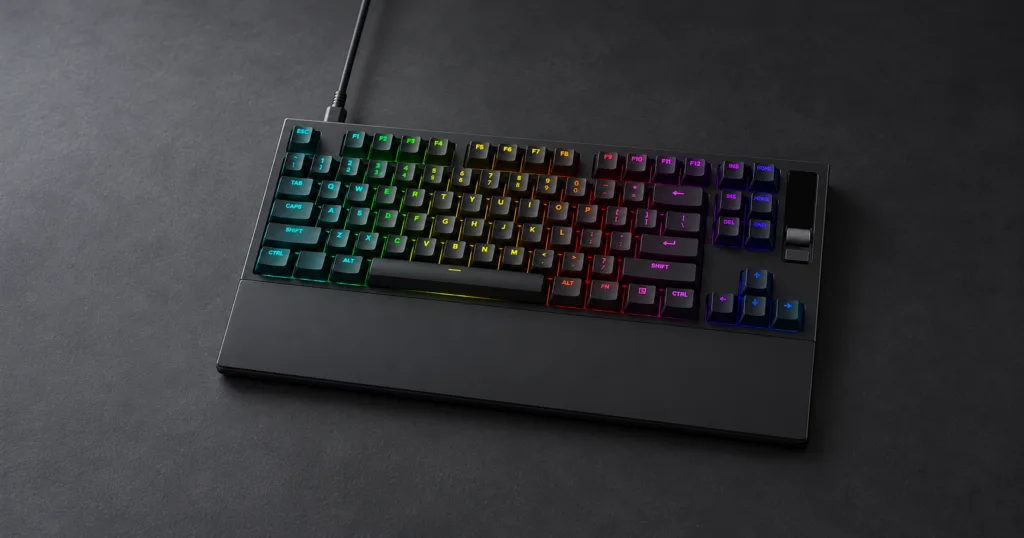
Logitech G introduced the Pro X2 Rapid on September 23, 2026, combining magnetic analog switches, an OLED settings display and support for an 8,000Hz USB report rate in a wired, tenkeyless gaming keyboard. The model brings per-key sensitivity adjustment and onboard configuration to the company’s competitive gaming range.
Logitech lists the keyboard at US$229.99, £209.99 and AU$399.95. Its specifications center on how keystrokes are registered and reset, with adjustable actuation and Rapid Trigger operating alongside a separate Key Priority feature for handling overlapping inputs.
Those functions address different parts of keyboard input. Actuation determines how far a key must move before a press registers, Rapid Trigger controls the return movement needed to reset it, and Key Priority determines which input takes precedence when selected keys overlap. The distinction matters because input-automation rules can restrict features that resolve competing movement commands.
Per-key actuation and Rapid Trigger
Logitech specifies custom, factory-lubricated KS-20 POM magnetic switches, with an actuation range of 0.1mm to 4mm in 0.05mm increments. The company says the actuation point can be adjusted individually for each key.
The Hall effect design detects key movement magnetically. Its adjustable threshold allows a press to register near the beginning of the key’s travel or after a deeper movement, depending on the selected setting. The 0.1mm minimum describes the physical travel threshold at the most sensitive setting.
Per-key configuration allows movement controls and other commands to use different thresholds. For example, movement keys can register with less travel while a weapon-selection key requires a deeper press. The movement and weapon controls can therefore respond at different points in their travel, even within the same configuration.
Rapid Trigger governs another stage of the input cycle. Logitech describes it as an adjustment to the distance a key must return before it resets and can register another press. A shorter reset distance allows repeated inputs with less upward key movement between presses.
The actuation and reset settings control separate events: the initial registration of a press and readiness for the next one. A shallow actuation point does not itself define how far the key must move back up before another press is possible.
Logitech also specifies an 8kHz key-scan rate and USB polling rate. The first concerns checking the keys, while the second concerns reporting input to the connected computer. These operating rates describe parts of the input process; they do not measure complete game response time.
Key Priority and competitive input rules
The Pro X2 Rapid includes Key Priority, which Logitech identifies as an SOCD feature. It determines how overlapping key inputs are resolved, allowing one input to take precedence based on the configured behavior.
With opposing movement commands, priority handling changes which command is passed through when the physical key presses overlap. This operates separately from an individual key’s actuation threshold and Rapid Trigger reset behavior.
Counter-Strike 2 provides an important limit on input automation. In its August 19, 2024 policy announcement, Valve said it would no longer allow scripting or hardware automation that bypassed the game’s core input skills. It said players suspected of automating multiple actions from a single game input could be kicked from a match, initially on Valve official servers.
Valve also instructed players to disable keyboard input-automation functions, citing Snap Tap Mode as an example. Its warning concerned automated input behavior and used conditional wording about enforcement. The announcement predates the Pro X2 Rapid and did not identify this model.
Key Priority is configurable separately from actuation and Rapid Trigger. That separation is relevant to the keyboard’s competitive positioning: its range of hardware settings does not amount to permission to use every setting in a particular game.
OLED controls and stored profiles
The keyboard’s onboard OLED display provides access to configuration without opening Logitech G Hub. Logitech says the interface supports the following adjustments:
- Key actuation points.
- Rapid Trigger settings.
- Key Priority behavior.
- Lightsync lighting settings.
The display sits on the right-hand side of the keyboard, above a button and scroll wheel. The wheel controls system volume by default, while the button opens the settings menu. This combines routine audio adjustment and access to keyboard configuration in the same control area.
G Hub provides another route to customization and profile management. Logitech says settings can be stored in onboard memory, allowing a saved configuration to travel with the keyboard. The display then provides a way to inspect or adjust supported settings directly on the device.
Logitech describes the screen as a response to constraints on competition computers. The company says tournament environments can restrict access to configuration software, leaving players unable to change a stored profile through G Hub at the venue. Its stated purpose for the OLED interface is to make those adjustments possible from the keyboard itself.
Logitech says the display can also switch between profiles and operate without a network connection. Stored profiles and direct controls serve complementary roles: the memory retains a configuration, while the screen provides access to supported adjustments when moving between practice and competition computers.
Compact layout and construction
The Pro X2 Rapid uses a tenkeyless, or TKL, layout, omitting the separate number pad found on a full-size keyboard. It is a wired model, with Black, White and Magenta color options.
Logitech’s construction details include an aluminum key plate and six layers of sound dampening. The company describes the acoustic layers as intended to reduce unwanted resonance and vibration. The aluminum specification concerns the key plate within the keyboard’s construction.
The company also lists replaceable doubleshot PBT keycaps and screw-in stabilizers. The stabilizers are intended to limit wobble in longer keys. These physical design provisions accompany the magnetic sensing and adjustable input thresholds.
An XL silicone palm rest accompanies the keyboard, and Logitech describes two height-adjustment positions. The included support sits alongside the keyboard, while the height settings change its angle on the desk.
Pricing and product positioning
The regional prices listed by Logitech are:
| Market | Listed price |
|---|---|
| United States | US$229.99 |
| United Kingdom | £209.99 |
| Australia | AU$399.95 |
The keyboard was introduced at Logitech G Play 2026 as part of the company’s Pro Series hardware announcement. Logitech positions the range around competitive gaming and says professional players contributed to its development.
For the Pro X2 Rapid, Logitech says design specifications and material choices drew on meetings with almost 100 esports athletes during development from April 2025 to May 2026. The company says that feedback informed both the physical design and the ability to adjust settings directly on the keyboard.
