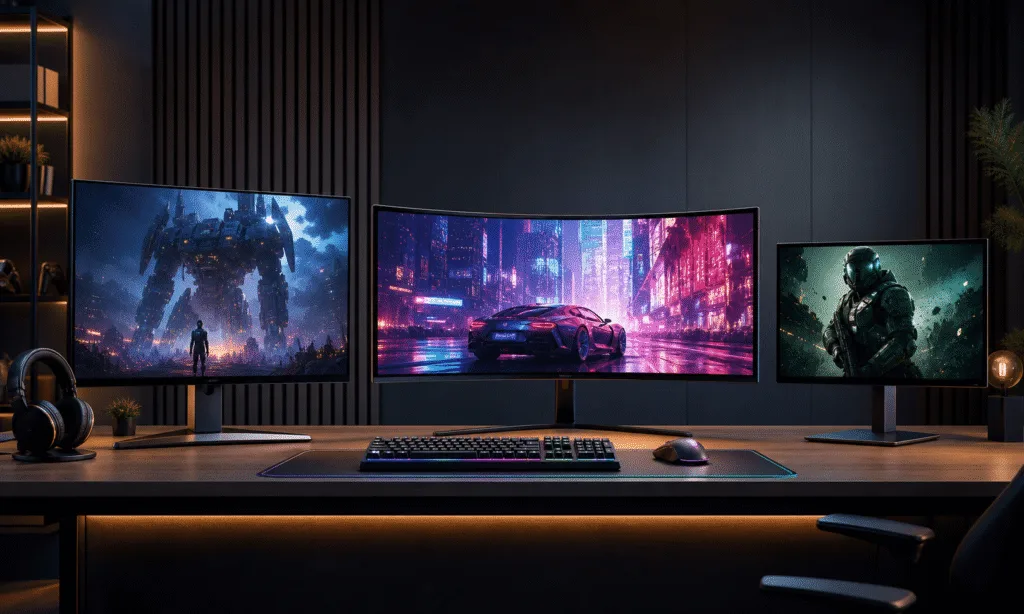
MSI’s QD-OLED gaming monitor range in May 2026 includes a 500Hz model for competitive play, two 4K displays with 240Hz refresh rates, and 34-inch and 49-inch ultrawides. The five models differ in screen format, resolution and refresh rate.
A 500Hz competitive gaming display
The MPG 271QR QD-OLED X50 pairs a 2560×1440 panel with a 500Hz refresh rate, the highest among these five models. MSI specifies a 0.03ms grey-to-grey pixel response time and separately claims input lag of 1.5ms. The frame rate produced by the PC and game determines how fully the display’s refresh rate can be used.
34-inch and 49-inch ultrawides
The MPG 341CQR QD-OLED X36 has a 34-inch, 3440×1440 panel with a 21:9 aspect ratio and a 360Hz refresh rate. It uses a fifth-generation QD-OLED panel with an RGB stripe subpixel layout, which MSI says improves text clarity and reduces color fringing.
MSI lists VESA DisplayHDR True Black 500 certification and claims peak HDR brightness of up to 1,300 nits. The company says its DarkArmor film improves perceived black levels under ambient light.
The MPG 491CQPX QD-OLED is the larger ultrawide, with a 49-inch curved panel, 5120×1440 resolution, a 32:9 aspect ratio and a 240Hz refresh rate. MSI lists VESA DisplayHDR True Black 400 certification and OLED Care 2.0 features.
Game support limits how the screen’s width can be used, including in simulation and cockpit-style titles. Games without native 32:9 support may display black bars or stretch the image.
Two 32-inch-class 4K models
The MPG 322UR QD-OLED X24 combines a 32-inch-class display with 3840×2160 resolution and a 240Hz refresh rate. It uses a fourth-generation QD-OLED panel and DarkArmor film, distinguishing it from the fifth-generation panel in the 34-inch X36.
The separate MPG 322URX QD-OLED also offers 3840×2160 resolution at 240Hz in a 32-inch-class format. Its connections include DisplayPort 2.1a with UHBR20 support and two HDMI 2.1 inputs for PC and console connections. Supported resolutions and refresh rates depend on the connected hardware and output mode.
OLED Care features include pixel shifting and dimming static screen elements. MSI says these tools reduce burn-in risk, but they do not eliminate the possibility of permanent image retention.